Guidelines for Underlining

Back in the 60s I learned how to type on a manual typewriter. Businesses were just beginning the transition to electric typewriters, and of course there weren’t any computers.

Typewriters had limited options for style and emphasis. My typing class learned to center titles by pressing the space bar over and over. Boldface was accomplished through patience and backspacing.

There was an underline key, but it was supposed to be used only to indicate italics (although high-school students like me used it recklessly to add emphasis and variety to whatever we were writing).

Fast-forward to the 21st century. Word-processing programs come with built-in styles that automatically format titles and headings. Our options are dazzling: Color, serif and sans-serif typefaces, and a whole range of font sizes. Boldface and italics are available by pressing a key.

So what do many writers do? They underline. @#$%&!

I’m going to list, calmly and rationally, the guidelines for underlining. Here they are:

  1. Never underline anything.
  2. Pretend there’s no underline key on your keyboard.
  3. Repeat this mantra as often as necessary: “Underlining is ugly, and professionals never use it.”
  4. Make use of the other formatting options in your word-processing program.

So why is the underlining key there if we’re not supposed to use it? That’s a legitimate question, and a few years ago I finally found the answer.

A few years ago a friend and I put together a book for a university press. We had to follow a complex set of formatting guidelines to ensure that our manuscript was compatible with the company’s publishing system. Everything had to be set up in a courier typeface, and we were forbidden to use any special keys except – gasp! – the underline key. No boldface, no italics, no colors. We couldn’t switch typefaces or font sizes. Our instructions were that any time we saw something that needed italics, we should underline it.

We duly followed the directions, and lo and behold: When our book was published, the ugly courier typeface had been magically converted into something snazzy and professional, and all the underlined words were transformed into italics.

And that, my friend, is the only time you’re allowed to use underlining. No, wait: There are two more. You can underline when you’re writing by hand, since you don’t have other formatting options. And if by chance you still own a manual or electric typewriter, you can underline to your heart’s content. Be my guest!

Typewriter Keys

Share

The Vanishing Palm Tree

Friends entering our living room for the first time always ask the same question: “That palm tree – is it real?”

Chamaedorea seifrizii

               Chamaedorea seifrizii

Yes, it’s real. You have to understand that my husband loves palms, so he has to have at least one to call his own – even though we live in a small fourth-floor condo.

Actually there have been two palm trees in that spot. The first – an unusual species called Chamaedorea erumpens – was later replaced by a Chamaedorea seifrizii, a widely available species commonly called a bamboo palm.

It would be logical to assume that the first palm succumbed to a disease, or outgrew the space, or no longer matched our decor. Wrong on all three counts. In fact we don’t know precisely when the switch took place. Call it the vanishing palm tree.

OK, I’ve teased you long enough. Here’s what happened: Palm taxonomists changed the name, deciding that there never was a Chamaedorea erumpens. Palms with that name were reclassified as variations of the familiar Chamaedorea seifrizii.

Does the name of our palm tree matter? Not to Charlie and me. We think it’s beautiful and admire it daily. But if we were collectors, the name might make a huge difference. Someone who’s trying to study as many species as possible wouldn’t want to allocate money and space for a duplicate specimen, even if it’s beautiful and healthy.

Why am I writing about palm trees on a language blog? I want to introduce you to an essential postmodern language concept: Language creates our reality. When we decide that the differences between two items are significant enough to be noticed, we give them different names. Things exist – in a sense – only because we name them.

Here’s what’s even more interesting: Postmodern language theory is simply restating what scientists have known for centuries. Names organize our world for us, via the same thinking tools that taxonomists use: splitting (separating members of a category) and lumping (finding connections between things that seem to be unrelated). In fact I think you could make a case for calling Carl Linnaeus (1707-1778) one of the fathers of postmodernism.

Renaming is often the result of a complex thinking process. I just read a provocative article about ADHD (Attention Deficit Hyperactivity Disorder): “No Diagnosis Left Behind: The Not-So-Hidden Cause Behind the A.D.H.D. Epidemic.”

ADHD is a psychiatric diagnosis for children (and some adults) with persistent behavior problems. Medication can make a huge difference for these patients and the people who live and work with them. But some pediatricians are raising important questions about the way ADHD is diagnosed today: Are medical professionals overdoing it?

Sometimes it comes down to a naming issue: Where do you draw the line between a “behavior problem” and “kids just acting like kids”? Some professionals are worried that an ADHD diagnosis could result in future legal and medical problems for a group of children whose only problem is that they can’t sit still in school. [Please note that no one is denying that ADHD exists and that treatment is valuable.]

To put it differently: When we’re talking about a large number of children, it makes a huge difference whether you lean more towards “splitting” (placing many kinds of behavior in the “psychiatric disorder” category) or towards “lumping” (assigning most childish misbehavior to the “normal” category).

The debate belongs to the professionals, and we’ll leave it to them. My point is that when we view the debate from the vantage point of language, we add another whole layer of meaning to the discussion – and that, in my opinion, is a good thing.

There’s much more to say about classifications, categories, and naming, but I just want to introduce these topics today. Here’s a project for you: Start thinking about naming. Here are two activities to get you started:

  • Criminal Justice – can you think of any behaviors that used to be labeled crimes but are now perfectly legal – and vice versa?
  • Health – can you think of any substances that used to be labeled dangerous that are now considered safe – and vice versa?

If you’re multi-lingual or multi-cultural, you have an exceptional doorway into the ways that language organizes experience. Does your first language make any distinctions that other languages ignore? And were you introduced to any new concepts when you learned a new language? (I’m thinking of the Welsh word hiraeth, the Finnish word sisu,  the Spanish word duende, and the Danish word hyggelig.)

Bottom line: Think about any great writer, and you’ll find that they used words in new ways to expand and explain human experience. Understanding the significance of names is the first step.

Share

A Tale of Two Sentences

Everyone wants to write better sentences! So today we’re going to look at two sentences that contain errors. Of course I’ll explain the mistakes – but my real purpose today is to ask whether the mistakes matter.

The first sentence is from a New York Times article from 2013 by psychologist Maggie Koerth-Baker: “No Diagnosis Left Behind: The Not-So-Hidden Cause Behind the A.D.H.D. Epidemic.” (I should explain that A.D.H.D. is an acronym for Attention Deficit Hyperactivity Disorder.) Here’s the sentence:

Numerous brain-imaging studies have also shown distinct differences between the brains of people given diagnoses of A.D.H.D. and those not — including evidence that some with A.D.H.D. may have fewer receptors in certain regions for the chemical messenger dopamine, which would impair the brain’s ability to function in top form.

Did you notice the indefinite pronoun reference? Here it is: which would impair the brain’s ability to function in top form. The word which should refer to something that’s already been stated. But if you ask what impairs the brain’s ability to function in top form, you come up with this answer: The smaller number of receptors in the brain of someone with A.D.H.D. Since those exact words don’t appear in the sentence, we have an indefinite pronoun reference.

Does the mistake matter? I would argue that it doesn’t in this case: The sentence is perfectly clear. So why would anyone even bother learning how to identify and label a construction called an indefinite pronoun reference? Here’s why: In some situations (a legal case, for example), precision is essential.

Now let’s look at today’s second sentence. My friend Ellen Massey sent me a link to an NPR feature about this problematic sentence from the just-adopted party platform of the Texas Republican Party:

Homosexuality is a chosen behavior that is contrary to the fundamental unchanging truths that has been ordained by God in the Bible, recognized by nations our founders, and shared by the majority of Texans.

Take a look at the second half of the sentence: ...that has been ordained by God in the Bible, recognized by nations our founders, and shared by the majority of Texans. You can’t say that truths “has been ordained.” You need the verb have.

So – according to the sentence – it’s homosexuality that “has been ordained by God in the Bible, recognized by nations our founders, and shared by the majority of Texans” – the opposite of what the Republican Party intended. (Oddly enough, the 2014 version of the platform had the correct verb.)

Now let’s ask the same question: Does the mistake matter? Everyone knows what the Republicans meant. You can make a strong argument (as I did with our first sentence) that a writer’s real goal is to be understood, and one picky mistake doesn’t change anything.

But suppose a sentence like this was the pivotal point in a legal case. Do attorneys ever take sentences apart to determine their meaning – and do judges ever hand down decisions based on a grammatical construction?

You betcha. Arguing that a mistake slipped past you and changed the meaning of a sentence probably won’t hold water in a court of law. (In the workplace, your boss might not have much sympathy either.)

And there’s something else to consider. Articles about the mistake in the homosexuality sentence appeared in the Huffington Post, the Texas Tribune, the Washington Post, and the Guardian. How many of us are willing to risk being embarrassed that way?

A word to the wise: Learn as much as you can about sentence structure – and always double-check your verbs! A mistake you overlook could come back to haunt you.

P.S. Kaylee Ferreira just sent me this link to a website that offers practical tips for LGBTQ safety: https://www.vpnmentor.com/blog/lgbtq-guide-online-safety/. Some of the tips might be useful to anyone who is dealing with cyberbullying.

Confused

Share

The Cat in the Monastery

A monastery was having a problem with the abbot’s pet cat. Felines are nocturnal, and this cat – true to form – became more active at night. When the monks gathered in the chapel to say their evening prayers, the cat distracted them by running, leaping, and meowing.

A monk was appointed to tie up the cat just before evening prayers every night and release it afterward. Problem solved!

Time went by, and the abbot died, and so did the cat. The monks promptly adopted another cat so that they could tie it up before evening prayers.

Question: How often do we forget the original reason for doing something – and keep up the practice even though conditions have changed?

When I conduct writing workshops, I’m often asked whether it’s one or two spaces after a period. I know right away that my answer – only one space, please! – is going to be met with howls of dismay: “But my typing teacher told me TWO spaces!”

Here’s a question I use to shake up those people: How is your typing teacher doing it now – one space or two?

Gulp.

My bet is that most of those teachers have switched to using only one space. Professionals know that computers are sophisticated typography machines with capabilities that the typewriters of old didn’t have.

Look at a capital I and a capital W: Their widths are very different. Typists used to be taught to insert an extra space after a period so that the differences in capital letters wouldn’t be so noticeable. But computers automatically adjust that space themselves. If you insert a second space, you’re announcing that you’re stuck in the past. (I also ask those skeptics if they still use a carriage return at the end of a line. Of course they don’t!)

I often encounter writers who are trapped in something a long-ago teacher (who wasn’t a professional writer) told them. The superstition (that’s all it is) about not starting a sentence with but, or and, or because is one of them, but there are others. For example, English teachers want sophisticated sentence patterns and vocabulary choices, but criminal justice reports require short, objective sentences and everyday language. I’ve seen many cops try to make a report about a stolen bicycle sound like critical treatise on Hamlet. It doesn’t work!

And then there are writers who studied journalism and think that the Associated Press Stylebook is an infallible guide to writing practices. It’s not. The AP is much more concerned with saving space and ink than other forms of publishing – hence the requirement to delete the last serial comma in a series and to lower-case words like president and pope. Other forms of publishing want greater length. Books, for example, need to be long enough to justify the selling price, so punctuation and capitalization practices are different.

Writers are (or should be) lifelong learners. Every writing situation is different. Start thinking about strategies for adjusting your habits as situations change. It’s a great way to grow as a writer, and it’s a requirement if you aim to be taken seriously in the professional world.

finger-pressing-computer-keyboard


Share

Thinking about Thinking and Thinkers

I’ve long been curious about the thinking habits of other people. What does a psychologist think about when she’s socializing with friends? Does she pick up little clues about their psyches that the rest of us miss? What does a professional dancer think about when he’s watching Swan Lake – or Dancing with the Stars? Does he notice technical and artistic points that I don’t understand?

Today I have a story about a person who was thinking about another person who was thinking – both in unusual ways.

The college where I was teaching invited noted educator Vincent Tinto to spend a day talking to faculty and staff about student retention. During the break, a librarian friend and I compared notes. She was as impressed with Tinto as I was, and she added something: “I’m wondering if he studied to be a Jesuit.”

Huh?

Jesuits are members of the Society of Jesus, a prestigious Roman Catholic religious order for men that emphasizes education. Tinto hadn’t mentioned religion.

“It’s the way he thinks,” she said. (Although she wasn’t Roman Catholic, she’d been a librarian at a Jesuit high school.) “Before he answers a question, he puts it into a larger context.”

We went back into the meeting room, and she was right – Tinto reframed every question before he answered it. Later that day I Googled him and found that my friend was also right about the Jesuit connection: Tinto had a degree in physics from Fordham University, a Jesuit institution in New York. (I once took a course at Fordham myself, but – alas – I don’t think it had any permanent effect on my brain.)

I have another story about thinking-about-a-thinker, and then I want to apply this idea to writing. A few years ago, when I was helping a friend edit a book about Bernard Shaw’s ideas about women, I started thinking about my own encounters with feminism.

My starting point had been Betty Friedan’s The Feminine Mystique, which I read in high school shortly after it was published. (It’s still one of my favorite books, and later I was thrilled to learn that Friedan did a lot of her writing at that most sacred of places, the New York Public Library.)

Odd, I thought – Friedan’s thinking was much like Shaw’s: She was interested in the ways that society manipulates women’s thinking to further its own ends. And suddenly I realized she must have been exposed to Marx in her youth. (Shaw’s penchant for critiquing ideologies was a direct result of his Marxism.) Perhaps, I mused, she’d had a boyfriend who was heavily into Marx.

I headed for the library and started searching through the early chapters of Friedan’s autobiography, Life So Far. And there it was: She’d been a fervent Marxist during her college years. (Incidentally, the early years in a famous person’s life are almost always the most interesting part of any biography. Maybe that’s another reason I keep reading The Little Princesses.)

Those of us who write, edit, and teach so often get sidetracked from what really matters: thinking. A teaching colleague – Ellen Massey – once remarked that our developmental writing courses were really courses in thinking. She was right, and it was an insight that had a powerful effect on what I was trying to accomplish with my students.

What about you, reading this? Who influenced your thinking? What thinking habits are unique to you?

There’s nothing – I repeat, nothing – like a powerful idea to energize and empower your writing. (Those of us who teach writing know that we get much better papers from our students when we give them something stimulating to think about.)

If you want to get to know yourself better (and perhaps find some unexpected springboards for writing), start journaling about thinking. I know that’s not very specific advice. That’s because you need to start from your unique perspective, not mine. If you’re not sure where to start, think about your role models – people you’ve admired not for what they know, but how they think. (Some of you already know how impressed I am by Carolyn Hax’s unusual take on everyday problems in her Washington Post advice column.)

You have an exciting journey ahead of you!

Neurons Kindle ok

Share

What’s the Correct Use of “Only”?

Village Wooing is one of Bernard Shaw’s lesser-known comedies. Only three scholars have had anything to say about it, and I’ve seen the play performed only once. Last year I spent a great deal of time thinking about Village Wooing because a friend asked me to write an article about it for a book that he was putting together.

While I was studying the play, I noticed a snippet of dialogue about a usage issue – the placement of only in a sentence – that I’m going to talk about today. A village shopkeeper – a single woman identified only as Z. – is pursuing a travel writer, a widower identified only as A. Here’s the exchange:

Z. Well, your second marriage may be an agreeable surprise, maynt it?
A. What, exactly, do you mean by my second marriage? I have only been married once. I mean I have been married only once.

How like Shaw: His central character is a stickler for grammar! (I’ll explain the rule about only in must a moment. I should add that Shaw considered apostrophes ugly and omitted them whenever he could – so he used maynt instead of the more correct mayn’t in Z’s question.)

In a short play like this Village Wooing, everything counts. When A. catches himself making a usage mistake, he establishes himself as an educated person and – despite the romantic promise of the play’s title – a stuffy person who might not seem attractive to the gregarious Z. This exchange is a good example of Shaw’s skill at exposition – helping audiences get to know the characters without slowing down the movement of the play. (I guess I should relieve your curiosity by explaining that A. and Z. do decide to marry before the final curtain.)

Today I want to focus on the misplaced only that A. stumbled over. I’m going to begin by explaining his mistake, and then I want to go on to ask whether it really was a mistake.

Expert writers are careful to place only right next to the word it modifies. Here’s a mini-lesson I’ve often used with my students. Notice how the meaning changes every time only is moved to a different position in the sentence:

Only I kissed her.

I only kissed her.

I kissed only her.

All three sentences are correct, and they all mean something different.

Although Shaw had little formal education (he attended school for only a year), he had a thorough knowledge of English usage and a reputation as a curmudgeon. But this is where it gets interesting. I’ve been reading Shaw for lo-these-many-years, and I can testify that he wasn’t always fussy about where he positioned only in a sentence – and I’m not just talking about his informal pieces. Take a look at this example from The Epistle Dedicatory to Man and Superman (the play that won Shaw a Nobel Prize):

I have only made my Don Juan a political pamphleteer, and given you his pamphlet in full by way of appendix.

Mind you, this is from a writer who scrupulously oversaw every detail of publication. So we can’t say that Shaw was just being careless, especially since there are many other examples of a misplaced only in his prodigious output.

Here’s what I think: Although Shaw knew the rule, sometimes he didn’t give a damn about it.

Can you do the same – ignore a rule because you don’t feel like obeying it? Or because it makes a sentence awkward – or you think it’s a stupid rule?

In a word: yes.

I’m thinking about the lovely song “I Only Have Eyes for You” (you can listen to it here). Would the song be as wonderful if the title were changed to “I Have Eyes Only for You?” I don’t think so. 

I’m wondering if our fetish about correct placement of only can be traced back to the well-meaning but misinformed grammarians who thought language had to be logical. That’s not true. Language is a multi-dimensional invention that can’t be squeezed into a logical system. “Misplaced” – like beauty – may be only in the eye of the beholder. (Or may only be in the eye of the beholder. Take your pick.)

Can you follow Shaw’s lead and place only wherever you think it works best? Of course – but remember that you may raise some eyebrows if you’re writing for a sophisticated readership.

My own practice is to be casual with only in everyday conversation. But when I’m writing professionally, I’m careful and precise. What are your thoughts?

320px-General_store_items_at_Window_on_the_Plains_Museum_IMG_0586

Share

Semicolons in a List

I used to teach a remedial English course that ended with a pass-fail final exam: Students submitted an essay to a committee, which decided which students could proceed to Composition I.

I was present at one of those grading sessions when a carelessly written essay (from one of my students – sigh) caused some controversy. Two committee members gave it a thumbs-down, but a third member asked them to reconsider. “This student used a semicolon correctly,” he said. “Doesn’t that indicate real writing skill?”

I held my breath as the paper was reread. (Instructors weren’t supposed to comment about their own students.) There was a whispered conference – and then the committee chair said “Pass!” and put a blue checkmark on the paper.

How did a remedial English student manage to use a semicolon correctly? The answer is that all my students learned how to use semicolons the first day of class – and they were required to use one on every assignment. It was a good motivational tool for students who thought English usage was a mystery they’d never crack…and good insurance for that scary final exam.

Here’s what I told students to do: Write two sentences. Change the first period to a semicolon, and lower-case the next letter. And I would add: “You now have a master’s degree in semicolons.” (If you, reading this, want a Ph.D. in semicolons, we’ll get there in a moment.)

So you could insert a semicolon after one of the sentences in the paragraph above:

Write two sentences; change the first period to a semicolon, and lower-case the next letter. CORRECT

But don’t the two sentences need a connection? Yes, they do – but it doesn’t have to be something mystical or complicated. Almost everything we write – even a jokey email – has a string of connected sentences.

Compare my common-sense approach to semicolons with this explanation that I just found on a university website:

Semicolons help you connect closely related ideas when a style mark stronger than a comma is needed.

“A style mark stronger than a comma” – does anyone (besides the person who wrote that) know what it means? How on earth could you apply such a vague explanation?

Here’s another favorite:

Link two independent clauses to connect closely related ideas.

If you, reading this, are an English teacher, I submit this challenge to you: Hand out strips of paper and ask your students to write an independent clause. I guarantee that most students will just stare at you blankly. Yes, they always listen politely when we ramble on about independent clauses. But many of them don’t understand what that we’re talking about.

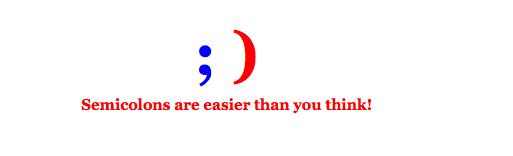
OK. End of rant. Let me help you get that Ph.D. in semicolons. Here’s what you need to know: Semicolons are required with a special kind of list – one with at least one item containing a comma.

Invited speakers include Jimmy Thompson, a Little League coach; Dr. Winnie Goldblatt, a pediatrician; The Reverend Susan Sanchez, a youth minister; and Lionel Fordham, an elementary school principal.  CORRECT

I wish I could reach out across the miles, hand you your sheepskin, and shake your hand. Congratulations!

semicolons

Share

React!

I just finished reading The Ear of the Heart, a fascinating biography of former Hollywood and Broadway actress Dolores Hart. In 1963, at the height of her career, she stunned the entertainment world by entering Regina Laudis, a contemplative Benedictine monastery in Connecticut. A college friend of mine who joined an active religious order in Connecticut once saw Hart working in an apple orchard with a group of other novice nuns.

Because much of the book is written in Hart’s own words, you can watch the seeds of her religious vocation grow. One comment about her acting career is particularly telling. Hart says that she made marvelous friends during the long days and weeks of filming, so that the cast and crew became a family – but the family always fell apart when the filming ended and everyone returned home.

So it was not surprising that she longed for a stable and permanent family (her parents’ relationship was full of turmoil). She began making retreats at Regina Laudis, made friends with some of the nuns, and fell in love with the monastery.

But she soon discovered that that monastic life was very different from those mystical retreats. Her superiors – wary of a Hollywood star accustomed to luxury and fame – were harsh. Living conditions were arduous. She remembers that she was so cold after evening prayers on winter nights that she used to sit on the hallway radiator before going to bed in her unheated cell.

Most seriously, friendships between the nuns were prohibited. Although there was an hour of recreation every day, nuns were permitted only one topic of conversation: their daily work on the monastery farm and buildings.

Hart’s voice is honest and real, but I often felt that something was missing in her book: Her reactions. Did she think about leaving? And what forces drove her to stay?

She makes only one statement about that long and difficult transition: For the first three years she cried herself to sleep every night. (Later on, changes prompted by Vatican II brought a vast improvement in monastic life, and Dolores – “Mother Dolores” by then – became a leader in her community.)

If I’d had a chance to edit Hart’s book, I would have asked her to describe her reactions to those experiences. What was she thinking and feeling when she shivered after evening prayers – listened to unending conversations about weeding, mopping, and hoeing – endured yet another rebuke from a superior?

But wait a minute. A writing rule (one of my favorites) states that you shouldn’t do your readers’ thinking for them. Couldn’t readers figure out for themselves that Hart was upset by those experiences?

The answer is no.

“Upset” is a catch-all word that says very little. When you start digging into what “upset” means, you come up with a long list of reactions Hart could have had: anger (at herself or the monastery), betrayal (because no one warned her what it was going to be like), stubbornness, guilt (because she was having so many unspiritual feelings), regret, sadness, disappointment, loneliness…and probably some I haven’t thought about.

And when you start thinking about the forces that compelled her to stay…well, there’s probably another whole book to be written.

What ultimately makes writing worth reading is the inner life of the writer. That’s true whether you’re writing fiction, nonfiction, or poetry. Every word you write is shaped by your personality and experience…even if you’re trying to write impersonally.

After a close friend read my book Pygmalion’s Wordplay (a scholarly treatment of the writings of Bernard Shaw that rarely includes the words I and me), she told me that she understood me for the first time. Egad.

Whenever you sit down to write, no matter what the task is – please, please react. We’re interested in you, your thoughts and feelings, and the connections you draw to other experiences, ideas, and memories. Don’t hold back!

Share

Am I a Grammar Snob?

During my first year as an English instructor, I went to a beautiful New York restaurant for dinner with the rest of the staff. Shortly after we sat down, the server brought us a basket of warm, fragrant bread. I took a slice, buttered it, and happily started eating – and horrified my boss, who explained that you’re supposed to tear off small pieces and eat them one at a time.

Good grief. No one ever told me there were rules about eating bread and butter.

I’ve told that story to countless English classes over the years. Students who had worked as restaurant servers had stories of their own to share about silverware, napkins, and other issues connecting with fine dining. One favorite topic was the procedure for ordering wine (just look at the cork – don’t sniff it). 

Those discussions were always lively and fun, and they were an effective lead-in to my main topic: The question of snobbishness. Students readily agreed that table manners aren’t snobbery: They’re common sense. Most of us adapt our eating habits according to the situation, and we do same with English usage. I don’t tear bread into small pieces when I eat at home, and I don’t always use Standard English either. But both sets of skills are highly useful when I attend a conference or meet with an editor.

The question of snobbishness has been on my mind lately in connection with a provocative video denouncing grammar snobbery made by Mona Chalabi for The Guardian (a British newspaper company) last month.

Chalabi quickly destroys the most common argument for good usage – that it helps us understand one another. Nobody, she says, is confused if you say less items instead of the more correct fewer items.

More serious, according to Chalabi, is the damage wrought by grammar snobbery, which she says “is often used to silence those who have less of a voice in society….We should spend more time listening to what others have to say and less time focusing on the grammar that they say it with.”

Hear, hear! Too often English usage is taught as if Moses was carrying a copy of Fowler’s English Usage when he came down from Mount Sinai. We should always respond to – and respect – a writer’s ideas before we start correcting punctuation and sentence structure. Often there’s no need to butt in with corrections at all.

But I would argue that there are some points that Chalabi overlooked. In Derridean fashion, her own impeccable English undermines her point. The video’s title, for example, is a perfect example of parallel construction (a rhetorical principle that confuses many professional writers): “Patronizing, Pretentious, and Just Plain Wrong.” Would we be listening with the same respect if she used slang to make her argument?

She’s mistaken about one of her supporting points – that there used to be a rule against starting sentences with and and but. There’s no such rule and never has been. (I used to make bets with my students about this. Nobody ever claimed the $100 I offered to a student who could prove me wrong.)

I have another reason for arguing that English usage is relevant. Nonstandard usage conveys the message that you’ve never acquired the habits of looking and listening. I once knew an English professor who always substituted “antidote” for “anecdote.” And I just read a wonderful biography of Dolores Hart (the Hollywood star who became a nun) that distracted me on every page because all the periods and commas were positioned outside the quotation marks.

Somehow these two people (and I’ve known many others like them) have never noticed that they’re out of step with everyone else. (I can’t help wondering if they ever acquired table manners!)

There’s also the issue of pride. Professional people care about quality. My husband has been a garden writer for more than 20 years. He goes over his columns carefully before he submits them to the newspaper – and he always takes one additional step: Asking me to proofread them.

I don’t think he’s ever cracked a copy of Fowler’s English Usage, and he’s not much interested in abstruse topics like indefinite pronoun reference and gerundives. But he takes pride in his writing, and I respect him for that.

And there’s one more thing. Standard English sometimes serves as a kind of bonding tool. Educated people can instantly recognize one another, and that’s not always a bad thing. Let me give you a non-academic example.

Years ago a TV magazine ran an article about the Honeymooners TV show – long a favorite in my family. (My husband still carries in his wallet his membership card in a long-ago Honeymooners fan club.)

About halfway through the article, I started screaming – with joy, I should add – because the writer referred to Ralph Kramden and Ed Norton (central characters in the show) as Racoons.

Wow.

Ralph and Ed were members of the Royal Order of the Racoons – always misspelled (whether deliberately or not) on the show.

Very likely the editor of the magazine wanted to fix the spelling, and the writer held firm. I can picture him arguing that real fans of the show (like me) would instantly recognize him as a brother.

And now I will raise the tail of my imaginary racoon hat (a Racoon lodge ritual) to salute all the other Honeymooners fans who are reading this. And then it will be time for some proofreading of my own – undoing all the automatic corrections of Racoon in today’s post. Ain’t language fun?

Two members of the Royal Order of the Racoons

     Two members of the Royal Order of the Racoons

Share

Who or Whom?

Few writers feel confident using whom. As a result, some writers have dropped whom and use who exclusively. Other writers overuse whom, figuring they’ll be right at least part of the time.

If you’re not sure, the first mistake is the way you want to go. Whom is rapidly disappearing, so it isn’t required for conversation and most writing tasks. I reserve whom for two situations: writing for publication and teaching a class.

English teachers (remember, I’m one of them) have to bear a lot of the blame for the gradual disappearance of whom. Ask an English teacher for an explanation of who and whom, and you’ll hear a lot of jargon about transitive verbs and objects of prepositions. Not surprisingly, many people simply give up.

Since you’re reading this post, you’re a special person who would like to crack the mystery of who and whom. Let me show you a trick.

Memorize this phrase: He for who and him for whom. (You can sing it if you know the song “Tea for Two”!)

Any time you’re wondering whether whom is correct, plug in the word him and see if it works. (Both words end in the mmm sound – another aid.)

Give the package to anyone who/whom answers the door.

Would you say him answers the door or he answers the door? He answers it! Use who. (You’re singing, right? He for who and him for whom.)

Give the package to anyone who answers the door.

The same trick works for whoever (use he) and whomever (use him). (That mmm sound is still there in whomever and him to help you.) Incidentally, mistakes with whomever are common even with highly educated people.

Let’s try one:

The invitation is good for whoever/whomever wants to attend.

Which works better: him wants to attend or he wants to attend? He wants to attend! Use whoever:

The invitation is good for whoever wants to attend.

Let’s do one more, ok?

This shirt will look good on whoever/whomever it fits.

It fits him or it fits he? It fits him! Use whomever:

This shirt will look good on whomever it fits.

If you stayed with me for all these examples, congratulations! You’ve learned a usage skill that eludes even some professional writers.

Whooom?

                               Whooom?


Share