The Times, It Is A-Changin’

The October 17, 2019 New York Times featured an article about the impeachment inquiry: A Blockade Crumbles as Witnesses Agree to Talk. Here’s a sentence from the front page:

One by one a parade of Trump administration career diplomats and senior officials has offered a cascade of revelations.

The article was a long one that continued on an inside page. Here’s what I found there. Notice anything?

We have a problem. The sentence on the front page uses a longstanding subject-verb agreement rule: “a parade…has offered.” You skip the “of” phrase when you choose your verb. (You can learn more about this rule by clicking here.)

One by one a parade of Trump administration career diplomats and senior officials has offered a cascade of revelations.

But the person who wrote the box ignored that rule (something that even good writers are beginning to do). Here’s what I mean. They skipped “a parade” and made the sentence about diplomats and officials:

A parade of career diplomats and senior officials speak up.

Because I’m a diehard, I’ll probably continue to use the traditional rule: I like its precision. But nowadays you’re free to ignore it.

Note, however, that if you’re a professional writer, you have to heed the guidelines of the organization that’s paying you. No company is going to flip back and forth between two versions of a rule. (Well, the Times just did. But you know what I mean.)

In other words, look at the style guide you’ve been given. How do they do it? Go thou and do likewise.

And if there isn’t any style guide, you need to be consistent. Use the rule or skip it: you have my blessing either way. But don’t jump back and forth!

A bullseye with three arrows

                                  Be Consistent!

Share

A Spelling Quiz

Today I have a quick spelling quiz for you. Which words are misspelled? Scroll down for the answers.

  1. My mother warned me not to loose my passport.
  2. If the school increases it’s tuition, students might decide to transfer.
  3. We have a miniscule chance of winning that beautiful trophy.

ANSWERS:

  1. My mother warned me not to lose my passport. 
    Don’t confuse lose (misplace) – and loose (not tight)
  2. If the school increases its tuition, students might decide to transfer.
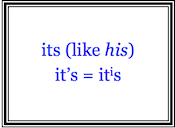
    It’s means it is – wrong for this sentence. Try his (increases his tuition – increases its tuition). There’s no apostrophe in either possessive pronoun.
  3. We have a minuscule chance of winning that beautiful trophy.
    Look for minus, and you’ll spell minuscule correctly every time.

If you found all three mistakes, congratulations! Many people miss at least one of these commonly misspelled words.

Explaining the difference between its and it's

Share

Avoid Filler Words

Amateur writers often rely on a principle that doesn’t work: “The longer, the better.” No. You want strong, punchy sentences that move.

Give your readers’ brains something interesting to do. Put their neurons to work!

Here are some sentence pairs for you. Notice that the second version is always shorter…and stronger. You don’t need the filler words in red. Your readers’ brains will figure it out – honest!

I began to search my closet for the missing jacket.
I searched my closet for the missing jacket.  BETTER

Eventually I found it under a pile of sweaters on the floor.
I found it under a pile of sweaters on the floor. BETTER

Needless to say, JoAnn and I aren’t seeing each other any more.
JoAnn and I aren’t seeing each other any more.  BETTER

Mr. Brown asked for volunteers, whereupon Alan and I said we would be glad to help.
Mr. Brown asked for volunteers. Alan and I said we would be glad to help.  BETTER

Subsequently we sold the car and bought a safer model.
We sold the car and bought a safer model.  BETTER


Share

Subject-Verb Agreement

I type my husband’s gardening columns every week. Happily, they usually need very little editing – he’s an excellent writer.

But we ran into a thorny problem recently, and we didn’t know what to do until we realized that there are two (not one!) correct answers. Take your pick! (We did.)

The problem was the word fruit. Or should it be fruits? Charlie was writing about ornamental peppers (which – botanically speaking – are fruiting plants even though cooks call them vegetables).

Here’s the sentence that drove us nuts:

In addition, the fruit of most varieties are notably hot, as measured on the Scoville heat scale.

The fruit…are sounds odd. There was a simple solution: change fruit to fruits.  The sentence would read “the fruits of most varieties are notably hot…” Fist pump!

Not so fast. Elsewhere in the column we used fruit as a plural noun:  peppers bear ornamental fruit. “Bear ornamental fruits” just didn’t sound right.

Here’s a better explanation of what was bugging us: we didn’t want to say “fruit is” in one place and “fruit are” in another.

I hope you’ve hung in with me this far, because this question is going to take an unexpected turn. 

There’s a rule in English grammar that you can’t use an of phrase as the subject of a sentence. But – happily for us – that rule is starting to disappear. Neither the New Yorker nor the New York Times bothers with it any more.

So we’re treating varieties as the subject of the sentence. Varieties are. Problem solved!

In addition, the fruit of most varieties are notably hot, as measured on the Scovill heat scale.

If all of this has you holding your head in bewilderment, fear not! The ultimate point is that languages change over time. Rules change. In this case, things got simpler. I’m applauding!

Share

Native English Speakers Have Problems

The BBC is one of the world’s most respected news services. So naturally I was interested in a BBC article called “Native English Speakers Are the World’s Worst Communicators.”

The article points out that people who grew up speaking English sometimes forget that non-native speakers may have trouble understanding them. Click here to read it: http://www.bbc.com/capital/story/20161028-native-english-speakers-are-the-worlds-worst-communicators.

I thought I would learn something new about some hidden minefields in the English language. But the article was disappointing. It pointed out communication habits that (in my opinion) might happen in any language.

Native English speakers sometimes talk too fast, and they make jokes and cultural references that people from other countries may not understand. Those are valid complaints – I’ve seen it happen myself. But are we the only people in the world who do this? I doubt it.

There was one point – right at the beginning – that I thought was valuable. English words often have two contradictory meanings. The article tells a story about a native English speaker who sent an important business message to a person who was still learning English.

The message included an unfamiliar word. The recipient looked it up and found two contradictory meanings – and chose the wrong one. As a result of the confusion, the business lost hundreds of thousands of dollars.

I wonder if you have the same question I did: What – for heaven’s sake – was the word? The article didn’t reveal it. The author said it’s specific to a particular industry, someone might figure it out, and the company would be embarrassed.

I call that…bad writing. The article didn’t have a single example of a confusing word that native speakers should use carefully. That’s not helpful.

I (ahem!) am going to provide two examples.

1. Flammable and inflammable. You probably know that they mean the same thing: able to burn (flammable/inflammable materials, for example). But “in” often means “not”: insecure, indefinite, incapable. Someone who doesn’t know English well might think that inflammable means “fireproof.”
I would tell business writers never to use the word inflammable. Why open the door to confusion? Flammable is a perfectly respectable word, and nobody is going to be confused.

2.  Buckle can mean “connect” (buckle a belt) and “collapse” (his knee buckled). The context will probably make it clear which meaning you want. A smart writer will double-check what they’ve written to make sure the meaning is clear. (In fact smart writers do that routinely, every time.)

I want to make one more point. Regular visitors to this blog know that I often rail against jargon. It’s pompous and confusing, and it hinders communication. Why use it?

Let’s go back to that story about the confusing “industry-specific” term. That is jargon doing its evil work.

Ye gods and little fishes. Why was that term used in the first place? Surely there was a simpler word (or group of words) that would have done the job.

A little common sense and brain power can go a long way. That’s what I wish the article had talked about.

communication

Share

Write Strong Sentences

Here’s a weak sentence I came across recently. See if you can figure out what I don’t like about it:

This cold-hardy, pest-proof, drought-tolerant shrub thrives in sun or light shade and is long lived.

The answer is that the sentence sputters. Your writing should always feel as if it’s going somewhere. And there’s a second problem: too much information has been crammed into one sentence.

Here’s my version:

This long-lived shrub is cold hardy, pest proof, and drought-tolerant. Even better, it thrives in sun or light shade.

 A powerful runner

Share

Stop Using “Quid Pro Quo”!

Thirty-two writers recently signed a letter to the New York Times complaining about two expressions we often hear in discussions about current events: quid pro quo and “dig up dirt.”

I think the letter makes an excellent point: when you use a word carelessly, you risk losing precision and clarity.

The letter mentioned two problems with quid pro quo. One is that many people don’t understand what it means (literally this for that – an exchange of favors).

More seriously, there’s nothing wrong with a quid pro quo exchange of favors, even though the term is often used in an accusatory way. We do it all the time. I’ll water your houseplants when you’re on vacation, and you’ll do the same for me.

If you’re claiming that a politician is pressuring someone for personal gain, that’s not quid pro quo or an exchange of favors. A more accurate word would be extortion.

Similarly the expression “digging up dirt” is too vague to be useful. Are you looking for evidence of wrongdoing? Say so: “I’m researching Richard Nixon’s behavior during the Watergate investigation.”

If someone is pushing a false story, call it what it is: “telling lies.”

“Words matter,” according to those 32 writers. Amen. You and I – in our everyday conversations – are often confronted with choices. We can select words that tell the truth – or we can manipulate, exaggerate, and fabricate.

I highly recommend making the ethical choice.

Share

Does a Comma Take the Place of “And”?

I was an English teacher for 40 years. Every semester when it was time to teach punctuation, a student would gently remind me about a rule I hadn’t mentioned: “A comma takes the place of and.”

No, it doesn’t. But there were always a few students who would nod knowingly.

If I thought hard enough, I could probably come up with a sentence where you could indeed substitute a comma for and. But I’d rather save my brain cells for other tasks.

So – if you harbor this urban legend, let it go.

Here are three comma rules that will cover most sentences:

  1. Use a comma when a sentence begins with an extra idea.
  2. Use a comma when you join two sentences with and or but (or any of the seven FANBOYS words).
  3. Use a pair of commas with an interrupter.

You can learn more about these comma rules here. You can download a free handout Happy commas!

Share

Is Grammar Necessary?

Is grammar necessary? My answer might surprise you: No, it isn’t – not if you mean identifying parts of speech and diagramming sentences.

People who adore formal grammar often say that correct grammar is essential if you want to get a precise message across. I say that’s rarely true. Suppose you heard someone say, “John don’t like that restaurant.” The grammar is wrong, but you would understand perfectly.

Here’s a joking message sent to me by my friend Margaret Wheaton. Numerals have been substituted for many of the letters – and yet most people can read the message easily:

Standard English is a beautiful thing. It showcases your communication skills and professionalism. But don’t confuse good writing with grammar gobbledygook. They’re not the same thing.

Share

Happy Halloween!

I’m celebrating Halloween today! More accurately, I’m celebrating Hallowe’en. I sometimes use the apostrophe even though it’s no longer standard. It stands for the missing “v” in All Hallows’ Even (“evening”) – one of the earlier names for our October 31 holiday.

In honor of Hallowe’en, I’m going to discuss two features of English that are scary – or just plain crazy.

Here’s a sentence that’s grammatically correct but so weird that I would never use it:

Either you or I am likely to win first prize.  CORRECT (but yuk!)

Here’s the rule: in an either/or sentence, the “or” part (or I) determines the verb. I am likely to win first prize is correct. That gives us “Either you or I am likely to win first prize.”

Nope. Grammar be damned – it’s just too awkward for me. I would use this version:

Either you or I are likely to win first prize.  INCORRECT (but I like it)

Let’s go on to something else that’s grammatically correct but – to me – unbearably clumsy: “that of.” Take a look at this sentence from “This Is the Moment Rachel Maddow Has Been Waiting For,” an article in the New York Times Magazine:

If today’s dominant political recreational metaphor is that of the three-dimensional chess game, Maddow is hunched over in the corner of the rec room, methodically putting together a jigsaw puzzle. CORRECT (but yuk!)

What – I ask you – would be lost if you deleted that of?

If today’s dominant political recreational metaphor is the three-dimensional chess game….

Have a wicked Hallowe’en!

Halloween pumpkin

Share