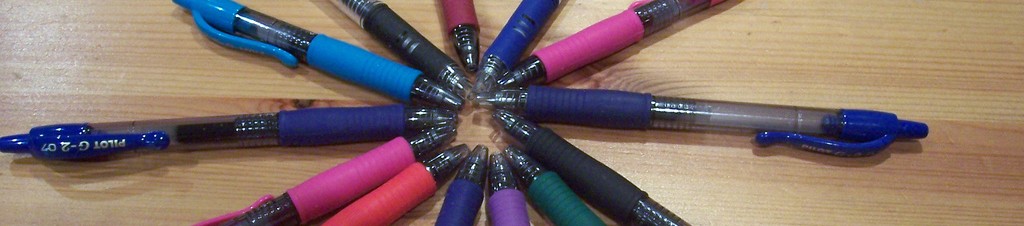
Writer’s Block

Someone online posted a desperate plea for help with writer’s block. The question mentioned a “massive project” like a book proposal or dissertation.

Oh, my. I feel for you. I was so frozen with fear when I started my own dissertation that I didn’t write a single word for a month.

But there’s hope! I finished my dissertation, learned a lot along the way, and went on to become a pretty productive writer. Here are some strategies to try:

  1. Make up your mind to do it badly. That removes the intimidation factor. You can always make improvements later – and you will, once you have something substantial to work with.
  2. Start with a leading task – something small related to your project. You could type a couple of quotations you’re planning to use, for example, or look something up. Tell yourself “I’m just going to….” Often that will get your engine going.
  3. Know your favorite escapes and excuses. Mine is housework. I didn’t clean my stove for two years while I was writing my dissertation. It was too tempting to divert my energy into making my house sparkle.
  4. Find a buddy. Plan to meet for writing sessions.
  5. Change your location. I went to a coffee shop every evening for an hour.
  6. Don’t worry about inefficiency. Those coffee shop trips involved a lot of wasted time – packing my stuff, driving there, unpacking when I got home, trying to concentrate in a noisy atmosphere. But over the long haul I got a lot done, and those nightly trips gave me something to look forward to.

Good luck, and hang in there!

___________________________________________________________________________________________________

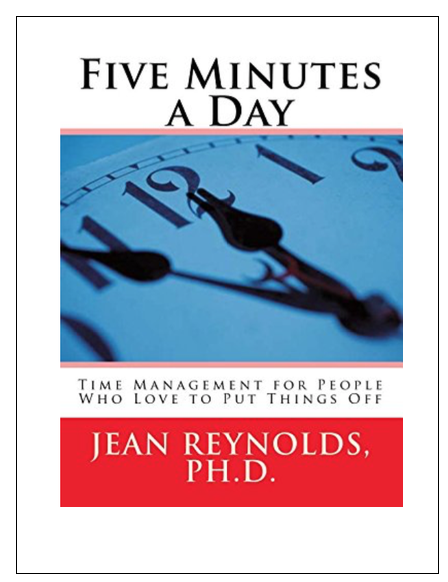
Jean Reynolds’ book Five Minutes a Day: Time Management for People Who Love to Put Things Off can be purchased from Amazon.com and other online booksellers for $6.25 (paperback) or $1.99 (Kindle). Other ebook formats are available from Smashwords.com for $1.99.

Share

Let’s Stop Talking about Possessives

Every American should know the words to The Star-Spangled Banner, our national anthem:

Oh, say, can you see
By the Dawn’s early light
What so proudly we hailed
At the twilight’s last gleaming?

But wait a minute! Because dawn isn’t a person, it can’t own the “early light.” For the same reason, twilight can’t own the “last gleaming.”

Did Francis Scott Key screw up our national anthem?

Of course not. You might have been told you can’t use an apostrophe + s construction unless the owner is human. You can’t say “the dog’s collar” or “the tree’s leaves” or “the song’s lyrics.”

But that’s a bogus rule made up by people who should know better.

How did this mistake get started? Here’s what probably happened. Grammarians often talk about possessives (“Joe’s shoes”). It wasn’t long before some self-appointed grammarians decided that only people can have possessions.

Teachers and editors latched on to that made-up rule, and that opened the door to all kinds of clumsiness: “the collar of the dog” instead of “the dog’s collar” – and so on.

When you stop to think about it, many possessive constructions don’t involve ownership at all. A teacher’s desk is one example. Every classroom I used in my 40-year teaching career had a desk for the teacher (me). I didn’t own it, of course. I couldn’t take it home. But it was still the teacher’s desk.

I want to make two points today.

1. We need to stop talking about “possessives.” When I was teaching, the term I used was “of expressions.”

2. Some apostrophes are disappearing. The Associated Press has dropped the apostrophe from Veterans Day (which used to be Veterans’ Day – the day of the veterans). I often see signs like “Doctors Lounge” and “Judges Entrance.”

James Harbeck has some interesting observations about “of” constructions at this link: https://theweek.com/articles/564165/stop-calling-possessives-possessive

Share

Get Rid of Empty Words

My husband and I recently leased a new car. We selected the car we wanted from a list of closeout vehicles on the dealership’s website. The sales associate asked if we knew the VIN. I was impressed!

Many people would have said VIN number. That’s not quite correct. A VIN is a vehicle identification number. You don’t need to put number at the end: vehicle identification number number.

Similarly, you don’t need to say ATM machine: it’s an Automatic Teller Machine. Nor is it necessary to say Jewish rabbi, actual fact, or free gift.

Whenever someone says “Can I ask a question?” my response is “You just did!”

There’s no difference between “What’s the current time” and “What’s the time?”

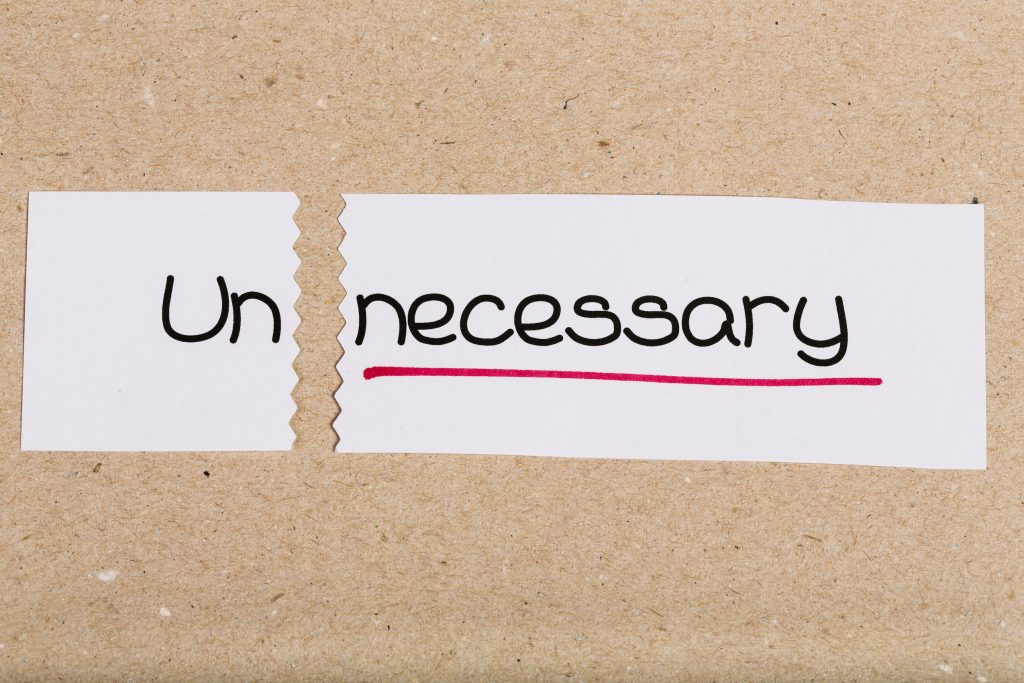
Unnecessary words can clutter your writing. Develop the habit of looking for these redundancies – and getting rid of them. Your writing will be better for it!

Sign with word unnecessary turned into necessary

Share

The Whistleblower

My friend Karen White just sent me a link to a wonderful New York Times article: “The Whistleblower Knows How to Write.” It’s a good refresher on some important points about writing.

The author, Jane Rosenzweig, directs the Harvard Writing Center. She analyzed the “whistleblower complaint” – a letter from a CIA officer claiming that President Trump put pressure on the Ukrainian government to interfere in next year’s Presidential election.

Somewhere there’s an English teacher who should be feeling very proud! Too bad that unsung person will never know that all those late-night grading sessions really paid off.

Share

Let’s Edit a Sentence

I love to think – and talk – about sentences. Writers quite naturally want to talk about big concepts: unity, coherence, emphasis, and the like. I prefer to get up-close-and-personal with a sentence. I think that’s where great writing happens.

Let’s edit a sentence today:

Protein, as well as vitamins A and C, abounds.

It’s correct. But I don’t like it. I think readers are going to stumble when they come to abounds. Shouldn’t it be abound?

Nope. The sentence is saying that protein…abounds.

“As well as vitamins A and C” is extra. You drop your voice. Those vitamins don’t really count. (Read the sentence aloud – you’ll hear that it’s really about protein.)

I have a rule (okay, I made it up) that if a sentence sounds odd, you should change it. So here’s my version:

Protein and vitamins A and C abound.  CORRECT

Elegant and easy! (Isn’t that what we’re aiming for when we write?)

It’s always a good idea to take an extra minute or two to edit a sentence. Those small changes add up!

Share

An Interesting Sentence!

A friend just sent me a link to a wonderful article about self-publishing: “The Authors Who Love Amazon” by Alana Semuel in The Atlantic, July 20, 2018. (You can read it at this link: https://www.theatlantic.com/technology/archive/2018/07/amazon-kindle-unlimited-self-publishing/565664/.)

I love self-publishing. It’s wonderful if you do it right! I always tell writers to use a free platform – Kindle Direct Publishing, Smashwords, or both. Do not pay anyone to publish your book! You can find lots of resources for self-publishing at this link.

But what I really wanted to talk about today was this sentence in the Atlantic article:

Omer is one of a growing number of authors who have found self-publishing on Amazon’s platform to be very lucrative.  CORRECT

I’m reeling. Hardly anyone gets one of these sentences right – but there it is! Most people would have written it like this: 

Omer is one of a growing number of authors who has found self-publishing on Amazon’s platform to be very lucrative.

I insist that it should be have found. How do I know I’m right? Compare these sentences:

Omer is an author who has found self-publishing on Amazon’s platform to be very lucrative.  (one author)

Omer is one of a growing number of authors who have found self-publishing on Amazon’s platform to be very lucrative.  (a group of authors)

The first sentence is about an author who has found Amazon to his liking.

The second sentence is about a group of authors who have found Amazon to their liking:

Omer is one of a growing number of authors who have found self-publishing on Amazon’s platform to be very lucrative.  CORRECT

Three cheers for the Atlantic and its editorial team!


Share

Oops! Did I Really Write That?

Every fall my husband arranges for a crew to remove inflorescences and dead leaves from the palm trees at our building. Here’s a notice I posted for residents this morning:

About an hour later I realized that I’d made an embarrassing mistake. Did you spot it?

It is one of the trickiest words in the English language. The mistake I made is called an “indefinite pronoun reference.” In plain English, it was pointing to the wrong word. We were asking residents to move their parking spaces, not their cars. Or maybe we wanted them to move their palm trees! (My thanks to Joy Smith for pointing that out.)

Here’s the revised sentence:

If your parking space is near a palm tree, please move your car to visitor parking or Pope Avenue Tuesday morning.  CORRECT

Much better!

Share

Yes, You Can Start a Sentence with “But”!

Last week Ann Levin reviewed a novel called Red Bone for the Associated Press. I immediately sent a response to my local newspaper, which printed Levin’s review. She made a serious error in her first paragraph:

Jacqueline Woodson begins her dazzling new novel, “Red at the Bone,” with an afterthought, in the middle of things, and breaking all the rules of grammar by starting with a “but”: “But that afternoon there was an orchestra playing.”

Woodson didn’t break “all the rules of grammar.” She didn’t break even one rule of grammar. There’s no rule against starting a sentence with but – and never has been. AP articles frequently start sentences with but, and I’m astonished that Levin – an AP writer – doesn’t know this.

My letter appeared in yesterday’s newspaper. You can read it here: https://www.theledger.com/opinion/20190923/letter-but-you-can-start-sentences-with-but

Share

National Punctuation Day

It’s National Punctuation Day! Have fun! Celebrate!

Here are two websites to get you started:

www.NationalPunctuationDay.com (suggested by my friend Bev Lerner)

And just for fun: Victor Borge’s Phonetic Punctuation

Here’s a quick punctuation quiz. Read the five sentences below and correct any punctuation errors. When you’re finished, scroll down for the answers.

1.  We just got back from our trip to New York, it was a wonderful vacation.

2.  We spent a week there and visited: the Statue of Liberty, the Metropolitan Museum of Art, and the Bronx Zoo.

3.  Next year we’re thinking about visiting Washington D.C.; the nations capital and a fascinating place.

4.  Although, we might take the girls’ back to New York instead.

5.  A trip to Europe, if we can save enough money is our ultimate goal.

THE ANSWERS

Every item contains at least one punctuation mistake. Here are the corrected versions, along with explanations.

1.  We just got back from our trip to New York. It was a wonderful vacation. OR We just got back from our trip to New York; it was a wonderful vacation.  [Handy rule: “If it starts with it, it’s a sentence.”]

2.  We spent a week there and visited the Statue of Liberty, the Metropolitan Museum of Art, and the Bronx Zoo.  [No colon. Use a colon only if a sentence stops before a list. Incidentally, the Oxford comma after “Metropolitan Museum of Art” is optional. Don’t let anyone tell you it’s wrong to use it or not use it.]

3.  Next year we’re thinking about visiting Washington D.C., the nation’s capital and a fascinating place.  [A semicolon is like a period. If a period won’t work, a semicolon won’t either. This is actually a Comma Rule 3 sentence. Nation’s capital = capital of the nation and requires an apostrophe.]

4.  Although, we might take the girls’ back to New York instead.  [Three things are seriously wrong here! First, never put a comma after although. Second, anything that starts with although is an extra idea and must be glued on to a real sentence. Third, girls don’t own anything in this sentence: No apostrophe. See below for suggestions about correcting this fragment.]

However, we might take the girls back to New York instead. OR

Next year we’re thinking about visiting Washington D.C., the nation’s capital and a fascinating place, although we might take the girls back to New York instead.

5.  A trip to Europe, if we can save enough money, is our ultimate goal.  [Another Comma Rule 3 sentence.]

How did you do?

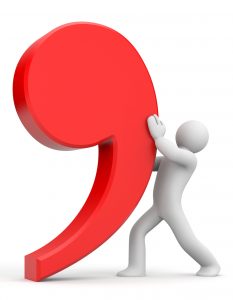
Man propping up a comma

Share

Do You Need to Be Politically Correct?

Recently I’ve been talking with some writers who are worried about political correctness – the pressure we may be feeling to choose a polite word in a sensitive situation.

Here’s one question we’ve been talking about: “How can I get my message across if someone else is telling me which words to use?” Here’s another: “Are we putting our democracy in danger?” And one of my friends wondered whether it’s possible to talk openly about sensitive subjects when we’re also thinking about being politically correct.

Instead of trying to answer those questions, I shared some memories. When I was a teenager, I read two remarkable books written by a former patient at a leprosy hospital in Carville, Louisiana: Miracle at Carville and No One Must Ever Know. The author – “Betty Martin” (she never revealed her real name) – described the heartbreak and loneliness she felt after she was diagnosed with leprosy as a young woman.

Eventually she and her husband (a patient she fell in love with and married in Carville) were cured. But the fear of being labeled a leper was so great that she kept their secret until her death in 2002 at the age of 93.

Soon after I read both books, I watched a TV documentary about leprosy. The TV host interviewed a physician who specialized in Hansen’s Disease (as leprosy is now called).

It was obvious that physician was dedicated to helping his patients return to health. But he had one complaint: he resented the pressure he was under to use the name Hansen’s Disease. “We should keep calling it leprosy,” he said. “That’s the correct name.”

I wonder if he would have felt that way if he had been of those patients. What would it be like to have even your own doctor refer to you as a “leper”? How does that help? Or – to turn the question around – what would have happened if had switched to the term Hansen’s Disease? Would he have been a less effective doctor?

* * * * * 

I used to drive by a house every day that had a large sign posted by the local police department: “Deaf and dumb child lives here.” It was a warning to drivers that this child couldn’t hear a car approaching or a horn honking. Good idea.

But was “dumb” really necessary? Suppose that deaf child – let’s call her “Sally” – had a brother who rode the school bus. Every day he and his friends saw that sign from the bus window.

Would some of the other kids on the bus have made fun of Sally? How would her brother feel? Would he have felt obliged to defend her? Do we really want to put those two children – “Sally” and her brother – into that situation?

* * * * * 

Is our democracy stronger if we say that there are around 6500 lepers (rather than 6500 Hansen’s patients) in the US today? And should the feelings of those 6500 patients make a difference?

Is it useful to make sure that everyone knows that Sally is “dumb”? Would our society lose something important if the police had tried to be more sensitive to the feelings of a little girl and her family?

* * * * * 

I’m a woman of Polish-American descent. I do not tolerate being called a Polack, a broad, or a babe. If you were a professional writer, would those restrictions hamper you? If you met me in person, would you chafe because I insisted that you refer to me as Polish-American or as a woman?

No answers today, just questions.

politically correct

Share