Some Frequently Asked Questions – and Answers

Here are some FAQ’s about writing for you! These are frequently asked questions that show up in social media and my email account.

What are some big words that will impress my readers?

There aren’t any. Nobody is impressed if you say “Extinguish the illumination” when you mean “Turn out the lights.” You need to have something interesting to say – and to know how to say it in an engaging way. That’s how you impress readers.

Can I start a sentence with but?

Yes. All English-language professional writers start sentences with but – frequently. You’ve probably never read a book, newspaper, or magazine that doesn’t have sentences starting with but.
You can learn more here:  Can a Sentence Start with But?

How do I know when to use a semicolon?

There’s no right (or wrong) time to use a semicolon. You never need one. (Well, there’s an obscure rule about using semicolons when items in a list have commas.)
Use a semicolon when you want to show off. It’s easy!
Find two sentences that go together. (Most sentences will fill the bill.)

Change the period to a semicolon. Lower-case the next letter. You’re done.
Jane overslept this morning. She was late for school.
Jane overslept this morning; she was late for school.
We had to change the date for our meeting. Tuesday afternoon is good for everyone.
We had to change the date for our meeting; Tuesday afternoon is good for everyone.

Can you recommend a grammar book for me to study?

No. Formal grammar is a waste of time. Circling words and memorizing parts of speech never helped anyone become a better writer.
Here’s what you need to work on:
-usage (punctuation, word choice, diction, capital letters, and similar skills)
-writing powerful sentences
-writing strong paragraphs
-selecting, organizing, and presenting ideas and information

Share

Sometimes More Is Better

Books about writing often warn you about unnecessary and repetitious words (whispered softly, ran quickly, a smile on his face). You don’t want empty spaces in your writing. Stimulate your readers and hold their interest by making every word count.

But sometimes longer is better. Wordiness can be an effective choice. Good writers know that there’s no such thing as a one-size-fits-all rule for every writing situation.

More-is-better is a useful principle when:

  • You’re trying to create a mood or an atmosphere
  • You’re giving unwelcome news (for example, saying “no” to a customer)
  • You’re explaining something complex
  • You’re emphasizing a point that readers might miss

Here’s one example of useful redundancy: The close of a paragraph. Let’s say you’ve just described the warmth and love you experienced in your grandmother’s kitchen as a child.

You’ve said it all: The cinnamon in the air, the purring of her cat, the teakettle whistling on her stove, the songs she used to hum when she was making her famous chicken and dumplings.

What’s left to say? Nothing – but if you’re an exceptional writer, you’ll wrap up the paragraph with one more closure sentence. Here are three possibilities:

  • I was happy there.
  • I wish I could go back.
  • I have wonderful memories of her.

There’s a grace and ease about a few extra words in just the right place. Don’t be afraid to take a little longer to say exactly what you want your readers to know. The results will be worth the effort.

(Did you notice that last sentence? It’s not really necessary, but it added a little finesse to what I’d written. At least I hope it did.)

Share

How to Write Well

I am joyfully reading a new book about writing: The Destiny Thief, by Richard Russo. Note that word “joyfully.” I can’t remember the last time I read such a wonderful book about writing. The only author I can come up with is Theodore Bernstein. Please, please – surely there have been other good books about writing since I read Miss Thistlebottom’s Hobgoblins twenty years ago!

Maybe not. So let’s talk about Richard Russo. I did not – I’m sorry to admit – enjoy his novel Empire Falls. But I loved Straight Man. It’s one of the rare books that left me feeling empty and bereft when I got to the last page. I couldn’t let go of the characters.

I had low expectations for The Destiny Thief. Most books about writing are…dull. I’ve heard it all before, and often the writing isn’t very good. So I was delighted when I came upon this on page 1, where Russo is describing a conversation with one of his university professors:

My prose, he explained, was full of jargon and intellectual pretension. Most writers had about a thousand pages of shitty prose in them, he went on, and these have to be expelled before they can hope to write seriously. “In your case,” he added, “make it two thousand.”

Amen. Amen.

So how do you make the switch from “shitty prose” to good writing? I don’t have any foolproof formula to teach you how to write well. But I do have three suggestions.

1.  Monitor your own feelings while you’re reading. If you’re reading something and start experiencing the Yippee! feelings I had while reading The Destiny Thief, go back and read it again. Try to figure out what makes this piece so wonderful – and do likewise.

2.  Make a vow that you’re always going to aim to create that feeling for your readers.

3. Read the New York Times.

Here are a few sentences from a page 1 story in last Friday’s Times about the 73 million Rohingya Muslims who have fled Myanmar:

The Rohingya have not returned by the hundreds of thousands, or even by the thousands.
In fact, they have hardly returned at all.
After all the assurances that it was safe for them to return to Myanmar, only a few dozen have done so. The first batch of about 1200 returnees was supposed to be sent home in January 2018….

That is gorgeous writing. No pretension. Why doesn’t everyone write like this? (Why don’t I always write like this? I hope I do part of the time. But why not all the time?)

It’s so readable and clear – and so human. You’re drawn in to the story. You understand the problem that journalist Harriet Beech is describing, and you’re trying to figure out what’s coming next. She’s piqued your interest, and you want to keep reading.

I ran it through seven readability formulas. They all placed it in the “difficult range” – 11th or 12th grade. But it’s still eminently readable. Pleasurable. The only slightly difficult words are “assurances” and “returnees.” What lovely, lovely writing. 

Have you made that vow? (I did.)

Share

The Apostrophe in People’s

I used the phrase “the people’s choice” in a post last week, and a couple of people thought the apostrophe was wrong. Their reasoning: people is a plural word, and therefore the apostrophe is supposed to go after the “s.” Isn’t that right?

No. The before-the-s, after-the-s rule is guaranteed to get you into trouble. I wish books would drop that explanation.

Here’s the problem: there are exceptions: men’s, women’s, children’s, and people’s. I like rules that work 100% of the time. No exceptions. So here goes:

Spell the word. Put the apostrophe after the last letter.

people

The last letter is “e.” So: people’s.

You can see more applications of this handy rule by clicking here.

Share

More about Hyphens

What do you think of this sentence?

Jeff, a fifth-grade teacher, will soon be moving into his newly-painted house. 

Hyphens can be slippery! I want to make two points today. First, don’t use a hyphen with an adverb (a word ending in -ly). But note that hyphens are okay with well: a well-written story. (Some writers don’t use them, though. I told you hyphens are slippery!)

Jeff, a fifth-grade teacher, will soon be moving into his newly painted house.  CORRECT

Second, hyphens tend to disappear over time. The Associated Press recommends dropping hyphens when there’s no possibility of confusion. If you agree with the AP (as I do!), you can drop the hyphen in fifth grade teacher.

Jeff, a fifth grade teacher, will soon be moving into his newly painted house.  ALSO CORRECT

open can of paint on a wooden background

Share

Subjects and Objects

If you visit my blog often, you know I dislike formal grammar. (Dislike isn’t the right word. I despise it.)

A discussion I saw on social media today stirred up all of those negative feelings. Someone asked which version is correct: “This is she” or “This is her.”

Several people explained (incorrectly) that this is the subject, is is the verb, and her is the object. Good grief. I’m appalled.

 Is doesn’t have an object. It’s like an equals sign. Compare these sentence pairs:

This is Jane. (Jane is subjective case)

This helped Jane.  (Jane is objective case)

This is she.  (she is subjective case)

This helped her.  (her is objective case)

It is I.  (I is subjective case)

It helped me.  (me is objective case)

This is the kind of mess you can get when people are forced to learn grammar. They lose their faith in common sense and invent garbled explanations to justify the answer they want.

But hold your horses – even though This is she and It is I are grammatically correct, they’re the wrong answers. They sound awful, and you’re not obliged to use them. This is her and It’s me sound better to most people. Feel free to use them.

The English language is a social tool. The rules are created by the people who use it. I use This is her myself.

If you’re holding your head in pain, I’m with you. This is the kind of pickle you get into when you start talking about formal grammar. We don’t need it. We shouldn’t bother with it. We’re better off without it.

*  *  *  *  *

But what about subjects and objects? And linking verbs? Don’t they matter?

Yes – sometimes. But you can’t force everything you say and write into a little box of Correct English. Sometimes you need to go with the popular choice – grammar be damned.

*  *  *  *  *

Here’s an example. Everyone knows all about is/are: is, plural; are, singular. Joe is here. Joe and Sam are here.

But we often say you are to one person: “Aunt Mary, you are my favorite aunt.”

The correct English would be “Aunt Mary, thou art my favorite aunt.” In Shakespeare’s day, people were starting to drop thou art, and grammarians were positively frothing and predicting the death of the English language. “You can’t say you are to one person!”

Today people win Pulitzer Prizes for books that use “You are”  for one person. Nobody cares. Nobody even notices.

*  *  *  *  *

And here’s the clincher: The people of France are maniacs about correct grammar. There’s even an official body that makes the rules. And do you know what? The French say “It’s me” all the time (C’est moi). Grammar be damned.

Notice I’m not giving you permission to get together with a couple of friends and make up your own version of English. But I am giving you permission to go with the popular choice when millions of people share the same view.

Share

There’s No Such Thing as Objectivity

Two days ago I wrote a post about some unofficial rules I’d made up. An old friend gently chided me because I’d said that the rules “worked great” for me. She thought I needed a more professional tone.

I emailed her that I’d checked the dictionary before publishing the post, and she was right: great indeed is an informal adverb. “Worked great” is too folksy for formal writing.

But here’s the thing: I don’t always feel like writing formally. And it’s not just that I hate pompous language: I also get tired of striving for objectivity.

Sometimes I want to discuss the mysterious pathways my thoughts have been taking…or exploring an idea in the context of my own life.

In the My Fair Lady article I just published, I talked about my thoughts and feelings several times:

On a recent trip to New York I bought a ticket for the Lincoln Center revival of My Fair Lady, Lerner and Loewe’s musical version of Pygmalion. My Fair Lady has always been special for me: it was my first Broadway play and my first encounter with Shaw. On the subway ride to Lincoln Center, I knew I was going to be seeing a superb production—but I also knew I was supporting an enterprise that would have appalled GBS.

When I first saw My Fair Lady in the early 1960’s, I was thrilled by the prospect of a Higgins-Doolittle wedding. But by 1992 my feelings had changed….I was sure Eliza would never marry Higgins, and by the time I’d bought my ticket for My Fair Lady in 2018, those convictions had deepened and hardened. Starting in October 2017, news outlets were flooded with #MeToo news stories about men who treated women as if they were less than human. I’d had some life experience of my own with male-female power struggles….

Our ideas about language are evolving. We used to think that you could ensure objectivity by carefully avoiding the words I, me, and my. Police officers were taught to write “this officer” instead of I. “The suspect was patted down” guaranteed that you were telling the truth; “I patted down the suspect” hinted that you were lying.

It was all nonsense, of course. Today (thanks in large part to the postmodern language theory) we’re recognizing that there’s no such thing as total objectivity. Avoiding the words I and me won’t turn a dishonest person into an honest one.

Every academic project involves opinions and decisions. Even choosing My Fair Lady as a topic involved a value judgment: I thought the play was important enough to be worth study.

Why not be honest about your values and opinions?

My larger point is that sometimes it’s okay to challenge the rules. That raises an important question: how do you know when you’re allowed to follow your own path?

The answer is that you don’t. If you’re a professional writer, it helps to study the publisher or journal you’re writing for. You can often get a sense of what they’re looking for and what rules they follow – and when it’s safe to break them.

But sometimes you just have to jump in. That involves admitting to yourself that you’re taking a risk, and deciding not to be disheartened if an experiment doesn’t work out for you.

Writing is always about you – your style, memories, experiences, values, beliefs, interests. Writing honestly is a way of honoring who you are. I encourage you to embrace the risks. And don’t forget to have fun!

Share

Five Rules I Made Up

Here are five grammar rules you’re probably not going to find anywhere else, for a very good reason: I made them up. They’re neither official nor foolproof, but most of the time they work great for me.

1.  Avoid the word “reason.”

Of course “reason” is a useful and perfectly good word. But it often gums up sentences. Safe bet: Try rewriting the sentence without it.

Her reason for skipping church this morning was that she hadn’t slept well.  AWKWARD

She skipped church this morning because she hadn’t slept well.  BETTER

2.  Don’t start a sentence with “by.”

Good writers start sentences with “by” all the time. I do it too. But student writers tend to come up with something messy like this:

By going to bed early helped me feel rested for the big test.  WRONG

This version would be better:

By going to bed early, I felt rested for the big test.  BETTER

But why take a chance? Cross out “by” and rewrite the sentence:

Going to bed early helped me feel rested for the big test.  BETTER

3.  Avoid using more than three commas in a sentence.

In the real world there’s no limit to the number of commas you can use. But once you insert your fourth comma, you’re likely to have a complicated sentence.

And once a sentence gets complicated, there’s a good chance than an error or two will creep in. Keep your sentences simple.

4.  Avoid “being.”

 If “being” finds its way into one of your sentences, consider getting rid of it. It’s another word that often gums up a sentence.

I experienced many challenges while being a substitute teacher.  AWKWARD

Substitute teaching was a challenging experience for me.  BETTER

5.  Don’t let a comma touch the word “that.”

Any English teacher or professional writer reading this can probably come up with forty or fifty sentences with a comma next to “that” in no time at all. (I know this is true because I can do it myself.) I’m standing my ground, however.

Most of the time it’s wrong to put a comma right in front of – or in back of – that. This timesaving rule has saved me from many comma errors. 

Share

Jean Is Still Writing

Harper’s Magazine recently published an article (Semantic Drift) arguing that English is deteriorating, and the solution is more grammar instruction. (My thanks to Margaret Swanson for telling me about it!). If you know me well, you already know that I disagree with the article on both counts. English is not deteriorating, and grammar instruction isn’t the solution to anything.

I started early one morning writing a couple of thoughts, and…boom! An essay started to take shape. I have a lot of historical information about changes in English, so it was an easy article to plan and put together. (I did a lot of chuckling and chortling.)

Another advantage is that I still have a library account with the college where I used to teach. Their online resources include the Oxford English Dictionary (often called the OED). O frabjous day! Calloo, callay!

(Note to self: write a post about the OED.)

One evening the ideas wouldn’t stop coming, and I plugged away at the article until nine o’clock. Finally the article signaled that I’d worked hard enough. I got into bed and read a couple of articles in the back issues of the New Yorker that I keep on my bedside table. At 10:30 I sleepily turned off my reading lamp.

And then at about two I woke up and couldn’t go back to sleep. The only solution was to sit down at the @#$%! keyboard and write another chunk. I really, really would prefer to skip these sleep interruptions – they mess me up the next day. But I don’t seem to have a choice.

What’s interesting is that I’d been dragging the previous week – unusual for me. I was thinking that my age was catching up with me, and maybe I should see my doctor. And then this essay popped into my head, already organized and accompanied by a list of examples.

I’m thinking now that my unconscious was working on the article the whole time and wanted peace and quiet. Do other writers go through these struggles? And always lose, like I do? (Incidentally, that “like I do” is bad, according to the Harper’s article. My response: I don’t care.)

It’s been interesting to compare the Harper’s response with another article I’m writing, about Shaw’s brief play Village Wooing. The Shaw article was supposed to take five or six days. It’s now been more than a month, and I’m having to make major changes because I came up with a new idea that doesn’t fit tidily with what I’d already written. 

The Village Wooing article started with one small point that wasn’t strong enough to warrant an entire essay. Then ideas started exploding, and I keep having to start over. I’m having so much fun with it that I sometimes feel guilty about sitting down to write. Shouldn’t I be vacuuming?

I’ve really enjoyed all the excitement. But what a nice change of pace this new project has been! Straightforward, easy to organize.

I hope your summer has been as much fun as mine has been!

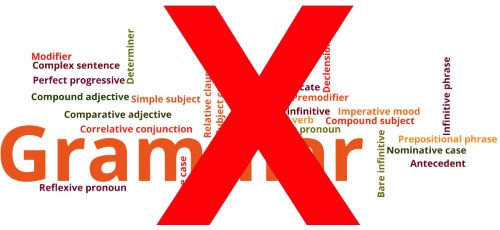
A word cloud about grammar

Share

Let’s Make It Simpler!

This is a follow-up to Monday’s post, where I discussed an interesting article in The New Yorker: Is the Internet Making Writing Better? Here’s a sentence from the article:

As with online irony, online civility emerges from linguistic superfluity, the perception that an extra effort has been made, whether through hedges, honorifics, or more over-all words.

I would have simplified it: Online writing sounds more polite when you take the time to write more words.

The article goes on to suggest three ways to add those words: “hedges, honorifics, or more over-all words.” Bad advice. The first suggestion – hedging – would weaken your writing.

The other advice is too vague to be helpful. What’s the difference between “more words” and “more over-all words”? And how do you do add words effectively?

Honorifics are titles or words indicating respect. How would you use them?

I’m surprised The New Yorker didn’t send the article back for some revisions.

Share