Internet Writing…and More

I just read an interesting article in The New Yorker: Is the Internet Making Writing Better? It’s a review of Gretchen McCulloch’s new book Because Internet: Understanding the New Rules of Language.

Although I haven’t read McCulloch’s book yet, the article is fresh and worth reading. Writing tends to be a stuffy and stagnant subject. I often feel that I keep reading the same ideas everywhere I go. McCulloch argues that technology opens up new possibilities for writing.

Here’s a paragraph from that New Yorker article that got me thinking:

As with online irony, online civility emerges from linguistic superfluity, the perception that an extra effort has been made, whether through hedges, honorifics, or more over-all words.

If you pull your copy of Strunk and White’s The Elements of Style off your bookshelf, you’ll find this advice in the “Elementary Principles of Composition” chapter: Omit Needless Words.

“Vigorous writing is concise,” counsel Strunk and White. “A sentence should contain no unnecessary words, a paragraph no unnecessary sentences, for the same reason that a machine should have no unnecessary lines and a machine no unnecessary parts.”

But I’d say that Strunk and White were only partially right. First, it’s not always obvious which words are unnecessary. Second – and this is the point McCulloch makes – sometimes it’s better to take extra time and say something more.

When I taught at a business school, I told my students to “say yes quickly – but say no slowly.” Make your reader feel that you took the time to think about the situation and come up with your answer. It softens the disappointment.

Here’s another example of taking extra time: I often tell writers to add an extra sentence to the end of a paragraph (a strategy I used in the paragraph before this one!). That might seem odd in light of Strunk and White’s insistence on brevity. But that extra sentence adds a professional touch – like a bow on a package.

Here are some closure (final) sentences that impressed me:

  • I still think about that weekend.
  • He keeps her picture in his wallet.
  • That rosebush blooms every year, without fail.

In today’s post I’ve offered two pieces of advice about writing. One is to pay extra attention to the ends of your paragraphs. Often an additional sentence can add some pizzazz. (But don’t try it in every paragraph!)

My other suggestion is to keep looking for new ways to learn about writing. Don’t get stuck in the tried-and-true advice we’ve all heard a hundred times.

I discovered the closure trick by reading student papers at a community college. A few students did it naturally, others imitated them, and I soon realized we were on to something.

When you read something you like, slow down and ask yourself what made the difference. Then try it yourself. It’s one of the best ways to develop your writing skills.

Yes, I think Gretchen McCulloch is on to something. The Internet is going to teach us a lot about writing. I can’t wait!

Share

Affect or Effect?

Affect and effect cause a great deal of confusion because the spellings are so similar. My advice about them might surprise you: don’t use affect at all.

Affect is a vague word that tells your readers nothing:

The new zoning law will affect the value of our property.  VAGUE

Will your property be worth more…or less? “Affect” doesn’t tell you.

The new zoning law will lower the value of our property.  BETTER

The new zoning law will increase the value of our property.  BETTER

What about effect? It means “a result.” Here’s a trick: Try inserting the in your sentence and see if it works. If it does, chances are you have the right spelling.

We hired a consultant to help us explore the effects of the school proposal.  CORRECT

Share

All about Parentheses

Parentheses are wonderful punctuation marks. They enliven your writing by allowing little interruptions. (I use them all the time.)

But many writers are afraid of them! So here’s a crash course in parentheses:

  • Be careful not to overuse them. You don’t want to sound like a breathless teenager!
  • Never put a comma in front of parentheses. That’s an ironclad rule – and a useful one. You don’t have to parse the sentence to figure out whether it needs a comma: if there’s a parenthesis, NO COMMA.
  • But of course you can put a comma after parentheses (like this), if it’s needed.
  • If you put a complete sentence into parentheses, start with a capital letter and end with a period. (You can also use question marks, exclamation points, and other end punctuation.)
  • If it’s not a complete sentence, start with a lower-case letter, and don’t use a period (savvy readers will notice).

Congratulations! You now have a Ph.D. in parentheses. (Easy, wasn’t it?)

Share

Thinking and Telling

Today I’m going to tackle one big guideline for writers: Don’t confuse thinking with telling. They’re not the same thing.

Thinking on paper can look like telling. There are lots of words, many ideas, tons of examples. You’re scribbling or typing very fast. But you’re not writing for an audience…yet. Or maybe it would be more accurate to say that your audience is you.

People often get thinking and telling mixed up. I do it all the time. I’ll be rattling away excitedly about some idea that has just grabbed me. Suddenly my husband (or someone else who loves me) puts up a hand and says, “Stop! What are you talking about?”

And it hits me: I was talking to clarify my thinking for myself, rather than the person who’s listening.

Writing has (or should have) two clear-cut stages: Thinking and telling. Don’t even attempt to present your thoughts to a reader until you’ve thoroughly explored them. That often requires research, and it ALWAYS involves a first draft.

I’m convinced that many of the weak student essays I’ve read over the years are the result of the same mistake. Ideas – facts – opinions pour onto a piece of paper. The student is overjoyed. I’m writing! I have something to say!

Wrong. You’re preparing to write.

Here are some signs that you’re in the discovery phase:

  • You’re surprised by some of the things coming you’re saying or writing
  • The topic is new to you
  • If someone asked you to summarize your point in a single sentence, you wouldn’t know what to say
  • You have a pile of notecards in front of you that you’re trying to string together
  • You’re so busy thinking about your topic that you haven’t thought about your readers

Discoveries are a good thing! Write them all down. Explore your topic from every possible angle. Marshal all your examples. Then you can start shaping them for your readers (devising an opening strategy, organizing your supporting ideas, thinking about transitions and climaxes).

Think first, tell second: Simple advice that can make all the difference in your success as a writer.

Share

Jean Keeps Writing

I’m still working on a presentation for a Shaw conference in Spain next May. The road has been both bumpy and fun.

I was delighted when I had filled up seven pages. At the beginning of this project, I was afraid it was so slight that I’d have nothing interesting to present. That seventh page was a milestone and a beacon of hope. I could picture myself crossing the finish line.

But then I discovered that Village Wooing (the play I’m writing about) is much more interesting than I expected. Ideas started tumbling out. Yikes! I had to go back to the beginning to make room for my new insights.

Here – in no particular order – are some thoughts:

  • My goal is to create a lively PowerPoint for the conference. So why am I struggling to write a @#$%! paper that may never get published? Here’s the answer: a paper requires precise, orderly thinking. That discipline is forcing me to dig deeper and come up with better ideas.
  • The first page (which I’ve rewritten at least 10 times) is the key to everything. Once I’ve set up a reason to discuss Village Wooing, and introduced the points I want to make, everything else is going to be easy. (Or so I hope. I’m still working on that first page.)
  • I know it’s crazy to think that writing an academic paper is similar to writing a novel. But I think there are some similarities. I have to keep my readers in mind the whole time – setting them up for what’s coming without giving too much away. I suspect it’s similar to the thinking process that novelists use.
  • You might be surprised how much invention goes on in academic writing. Of course I’m not really inventing anything. This is a serious project that I hope will have lasting value. But it involves lots of choices. Which point will I make next? What’s the best way to support it? What should be left out? What needs to be emphasized?
  • It’s frustrating to have to backtrack. Sometimes I hold my head when I reread what I’ve written: who wrote this mess?
  • But it’s also great fun a lot of the time – and it’s thrilling to come up with something really good that hasn’t been said before.

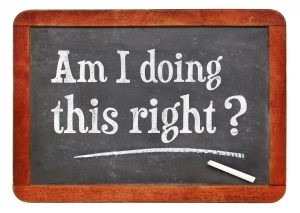
A chalkboard that asks if I'm doing this right.

Share

Whoever or Whomever?

If you’ve encountered the word whomever recently, I’d give you better than even odds that it’s been used incorrectly. Here’s an example of the kind of mistake I hear (or read) all the time:

Give the money to whomever needs it.

I would argue that the sentence should read:

 Give the money to whoever needs it.

But some people think whomever is more elegant, and they overuse it.

How can we solve this problem? First, let’s get who and whom straight. Who is like he; whom is like him. So far, so good.

But now we’re stuck between two choices:

1.  Give the money to him. Give the money to whom. Give the money to whomever. Give the money to whomever needs it. (This is what many people would do with the sentence.)

OR…

2.  He needs it. Who needs it. Give the money to whoever needs it. (This is my choice.)

So how do you know which is right? You reword the sentence and try our who = he and whom = him strategy again.

Let’s go:

Give the money to the person who needs it.

You wouldn’t say “him needs it.” So who and whoever are correct:

Give the money to whoever needs it.

Whom and whomever are disappearing – and I (for one) am thrilled. Whom doesn’t add anything useful to a sentence. It wastes time and confuses people. Who needs it? (Ha!)

whom

                                        Who?

Share

If You’re a Researcher

I just read a terrific post about research on James Harbeck’s Sequiotica blog: https://sesquiotic.com/2019/07/12/just-for-reference/. He offers several common-sense suggestions for making research references (endnotes and footnotes) more useful.

I’m going to add a comment to his wise advice about avoiding ibid (a term meaning “the same as the previous reference”). If you’re less than – say – 100 years old, you shouldn’t be using ibid. Why make yourself sound like a dinosaur?

Here are two more suggestions:

  • If you’re quoting from someone’s collected works, please give the name of the essay. It’s not much help to tell me that you’re quoting from Vol. 3, p. 298 of the Collected Works of Ralph Waldo Emerson if I don’t happen to own that collection. Taking a few seconds to include the title (“The Over-Soul” or “Self-Reliance”) makes it a lot easier for me to track down your quotation.
  • Make it easy for readers to match your endnotes with your sources. Let’s say I’m reading your chapter “New Beginnings,” and I want to look at the source for your endnote 15. I go to the back of the book. And what I find are endnotes for Chapter 1, Chapter 2, Chapter 3, and so on. There’s no heading “New Beginnings.” So I have to thumb back to find out that “New Beginnings” is actually Chapter 3.Have pity on your readers! Include both the chapter number and title in your endnotes. It’s such a simple thing to do – and it’s so helpful.

green dinosaur

Share

Jean Is Writing

This week I’m writing a paper about a short Shaw play called Village Wooing. Eventually I hope to turn my paper into a PowerPoint presentation for a future Shaw conference in…Spain!

This entire week I have been preoccupied with writing. In fact I skipped my weekly water park visit  (we live 15 minutes away from Legoland) because I was having so much fun with the paper. (My husband shook his head in bewilderment, but it’s true.)

Today we were headed out the door for our regular pizza outing when a sentence for the paper popped into my head. Charlie waited by the door, keys in his hand, while I ran to my computer to type it. By the time we arrived at the restaurant, I had a whole paragraph worked out in my head. I kept repeating it to myself until we got to our table, and then I grabbed a paper napkin to write it down.

I know, I know: academic writing is supposed to be drudgery – and so is reading it. Heaven forbid that you should have fun…or your readers should enjoy it!

My philosophy is just the opposite: if it’s not fun, why do it? And so my brain has been working overtime for a week now trying to come up with unconventional ways to make points that – frankly – wouldn’t startle or amuse anyone. Tune in again about a year from now (the conference is in May 2020) to see if I pulled it off.

A couple of tricks are making the writing much easier.  One is that the full texts of all Shaw’s plays are posted online. I can copy and paste dialogue from the play instead of retyping it – a great timesaver.

Another great trick is reading quotations from scholars into an audio text on my phone (I use the Evernote app). Saves a lot of typing!

Some advice for you: before you sit down to tackle an arduous writing task, ask yourself what you can do to make it easier or more fun. Is there anything about it that looks like fun? Can you throw in a surprise or two for your readers?  They’ll be grateful!


Share

Smashwords

Today I want to tell you about Smashwords.com. It’s a free (and excellent) service for self-publishing ebooks.

I use both Kindle Direct Publishing and Smashwords for all my self-published books. That means everything is published three times (not just once): as a KDP paperback, a KDP ebook, and a Smashwords ebook.

Smashwords has terrific resources available free (and you don’t have to publish with them – just sign up for a free account). I have learned tons from their free ebooks about formatting and marketing.

Smashwords has four features I especially like:

1. You can publish your ebook at no cost. (That’s also true of KDP.)

2. Royalties are generous.

3. You can make your ebook available in many formats, so you can sell to customers who have a Nook or another type of e-reader. (Kindle Direct Publishing is only for paperbacks and Kindle books.) The .pdf publishing option is especially useful because it lets customers read your book right on their computer screens.

4. You can easily set up coupons for discounts or free copies. I sometimes give away examination copies of my police report textbook. I just go to Smashwords, set up a coupon (it takes maybe 15 seconds), and email the coupon code. Done! And I don’t have to pay for a copy and shipping.

Earlier this year I obtained the rights to my book Pygmalion’s Wordplay (a scholarly book about Shaw I’d published with the University Press of Florida, which decided not to sell copies anymore). I wanted to make free copies available to Shaw scholars. Easy to do! I generated a coupon and put the code into an email sent to a group of active Shaw scholars. The whole process took me less than a minute.

Here’s another tip about Smashwords: I’ve written several ebooks that I give away to help publicize the books I sell. If an ebook is free, you don’t even have to bother with coupons. When it’s time to set the price, just choose free.

My free ebooks are short, but they have some excellent content. (One of them – Impossible Love – has been downloaded more than 1500 times.) At the end of these free ebooks I have a picture of a related book I’m selling and a sample chapter. Those free ebooks are a great marketing tool.

Share

Prescriptive Grammar?

Someone on Quora.com just asked for opinions about an approach to English called “prescriptive grammar.” That’s the belief you should stick to the should’s of writing and speaking English instead of what people actually do with English.

My answer is that there’s no such thing as “prescriptive grammar.” Grammar in English is largely based on word order. It has barely changed since Shakespeare’s day. We’ve lost a few syntax patterns, and we no longer use thee/thy/thou.

But nobody that I know of has any gripes about grammar nowadays. As I’m fond of saying, never mistake hear you a order word in. (You never hear a mistake in word order.)

Where you’ll see disagreements is in usage – diction, word choice, punctuation, capital letters, spelling and so on. (Ain’t – for example – is a usage issue, not a grammatical one. You can diagram a sentence with ain’t, and it will work fine.)

But – again – I doubt that there are many prescriptive vs. descriptive issues in the usage arena. Over time some usage practices change. We gradually get used to them. People forget what they were upset about and stop griping.

“Escalate” was a new word 60 years ago, and it was so controversial that it wasn’t allowed in the American Heritage Dictionary. Today nobody thinks twice about using it.

Dingbat meant “a printer’s ornament” until the All in the Family TV show came along. Today – thanks to Archie and Edith Bunker – it means “a silly person.” Again, nobody has any complaints. We got over it.

Lately I’ve been hearing wails about a supposedly new usage called the “singular they”: “If anybody needs a ticket, they should see Mrs. Johnson.” OMG! The language is dying! It’s the end of the world!”

But the “singular they” has been around since the 14th century. It was used by Chaucer, Caxton, Shakespeare, Shaw, Dickens, Thackeray, Austen, and a host of other writers. Our “his or her” rule is the real newcomer.

We’re all descriptivists at heart. Yes, some of us claim to be prescriptivists – but almost everyone jumps on the train eventually.

               Archie and Edith Bunker

Share