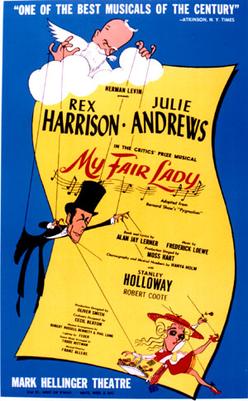
My Fair Lady

My article about the Broadway play My Fair Lady was just published in SHAW: The Journal of Shaw Studies. Today I’m writing a second post about some issues I thought about when I was writing it. (Click here to read the first post.)

I often hear questions about how to make yourself sound smarter and more academic. There’s a widespread belief that if you learn a couple of big words, everyone will think you’re brilliant.

No, no, no. They’ll think you’re pompous and boring.

Writing that article about My Fair Lady it was a challenge: How do you talk to serious scholars about a popular Broadway show? The answer is that you spend a lot of time looking for thoughtful and interesting things to say.

When someone asks me to teach them a couple of big, show-off words, I always try to send them down a different path. “Read,” I tell them. “Read a lot. Learn as much as you can. You’ll always have something interesting to talk about, and people will think you’re smart.”

When I was in high school, I lived in a small town with a small library. I read just about everything that looked interesting – including a biography of two great 20th century actors, Alfred Lunt and Lynne Fontanne. I had no idea then that I was going to become a Shaw scholar. I was reading – for fun – about two famous actors who happened to know Shaw and often appeared in his plays.

Turns out the academic gods were smiling down on me. When I started writing my latest article about Shaw, I remembered a Lunt-Fontanne story that I thought would be a good fit.

But there was a problem. I’d read the book more than 50 years ago. I live in Florida now. No way was I going to head back to Long Island in hopes of finding that biography on the shelf of that library. How on earth was I going to get my hands on it?

I decided to look at biographies of the Lunts on Amazon. Maybe something would ring a bell. And what I discovered was that only one biography had been published – at the same time I’d been in high school. Fist pump! Even better, a used copy cost less than three dollars.

Here’s the story I told in my article:

To maintain control over his plays, Shaw had friends everywhere who kept a close eye on performances. Actress Lynne Fontanne complained, “You could not cut a line without Shaw finding out.” But not even Shaw could control line readings, facial expressions, timing, gestures, and other performance details. In 1926 Fontanne finally discovered a way to alter some of the lines in Pygmalion without being found out. Henry Travers, who played Alfred Doolittle, “had a slight stutter and he had got into a habit swallowing and twisting sentences and words around.” Fontanne tried the same trick when she played Eliza Doolittle—and, she reported afterward, “Shaw’s spies never found me out.”

(I just ran the story through a readability checker. It came in at ninth or tenth grade level. Yes, I practice what I preach!)

Share

Procrastination

I’m a world-class procrastinator. In Jungian terms, I’m a “perceiving type.” When you put a good spin on that term, it means I’m flexible and spontaneous. But if you’re talking about time management, it means that schedules and To Do lists are my kryptonite.

I hate structure, I’m easily distracted, and I don’t have that built-in sense of urgency that productive people (like my husband) seem to have been born with. Writer’s block (the inability to tackle a writing task) is a persistent problem.

When I was teaching, and there was something I absolutely had to cover that day, I used to write my lesson plan on the chalkboard so that students could help me stay on task. It’s so easy for me to wander off! Geez, I could write a book on procrastination. (Actually I have!)

Yesterday was one of Those Days. I put some last-minute touches on a writing project and sent it off. Charlie and I did laundry and took a walk. I had a dance lesson. And that was it for the day. Procrastination was paying me an unwelcome visit.

While I was thinking about it today, it occurred to me that maybe the name we’re assigning to that can’t-get-the-old-engine-started feeling is part of the difficulty.

The first step in curing a disease is to diagnose it. If a physician mistakenly thinks she’s treating a sprain, that broken ankle is never going to get better. Perhaps procrastination works the same way: The only way to move ahead is to figure out what’s going on underneath all that inertia.

Procrastination, I’ve decided, could be many things:

  • “I’m depleted.” (I think this is what was going on with me yesterday. I’d worked hard on a big writing project the day before, plus I stayed up to watch a movie on TV.) The best remedy is to take some time off to recharge and renew our energy. (I like that remedy!)
  • “I’m overwhelmed.” Ninety percent of my procrastination problems seem to start right here – and I’m willing to bet that many other people have the same problem.
    My favorite solutions are a) to commit to doing a tiny part of the task or b) set out to do the task badly, with the idea that I can clean it up later. Both of these strategies usually work for me (except for days like yesterday).
  • “I’m bored.” This is a tricky one, because the word “bored” – like “procrastination” – needs to be unpacked so that we can see what’s really going on. Perhaps you’re trying to tackle a big task all at once instead of breaking it into smaller, more manageable pieces.
    Or maybe you need to incorporate more variety into your daily routine. Maybe a different setting would help (I wrote much of my doctoral dissertation in a coffee shop). Music works great for me and many other people. Pandora’s streaming music service has to be one of the best boons ever to writers.

And maybe the real problem isn’t procrastination – it’s the way we talk about it. Head-beating and chest-thumping about our character defects never accomplishes anything.

Here’s a crazy thought that might be worth pondering: What if there’s no such thing as procrastination? What if it’s only a warning sign that something else in my life needs attention?

Suggestion: The next time you find yourself procrastinating, try to find a different name for what you’re feeling and take it from there.

Procrastination Wiki Commons ok

Share

Powerful Words

Regular visitors to this blog know that I never miss Carolyn Hax’s advice column. Often there’s a bonus – wise advice from a reader.

A few days ago Carolyn Hax offered some sage advice to a woman who was dealing with a  relentlessly negative mother. Moments later, a reader came up with a handy sentence that might work with Mom: “You’ve just made four negative remarks. Now say something positive.”

Feedback is powerful – especially when it’s as specific as this sentence is (“four negative remarks”). It’s a double whammy: Mom realizes that daughter is listening to her – and  recognizes (perhaps for the first time) what she’s been doing.

When I taught writing, I discovered that the most powerful thing I could do for my students was to take them seriously. Even if an assignment was dashed off in a hurry, I read it carefully and said something thoughtful about it. Often it didn’t matter what I’d said. The unspoken message was “I’m paying attention to you.” The next paper was always better.

I think there’s a better than even chance that the daughter is going to see a shift – maybe just a small one, but something – in her mother’s attitude or behavior.

 * * * * * *

I can’t resist making a comment about the headline for this edition of Carolyn Hax’s column: “My mom’s negativity is impacting my mental health.” A grammarian would say that it’s an example of verbing – turning a noun (impact) into a verb (well, a participle – impacting).

Sticklers often grumble about “verbing.” There’s something slippery about a noun that  turns itself into a verb.

Those sticklers have my sympathy. I should add that my husband is forbidden to use impact as a verb. Of course I never do it myself.

But there’s a reason why nouns turn into verbs. One is that people like them and use them again and again. That’s a good enough reason to tone down our disapproval. I will confess that I’m fine with “He medaled” (heard often during the Olympics) and “They’re headquartered in Toronto.” Both medaled and headquartered are examples of verbing.

Another reason is that English words (which lost most of their grammatical endings during the Norman Conquest) can easily move from one function to another. In the following sentences, fancy starts as a noun, turns into a verb, and then becomes an adjective:

The hat took her fancy.

I fancy that hat.

It’s a fancy hat.

Such a lot to talk about in one newspaper column! Language is fascinating, isn’t it?

Advice columnist Carolyn Hax

                             Carolyn Hax

Share

Using a Colon Correctly

Ever wonder how to use a colon? Here’s advice I came across today:

Do not place a colon between a verb and its object or between a preposition and its object.

Correct – but almost useless, in my opinion. You have to label the parts of speech in the sentence you’re writing – something most people haven’t done since high school (if they’ve done it at all).

And it’s telling you what not to do instead of helping you do it – not very helpful!

Here’s a much simpler explanation:

Use a colon only when a sentence stops before a list or explanation.

You can make it even simpler by just listening (inside your head) for that stop.

Here’s a little quiz for you (answers below): Which sentences require colons? (Listen for that stop!)

Stop Sign Wiki Commons

Quiz Instructions: Insert a colon where it’s needed in the sentences below. Not every sentence needs a colon. Answers are below.

1. The kit included twelve packages of yarn, two crochet hooks, and an instruction booklet.

2. Don’t load the car it needs to be moved first.

3.  Here’s what we still need for the party ice cream, plastic glasses, paper plates, and potato chips.

4.  I’m waiting for news about my aunt she had an operation this morning.

5.  This weekend you don’t need to bring linens, silverware, and soap.

ANSWERS

1. The kit included twelve packages of yarn, two crochet hooks, and an instruction booklet.

2. COLON: Don’t load the car: it needs to moved first.

3. COLON: Here’s what we still need for the party: ice cream, plastic glasses, paper plates, and potato chips.

4. COLON: I’m waiting for news about my aunt: she had an operation this morning.

5.  This weekend you don’t need to bring linens, silverware, and soap.

One more point: Should you put a capital letter or a lower-case letter after the colon? Authorities disagree, so you can decide for yourself. Just make sure you’re consistent.

Or ask your instructor, if you’re in school. Or check the style manual for the institution or company where you work. (Or suggest that they create one if they don’t have one yet!)

Share

What Does “Unique” Mean?

My writing group recently had a lively discussion about the word unusual. I’m old school about it. I use unique only when I mean one-of-a-kind. When something is strikingly different, I use unusual instead.

Am I right? That’s the wrong question. Language (despite what English teachers endlessly tell us – remember I’m one myself!) often does not have right/wrong answers. There are only preferences.

Many people use unique and unusual interchangeably, and recent dictionaries give “unusual” as one of the definitions for unique. So you could decide that I’m a fuddy-duddy for trying to keep them separate.

Here’s where I’m coming from. If unique and unusual mean the same thing, we’re losing a useful word from English. Not everything that’s unique is unusual (my fingerprints, for example). And not everything that’s unusual is unique (such as a snowstorm on Easter).

English is (or should be, in my view) a sharp-edged tool. We lose some of that sharpness when words blend together. Here are some other word pairs that are becoming exact synonyms:

  • verbal/oral (verbal means anything to do with words, including writing; oral is only about speech)
  • imply/infer  (imply means to hint; infer is what Sherlock Holmes used to do)
  • notorious/famous  (notorious means famous for evil; famous means well known for any reason)

We’re on our way to losing the precise meanings of verbal, infer, and notorious. There’s no way to stop that train. But I’m committed to holding off the inevitable as long as I can – and that’s why I wrote today’s post.

Share

Latin or English?

My article about the Broadway play My Fair Lady was just published in SHAW: The Journal of Shaw Studies. I’m going to be writing a few posts about choices I made when I wrote the article.

One of the issues I thought about might surprise you: should I use Latin words?

Latin?

The Latin language has long been revered by academic writers. When I went to high school, I was taught to use abbreviations for Latin terms in my references: ibid. (“the same”), loc. cit. (“the same place), et al. (“and the rest”).

But why not just use English? That’s a question many scholars (including me!) started to ask. So I was delighted when the Modern Language Association (which makes reference rules for English scholars) decided to switch to English. (You can learn more at OWL.English.Purdue.edu.)

But the Shaw Journal stubbornly continued to use the Latin terms. &@#$%! I grumbled and argued. The Latin terms stayed.

Finally I quietly started doing my references in English, they way I wanted to. Guess what? The Journal published them that way! Other scholars did the same thing, and – mirabile dictu¹ – now we’re seeing far less Latin than we used to.

But one Latin phrase did find its own into my article. Ars gratia artis means “art for art’s sake.” I used the original Latin term – not an English translation – in my article. Here’s the sentence:

Shaw, hungry for fame and influence, had little appetite for ars gratia artis scruples about commercial success. 

I’m saying that Shaw didn’t go for pure art in Pygmalion (the play that eventually became My Fair Lady). Instead he concentrated on making Pygmalion a commercial success.

So why didn’t I just say so – in English? The answer is that the target readers for the SHAW Journal are Shaw specialists. Close to 100% of them would know what ars gratia artis means: it’s a term that Shaw himself used.

More important, it’s efficient. The phrase ars gratia artis is much shorter than explaining,”In the argument about pure art versus commercial success, Shaw always came down hard on the side of commercial success.” Three words instead of twenty.

There’s a third reason: using ars gratia artis was a signal that I’m an insider in the world of Shaw scholarship. It’s sort of a membership badge.

Let me give you a non-academic example of the same principle. I am an avid ballroom dancer (that’s an understatement). I often talk with friends about how my dance endeavors are going.

When I talk to non-dancing friends, I use ordinary words. There’s no reason to throw around the names of dance steps my friends might not know: chasse, telemark, or rond de jambe.

But when I talk to a teacher or another dancer, it’s much quicker to say “Let’s work on our telemark” than “Let’s practice the fox trot reverse step where I do a heel turn while you travel around me.” One word instead of sixteen.

This attention to who will be reading your work is one of the marks of a professional writer. You’d be surprised how many people don’t think about it!

_________________________________

¹”wonderful to tell”

Jean and her partner dancing

Share

Writing Is under Attack!

There’s a war against writing – and it’s not what you think. The problem isn’t bad spelling or commas running amuck. It’s a growing belief that writing is just one more obstacle you have to clear on your way to a diploma. Once you graduate, you can forget about writing.

How do I know this is happening? I see endless questions on Quora.com about which essay writing service is best. These companies advertise that they’ll do the writing for you so that you’re free to do other, more important things with your time. (Yikes!)

I guess that if you don’t have a lot of life experience, it almost makes sense. When is your boss ever going to ask you to write – say – a comparison/contrast essay?

The truth is that almost every high-paying job requires a lot of writing. Whether it’s heading a large church or running your own business, you need to know how to write well. (Yes, you will write comparison and contrast essays! But they’ll be called “technical writing.”)

Companies pay people to organize, develop, and present ideas and information effectively. It’s called “writing,” and successful people do it almost every day.

Often you need writing skills to get a promotion in the first place. Many companies assign projects to determine which employees are promotable.

Even if you have the leadership skills and know-how they’re looking for, you won’t get anywhere if you can’t handle the paperwork that goes with the project: a proposal, progress reports, a final summary.

That’s why you do so much writing in college. It’s the one takeaway from your education that you will use constantly.

I always tell doubters to make a habit of dropping by the learning center at their school. Here’s what I tell them: “Soon you’ll notice that the same people keep showing up day after day to work with the tutors and use the other resources. Those are the people who will be earning big salaries in a few years.”

Typing on a keyboard

Share

More about Writer’s Block

Here are more ideas about dealing with writer’s block, the bane of every writer.

1.  Know your favorite excuses and escapes, and train yourself to resist them. (Mine is housework. It helps to be married to another writer who understands why you want to avoid the vacuum cleaner today.)

2.  Go for a walk. I know, I know – wouldn’t it be better to stay at your desk and battle it out there? But here’s what those walks always do for me: Before I reach the end of my street, I’m ready to start writing again. There’s something about moving my feet and swinging my arms that gets the ideas flowing.

3.  Use a warm-up activity (preferably one that doesn’t require fancy stuff, like punctuation and elaborate sentences). Here are some that work for me:

  • List the “Journalist’s Questions” (Who? What? When? Where? Why?) on a piece of paper, and then use your topic to scribble answers to each question.
  • Make a cluster (also called webbing and mind-mapping). You draw a circle in the middle of your paper and write your topic in it. Then draw connecting lines and circles as you think of related facts and ideas. This is fun to do and doesn’t require any fancy writing skills. Here’s a sample:
    Mind Map
  • Freewrite. Jot down anything that comes to mind. Some of my best writing has started out this way on table napkins in restaurants or little notepads in hotel rooms.
  • Draw stick figures and get them talking.

Whatever you do, don’t start with the intention of writing something great. Make this your motto: “I can fix it later.” Put something – anything – on paper or onto your computer screen. Before you know it, your writer’s block will be gone!

Share

Writer’s Block

Nothing chills a writer’s soul more than a blank computer screen or an empty sheet of paper. Writer’s block – the bane of every serious writer – rears its ugly head! (Do you get the feeling that I might have had some trouble getting myself started today?)

Fortunately there are lots of ways to get yourself warmed up and on task. I’m going to write about a few of these today, and I’ll offer more next time.

1.  Get into a routine. Choose a time and place to start writing, and follow through every day. It may be tough in the beginning – but soon you’ll have overcome the biggest problem that writers face: Avoidance.

2.  Write something awful. Here’s a story (remember when I said that narratives are great for developing ideas?).

I came home from graduate school with my shoulders drooping and my head hanging because I realized I had enrolled in an impossible course. A research paper was required, and I knew I wasn’t going to be able to come up with anything good. It was the last course in my program, and I’d made it with straight A’s so far – but it wasn’t going to happen this time.

My ever-encouraging husband gave me some sensible advice. “Nobody is ever going to know what grade you got,” he said. “Write about something easy. You’re almost done with your program. Why stress about it?”

The clouds lifted, and I indeed picked an easy topic. Except that something funny happened: I started thinking of little things I could do to make it better – a sharper sentence, an extra reference, a better idea. Gradually I built up steam. In the end I earned (tada!) an A.

I thanked my husband for his helpful advice…and he said, “Do you realize you pulled this same thing with every course in your program?”

Well, no, I didn’t.

Moral of the story: It’s ok to be imperfect. You can always fix it later. Forget what your mother said about “If it’s worth doing, it’s worth doing right.” (Yeah, my mother said that too.)

3.  Get a writing buddy. This is the gold standard of writing advice. Commit to meet at a regular time and place (coffee shops are wonderful). Go ahead and spend a few minutes connecting and chatting – and then get to work.

Click here to read a follow-up post about writer’s block.

writer's block

Share

Be Emphatic!

Thinking about emphasis is a great way to improve your writing. Avoid playing down your ideas and experiences. Don’t start a sentence like this: “This probably isn’t very interesting, but….”

Here are three strategies that professionals use to make their writing more emphatic:

1.  Spotlight the last item in a list. Save the biggest or best for last – and make it sound special or important.

Dinners on our cruise included vegetable lasagna, a curry dish, and perfectly seasoned eggplant parmigiana.  

2.  Spotlight the final supporting idea when you’re making a point. Use most important, best of all, worst of all, or a similar marker. NEVER use last or finally.

Most important, the proposed bill will provide funding for the long-term growth we’re anticipating.  

3.  When you’re writing a paragraph, consider ending it with a closing sentence (a sentence that restates or highlights your point).

After dinner we lingered over coffee to reminisce about highlights from the cruise. Our server returned with endless coffee refills while we talked about the places we’d seen and the special memories we’d be taking away with us. John described tubing through the caverns in Belize. Sharon had all of us laughing as she recounted her shopping adventures. Joe and I talked about the turquoise sea at the Mayan ruins at Tulum. It was an evening I will always remember.  

Paying attention to emphasis is one of the marks of a professional writer – and a great way to add pizzazz to your writing!

Share