Pronoun Problem

Here’s a sentence with a pronoun problem that my husband and I found in the draft of a gardening column he was writing:

Mulch heavily and add to it annually.  INDEFINITE PRONOUN REFERENCE

The it is an indefinite pronoun reference. It doesn’t refer to a specific thing earlier in the sentence.

This might seem puzzling: “It” clearly refers to mulch, and there’s the word m-u-l-c-h four words earlier in the sentence:

Mulch heavily and add to it annually.

Nice try, but wrong. Mulch in this sentence is a verb (action), not a thing.

Here’s how we corrected the sentence:

Apply mulch heavily, and add to it annually.  CORRECT

Share

Understanding Passive Voice

Here’s an instant lesson in passive voice: How to recognize it, why you should avoid it (most of the time), and how to fix it.

The first step is to understand what passive voice is (and what it is not – a problem even for some professional writers). Compare these two sentences:

Jake threw the ball. ACTIVE

The ball was thrown by Jake. PASSIVE

In general, your sentences should tell who did what. Avoid roundabout verbs (is being baked by, was written by):

The cake for the wedding is being baked by Joellen. PASSIVE

Joellen is baking the cake for the wedding. ACTIVE

This essay was written by Jon. PASSIVE

Jon wrote this essay. ACTIVE

Active voice is usually a better choice than passive voice. There are exceptions, however. Sometimes you want to focus on what happened, not the person who did it. Passive voice can be useful in these situations:

Dirty dishes were left in the sink last night. PASSIVE

The money was stolen early Tuesday morning. PASSIVE

Simple enough…or at least it should be simple. Problems frequently arise because writers don’t always identify passive voice accurately.

Don’t be fooled into thinking that every was or is signals passive voice. Compare these two sentences:

Jane was shopping for a wedding gift. ACTIVE

A wedding gift was bought by Jane. PASSIVE

Another warning: Don’t assume that you need to put an active person into every sentence. The examples below are active voice even though they don’t feature active people:

A new way to format the article occurred to me. ACTIVE

That happens to Mary at least once a week. ACTIVE

The software quickly became outdated. ACTIVE

This behavior must stop. ACTIVE

Mom is resting. ACTIVE

Even professional writers sometimes experience confusion about passive voice. Paul Payack declared that Barack Obama was using passive voice when he said, “There will be setbacks.” Not true! Statements beginning with there (there is, there were, there will be) are active voice:

There were three items on the meeting agenda. ACTIVE

There will be no meeting tonight. ACTIVE

Taking a few moments to learn what passive voice is – and, equally important, what it isn’t – can help you ensure that your writing is vigorous and concise.

Jean Reynolds, Ph.D., is a longtime English professor, a Shaw scholar, and the author of eleven published books.

Share

Does the English Language Really Have a System of Rules?

How much do you know about English grammar and English rules? Try this little test. Are these statements always true?

1. “Everybody” is a singular pronoun.

2. Use “who” for people, “that” for things.

3. Double negatives (“don’t have none”) are wrong because two negatives make a positive.

4. “One” is singular, and “five” is plural.

5. It’s wrong to use “good” to modify a verb.

6. Good writers don’t start sentences with “but.”

All the statements are false. Surprised? Let’s take a look.

1. Of course “everybody” is usually singular. But take a look at these two sentences:

Everybody finished early. How did they answer all those questions so quickly?

No one would replace “they” in the second sentence with “he or she.”

The “everybody…he or she” rule goes back to 1795, when a self-proclaimed grammarian named Lindley Murray invented it for a book that went on to become a bestseller.

Before Murray wrote his book (and, some say, messed up a perfectly workable grammatical structure), “they” was a free-floating pronoun that could be either singular or plural. (English, remember, has lost the useful gender-free singular pronouns that many other languages still have.)

“He” became “he or she” in the twentieth century to make English more inclusive. Feminists everywhere (I’m one!) heartily approve that change…but it added a clumsy, unnatural construction to many sentences. Some language experts are encouraging writers to go back to the original “everybody…they” construction that everyone used before Murray came along.

2. Yes, “that” should be reserved for things. For example, The nurse that took care of my sister should be changed to who took care of my sister.

But like many grammar rules, this one doesn’t work every time. Take a look at this sentence:

He’s the only man that I know of who has visited all 50 states.

3. The “two negatives make a positive” argument against double negatives seems to make sense – until you realize that many other languages (Spanish is one) routinely use double negatives, even in formal writing. And if you study Old English, you’ll discover that our language used to have double negatives too.

Why are double negatives ok in Spanish and in Old English, but not in modern English? The answer is that educated people don’t use them. That simple principle is the basis for every rule.

4. Of course “one” is singular and “five” is plural – most of the time. But what about this sentence?

Five dollars is too much to pay for a gallon of gas.

“Five dollars” is a unit, not five separate things, as in this sentence:

Five stores are closing because business has been so slow.

5. Yes, verbs require adverbs (well, -ly words), and nouns require adjectives (good). But not always. Forms of the verb to be and its cousins, the copulative verbs (seem, look, sound, smell, taste, feel) also use adjectives.

Consider feel, which has two meanings. It can be an action (as when you feel for a light switch in a darkened room). But it can also be a form of is (I feel good about my chances for the job).

Note these examples:

The soup smells good.

Your idea sounds good to me.

That color looks good on you.

6. The “you can’t start a sentence with but” rule does not exist and never has. It doesn’t appear in any grammar books – in fact the grammar books themselves feature sentences that start with but. (Did you notice that three sentences in this article start with but?)

Great writers, both old and new, routinely start sentences with but. Check the King James Bible, the Declaration of Independence, the novels of Jane Austen and Charles Dickens, today’s newspaper…any professional writing you have handy. Look at The Elements of Style by Strunk and White and Fowler’s Modern English Usage. Turn the pages of Lynn Truss’s Eats, Shoots and Leaves. You’ll have a hard time finding an author who doesn’t start sentences with but (I haven’t found any yet).

Bottom line: Don’t try to force a sentence to fit into a logical system. Read, read, read. Figure out what good writers do, and use them as models. You’ll soon be on your way to expertise.
Share

Welcome to the Writing Revolution

Welcome to the Writing Revolution! The resources on this website will help you bypass jargon and complicated explanations to start becoming a better writer right away. You can expect to experience two revolutions: One in the content you’ll be learning, and the other in your growth as a writer.

How To Get Started

1.  Scroll down for a lively discussion about various writing topics. These posts change often, so keep coming back!

2.  Look on the right side of this website to find writing resources that deal with issues important to you. Clicking the links will take you directly to the information you’re looking for:

About Jean Reynolds: Jean Reynolds has published 11 books and is
Professor Emerita at Polk State College in Winter Haven, Florida.
She holds a Ph.D. from the University of South Florida and is
an internationally recognized Shaw scholar.
Contact her at jreynoldswrite at aol.com (to prevent spamming, the
actual link is not being published).

Share

Transition Words

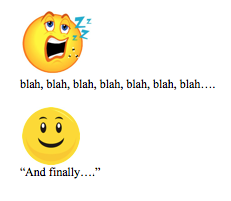
My students often wonder why I forbid them to use the word “finally” in their writing. They think it’s a fine way to transition to the last supporting idea in an essay. (I don’t let them use the word “last” either.)

 The illustration below shows why finally (and its friend last) are poor choices for transition words. Imagine that you’ve been sitting through a long speech, class, or sermon. You hear the speaker begin a sentence with “finally.” What is your immediate reaction? Hooray! It’s almost over!

Professional writers never use finally to introduce a point, for a very good reason: Finally evokes that “It’s over!” reaction. You want your readers to focus on the point you’re making. The pros save their best example or supporting idea for the end, and they introduce it with a phrase like most important, best of all, worst of all…you get the idea.

Why not start writing like a professional now?


Share

The Indefinite Pronoun Problem

I came across a troublesome sentence as I was reading Secrets and Wives, a book about polygamy by Sanjiv Bhattacharya. The author is discussing Sister Wives, a TLC reality show about Cody Brown and his polygamous family:

When the Utah authorities threatened to charge Brown with bigamy after the show aired, it merely encouraged the cable network to book them for a second season.  AWKWARD

A copyeditor should have fixed that sentence. The problem is it, an ordinary word that can cause immense problems.

Let’s reread the sentence up to it merely encouraged. Notice what your brain is doing while you’re reading:

When the Utah authorities threatened to charge Brown with bigamy after the show aired, it merely encouraged

Here’s what I was thinking: The Utah authorities encouraged….

Wait a minute! The Utah authorities weren’t encouraging the Browns to prosecute polygamy. And Utah authorities is plural. You can’t refer to them as it. What’s going on here?

Backtracking to the beginning of the sentence, I started over, more slowly. Aha! It in this sentence is a vague word that doesn’t refer to anything–as if you said “It’s raining.”

Bad writing. You shouldn’t have to read a sentence twice to figure it out. And here’s a more important principle: A sentence should state who did what. In this sentence about the Browns, The Learning Channel decided to renew the show for a second season. Say so!

Here’s a better version of the sentence (notice that I’m using one of my favorite tricks for fixing awkward sentences: Make it two sentences).

The Utah authorities threatened to charge Brown with bigamy after Sister Wives aired. Instead of backing away from the controversy, The Learning Channel responded by renewing the show for a second season.  BETTER

Grammarians have a name for the problem we’re discussing: indefinite pronoun reference. Here’s a simple way to avoid the problem: Always make sure that it refers to something specific that you’ve already named.

(To learn more about using “it” in a sentence, click here.)


Share

Happy National Writing Day!

In honor of National Writing Day, here’s a quiz to challenge you – along with some thoughts about the rules that govern correct English. Warning: You may encounter some surprises as you read on!

How much do you know about English grammar? Try this little test. Are these statements always true?

1. “Everybody” is a singular pronoun.

2. Use “who” for people, “that” for things.

3. Double negatives (“don’t have none”) are wrong because two negatives make a positive.

4. “One” is singular, and “five” is plural.

5. It’s wrong to use “good” to modify a verb.

6. Good writers don’t start sentences with “but.”

All the statements are false. Surprised? Let’s take a look.

1. Of course “everybody” is usually singular. But take a look at these two sentences:

Everybody finished early. How did they answer all those questions so quickly?

No one would replace “they” in the second sentence with “he or she.”

The “everybody…he or she” rule goes back to 1795, when a self-proclaimed grammarian named Lindley Murray invented it for a book that went on to become a bestseller.

Before Murray wrote his book (and, some say, messed up a perfectly workable grammatical structure), “they” was a free-floating pronoun that could be either singular or plural. (English, remember, has lost the useful gender-free singular pronouns that many other languages still have.)

“He” became “he or she” in the twentieth century to make English more inclusive. Feminists everywhere (I’m one!) heartily approve that change…but it added a clumsy, unnatural construction to many sentences. Some language experts are encouraging writers to go back to the original “everybody…they” construction that everyone used before Murray came along.

2. Yes, “that” should be reserved for things. For example, The nurse that took care of my sister should be changed to “who took care of my sister.”

But like many grammar rules, this one doesn’t work every time. Take a look at this sentence:

He’s the only man that I know of who has visited all 50 states.

3. The “two negatives make a positive” argument against double negatives seems to make sense – until you realize that many other languages (Spanish is one) routinely use double negatives, even in formal writing. And if you study Old English, you’ll discover that our language used to have double negatives too.

Why are double negatives ok in Spanish and in Old English, but not in modern English? The answer is that educated people don’t use them. That simple principle is the basis for every rule.

4. Of course “one” is singular and “five” is plural – most of the time. But what about this sentence?

Five dollars is too much to pay for a gallon of gas.

“Five dollars” is a unit, not five separate things, as in this sentence:

Five stores are closing because business has been so slow.

5. Yes, verbs require adverbs (well, -ly words), and nouns require adjectives (good). But not always. Forms of the verb to be and its cousins, the copulative verbs (seem, look, sound, smell, taste, feel) also use adjectives.

Consider feel, which has two meanings. It can be an action (as when you feel for a light switch in a darkened room). But it can also be a form of is (I feel good about my chances for the job).

Note these examples:

The soup smells good.

Your idea sounds good to me.

That color looks good on you.

6. The “you can’t start a sentence with but” rule does not exist and never has. It doesn’t appear in any grammar books – in fact the grammar books themselves feature sentences that start with but. (Did you notice that three sentences in this article start with but?)

Great writers, both old and new, routinely start sentences with but. Check the King James Bible, the Declaration of Independence, the novels of Jane Austen and Charles Dickens, today’s newspaper…any professional writing you have handy. Look at The Elements of Style by Strunk and White and Fowler’s Modern English Usage. Turn the pages of Lynn Truss’s Eats, Shoots and Leaves. You’ll have a hard time finding an author who doesn’t start sentences with but. (I haven’t found any yet.)

Bottom line: Don’t try to force a sentence to fit into a logical system. Read, read, read. Figure out what good writers do, and use them as models. You’ll soon be on your way to expertise.

Share

Editing Two Sentences

Both today’s newspaper and yesterday’s featured sentences with interesting errors. Why do I find them interesting? They’re mistakes that only sophisticated writers make – people trying so hard to get it right that they end up getting it wrong.

The first sentence comes from, Andres Oppenheimer’s October 12 column about Mexico’s political gridlock:

A group of 46 high-profile Mexican politicians and academics from across the ideological spectrum shook this country earlier this week with a daring proposal to end Mexico’s political gridlock: forcing whomever is elected president in 2012 to form a coalition government.

Did you spot it?

The problem is whomever. (Sigh. Any time you come across the word whomever, you can just about guarantee that it’s the wrong word.)

Use the “he for who, him for whom” system. (Try plugging he and him into the sentence you’re working with. If he sounds better, use who or whoever. If him works better, use whom or whomever).

Let’s try it:

…he is elected president in 2012

(You wouldn’t say “him is elected president in 2012,” would you?)

So who (or whoever – same thing) is correct. Here’s the corrected sentence:

A group of 46 high-profile Mexican politicians and academics from across the ideological spectrum shook this country earlier this week with a daring proposal to end Mexico’s political gridlock: forcing whoever is elected president in 2012 to form a coalition government.  CORRECT

Now let’s look at the other problem sentence. This one is from an article about Legoland, a new theme park that opened in Central Florida today. Here’s a sentence about The Ford Driving School, an activity that children are sure to enjoy:

It’s one of the few rides in Central Florida that puts children in full control of their ride experience.

Did you spot the error in this one?

“Puts” should be “put.” Here’s the corrected sentence (notice that it’s rides, not ride, that put children in full control):

It’s one of the few rides in Central Florida that put children in full control of their ride experience.  CORRECT

If you’re having doubts, compare the two sentences below:

It’s one of the few rides in Central Florida that put children in full control of their ride experience. (This sentence is about rides, so put is correct)

It’s a ride in Central Florida that puts children in full control of their ride experience. (This sentence is about a ride, so puts is correct.)

Editors beware! Sometimes it’s all too easy for errors to creep in when you least expect them.

Share

Can You End a Sentence with a Preposition?

Can you end a sentence with a preposition? I love Winston Churchill’s answer: “That is something up with which I will not put.”

Despite Winston Churchill’s dismissal of this grammatical nonsense, most of us have had an English teacher or two warn us about putting a preposition at the end of a sentence:

I haven’t decided whom I’m going to the prom with.  AWKWARD

I haven’t decided with whom I’m going to the prom.  AWKWARD

You can see the difficulty: Both versions are clumsy. If you’re aiming for a sentence that sounds natural, you might have to start over:

I haven’t decided who’s going to the prom with me.  BETTER

Instead of worrying about that preposition at the end, we might all be better off if we tried for the smoothest, most natural wording.

Another difficulty is that many common prepositions can also act as adverbs: off, up, out, on. Even the strictest grammarian would say you’re allowed to end a sentence with an adverb. So it’s perfectly ok to end a sentence with, say, the word out if it’s used as an adverb – but woe betide you if out (the same word) is acting as a preposition.

As soon as it stops raining, I’m going to take the dog out.  BAD: out is a preposition.

Janice is in the hospital, so I’m going over to her house to help out.  GOOD: out is an adverb.

Do we really need to spend our precious time making judgments about these hairsplitting distinctions?

Here are some phrases that seem to contain prepositions but actually end in adverbs and are acceptable at the end of a sentence:

sign uplog oncheer upcarry on, step downback up

Bottom line: Use your ear to decide whether a sentence is awkward and needs rewriting. And – if you live in the Deep South – remember that ending a sentence with an unnecessary at (“Where’s Jimmy at?”) isn’t appropriate for formal writing. Stick to “Where’s Jimmy?”


Share

Etc. Usage

How do you use etc. correctly?

Simple answer: don’t.

Etc. usage isn’t complicated. Etc. is not an effective shortcut in formal writing. (Of course it’s perfectly all right for something informal, like an email or a letter. If you do use etc., make sure you don’t stick “and” in front.)

This isn’t just a silly rule made up by a bunch of cranky English teachers with too much time on their hands. Etc. betrays sloppy thinking. (It’s also misspelled much of the time: ect. Sigh.)

Etc. is an abbreviation for the Latin et cetera, “and the rest.” (Thinking about the Latin phrase will help you spell etc. correctly every time. And it will help you remember to avoid that extra and – the et takes care of it.)

And that’s where the problem lies. In formal writing, you can’t just let a sentence trail off into vagueness that way. The rest of what?

Here’s an example I came across recently. The topic is the history of PEN (an organization of Poets, Essayists, and Novelists founded in 1921):

The acronym derives from Poets and playwrights/Editors/Novelists, but today the organization includes critics, translators, journalists, etc.

Many readers (I’m one) would like to know who else is eligible to join PEN. A songwriter? A ghostwriter? A rapper? What about someone who doesn’t write plays but directs them?

Here’s how the sentence might be rewritten:

The acronym derives from Poets and playwrights/Editors/Novelists, but today the organization includes critics, translators, journalists, and others who are paid for their writing.  BETTER


Share