Help for Ambitious Writers Part 2: Plagiarism

Some years ago a friend excitedly told me that a self-publishing company was helping her write a book. Among the services she paid for were copyediting, formatting, and publicity.

Although a team of experts was hard at work getting her manuscript ready, she gratefully accepted my offer to take a look at it. When I read it, I was shocked at the issues the copyeditor had overlooked. More seriously, my friend unknowingly was guilty of a copyright violation. No one on the team was concerned that she hadn’t sought permission to copy a large chunk of a piece published by another writer. She thought crediting the author was sufficient.

The story had a happy ending: My friend obtained permission, didn’t go to jail, and ended up with a successful book.

Her experience came back to me last week in a newspaper story about a school district superintendent who’s been accused of plagiarism.

In 2014, Alachua County Superintendent Owen A. Roberts self-published a book called A Framework for Improving School Systems in the 21st Century. He very properly listed his sources at the end.

But there are no attributions in the actual text of his book. Readers don’t know who created the charts and collected the data. There are no quotation marks around the paragraphs copied from other writers.

Simply put, Roberts is guilty of plagiarism – and he may also have violated copyright law. His self-publisher, Xlibris, didn’t talk to him about these issues.

Does it make any difference? Hell, it makes a lot of difference.

The legal problem should be obvious. Copyright violations can lead to lawsuits, sizable fines, and jail time.

But there are other difficulties. Publishing history is full of stories of mistaken facts and falsified research. (For example, I’ve read almost every book about the infamous Lizzie Borden murder trial, and the misinformation I’ve found is astounding.) For that reason, sophisticated readers want to know who did the research and who vetted the data. Sometimes they want to check the sources themselves. They may also want to know where a chart or quotation came from so that they can use it in their own work. And they may simply want to read another article or book about a topic that interests them. 

Roberts, who holds a doctorate in educational research and evaluation from the University of Miami, is bewildered by the uproar. “I didn’t know there were academic norms at all,” he said.

He has been the Alachua County schools superintendent since July 2014. The district has a clearly stated plagiarism policy:

“All materials taken from a source that duplicates or approximates the wording used on that source must be placed in quotes or otherwise set aside as quoted material,” the document states. “Direct reference must be made to the source within the text or through the use of footnotes or endnotes. Failure to fulfill this requirement is plagiarism.”


What does this mean to your own writing projects? You need to educate yourself about copyright, fair use, and plagiarism. There’s plenty of information online, and librarians can help. If you have a complicated question about information you want to copy, you should consider hiring an attorney.

Yes, you can copy snippets of another person’s work without permission (it’s called “fair use”). But anything larger than a “snippet” requires written permission and – in many cases – payment. I’ve paid hundreds of dollars to use comic strips, paragraphs, and essays in my published work.

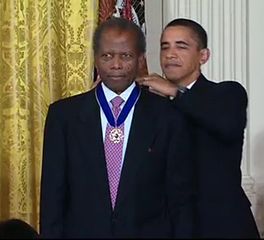
I have a marvelous permissions story to tell you about Sidney Poitier (a superb actor and a great and generous man). It will be the subject of my next post.

do-not-copy-Pixabay

Share

Help for Ambitious Writers Part I: House Style

So you want to get published – wonderful!

Perhaps you’ll fill a writing position for a publisher – or you’ll get a contract to write a book – or you’ll self-publish one. Maybe (like me) you’ll be lucky enough to do all three during your career.

Will you be ready? High school and college writing courses don’t always teach you everything you need to know. This week I’m writing two posts about the larger world of professional writing. Today’s topic is house style – policies that a publisher adopts to ensure consistency about various issues:

  • Which is correct: ok, okay, OK, or O.K.?
  • Should it be a.m., AM, or A.M.?
  • Should you use a capital or lower-case letter after a colon?
  • Is it healthcare, health-care, or health care?

The answer to all of these questions is…it’s a matter of preference. And that’s where copyeditors and house style come in.

My friend Charles Warren is a fine writer and the author of the one of the best young people’s novels I’ve ever read – Address Unknown. (If you know a youngster who likes to read, buy a copy as a gift.) Yesterday Charles sent me the link to a short TED talk by Mary Norris, copyeditor for the New Yorker magazine – meaning that she ensures that every article follows the guidelines for the magazine’s house style.

The video is less than 10 minutes long and well worth watching. It gives you some interesting examples of what good writers (and editors) think about when they prepare a written piece for publication. A bonus is that you’ll pick up some of the terminology that editors use.

Let me also recommend Norris’s wise (and very funny) book Between You and Me: Confessions of a Comma Queen. Her stories (some about working on a dairy farm) are hilarious – and you’ll also learn a lot about writing and editing your work. It’s a book I plan to read again.


Share

Libraries

Take a look at this post I saw on Facebook a few days ago:

Libraries Relevant

I love libraries, I’m glad Facebook users are supporting them, and I reposted the message myself.

But this message is an example of the traps built into our language. The phrase “no longer relevant” raises doubts in the same instant that it tries to dispel them.

If that seems crazy to you, think about this scenario: A man is leaving on a business trip. He kisses his wife and says, “There’s a myth going around that men have affairs at these conferences. Honey, that’s not true, and you don’t have a thing to worry about.”

Gulp.

Language is a highly useful tool – but it’s also a slippery one.

Share

The Holy City

True story.

My friend Joan and some Catholic friends were praying for a priest friend, Father John, who was making a trip to the Holy City. “It’s such a volatile part of the world,” Joan said. “I don’t know why he would go to Jerusalem now.”

Eventually Father John returned to the parish safe and sound. When the women told him about their prayers, he responded with a hearty laugh – the Holy City was New York!

I’m with him on that. I’m preparing for my own trip to New York next week, and of course I’m excited. Friends have been asking me about the trip (a Broadway play, a ballet, two art exhibits, and more). Often their parting words are “Be safe!” It’s a mantra that’s supposed to reassure me, but instead my brain starts to conjure up the opposite of safe – images of a mugger, gunman, or plane crash.

Blame language. So often we fashion a string of words to convey a particular message – only to discover that a shadow message has joined it.

You tell a friend how attractive she looks today, and she worries about what she looks like the rest of the time, or – worse – reports you for sexual harassment.  You tell a child that there’s nothing to be scared of at the amusement park – and she panics and has to be taken home. You warn a teenager about the enticements of street drugs  – and hear yourself listing all the reasons for experimenting with them.

I had a life-changing moment in graduate school when I heard my mentor, Richard F. Dietrich, make an offhand remark about Bernard Shaw: “I think of Shaw as a writer struggling with language.”

I was bewildered. In my mind, world-class authors didn’t struggle with language: That was a problem for college freshmen. That remark set me on a quest to figure out what this “struggle” might be. Slowly I began to see that Shaw indeed was a man struggling with language – and that he came out on the losing side of more than one battle.

We all do.

I’m planning some posts about the potholes and roadblocks that we’re likely to stumble over as we tackle a writing task.

But there’s no time for that right now because I need to pack a suitcase. I’ll be returning to this topic in future posts.

Times Square

                                   Times Square


Share

Fighting the Trend

In my recent post about Harriet Tubman and Andrew Jackson, I deliberately made an error  – at least in the minds of some editors:

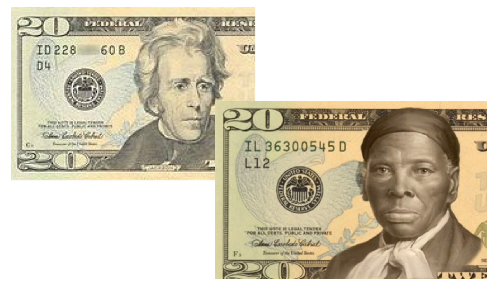
Many progressives are pleased that the Treasury Department decided to replace President Andrew Jackson’s picture with Harriet Tubman.

What’s the mistake? I didn’t use that of:

Many progressives are pleased that the Treasury Department decided to replace President Andrew Jackson’s picture with that of Harriet Tubman.

Here’s the reason. I hate that of. It’s clumsy, I distrust it, and I refuse to use it. I’ve lived a long life, and I have a sharp eye. I don’t recall seeing the irritating that of very much in the past. I think it’s a recent fetish, and I refuse to sign on.

(Some of you may be thinking that there’s an alternative that bypasses the problem, and you’re right: Many progressives are pleased that the Treasury Department decided to replace President Andrew Jackson’s picture with Harriet Tubman’s. That was actually my first version – but then I wouldn’t have had a jumping-off point for today’s post!)

Back to that of. Here’s a typical example that sets my teeth on edge:

The monthly condo fee in Springside is higher than that of Rosedale.

Here’s an alternative that I like better:

The monthly condo fee in Springside is higher than Rosedale’s.

But some authorities forbid this usage on the grounds that buildings are inanimate and can’t be owners. A pox on them. People use possessives that way all the time:

The building’s exits need to be clearly marked.

If objects can’t be owners, there would be no need for a possessive form of it:

My favorite blouse is missing one of its buttons.

The rules of English usage – as I never tire of saying – are created by the people who actually use the language. Don’t let anyone use a convoluted logical principle to talk you into adopting an awkward construction.

The Association Fallacy in Formal Logic

         The Association Fallacy in Formal Logic


Share

Andrew Jackson or Harriet Tubman?

Who should be featured on the new $20 bill – Andrew Jackson or Harriet Tubman?

Many progressives were pleased when the Treasury Department decided to replace President Andrew Jackson’s picture with Harriet Tubman. Eugene Robinson, columnist for the Washington Post, is one writer who favors the change.

(Allow me a detour for a moment: Robinson’s column is an example of stellar writing. That’s not surprising, since Robinson is a Pulitzer Prize winner. If you read the column, you’ll learn not only about Tubman and Jackson, but also about writing.)

Tubman was an escaped slave who returned to the South to lead 70 other slaves to freedom. During the Civil War, she led a raid on plantations along the Combahee River that freed more than 750 slaves. Robinson says she was probably “the first woman to lead U.S. troops in an armed assault.”

Now let’s turn to Andrew Jackson. Before he became President, he was a military hero who won the pivotal Battle of New Orleans. But he was also the driving force behind the “Trail of Tears” that robbed thousands of Native Americans of their tribal lands and – in many cases – their lives.

Robinson calls that undertaking “genocidal.” But a number of commentators feel that Jackson’s military success and Presidential accomplishments more than offset the harm wrought by the Trail of Tears – former Presidential candidate Patrick J. Buchanan, for example. (I was appalled by his column, but I’m providing the link so that you can read it yourself.)

This blog is about writing, not history, so I’m going to change my focus here and explain why I’ve been thinking about the Tubman vs. Jackson debate in the context of writing. What interests me is the link to a thorny issue – modes of development.

If you take a college composition course, at some point you’ll study modes of development: Narrative, Comparison/Contrast, Definition, Process, Classification, and Cause/Effect. The model paragraphs and essays in your textbook will probably be lists of boring information: The steps in changing the oil in your car. The differences between sports cars and sedans.

Most textbooks don’t provide the slightest clue about why you’re studying these modes and how they apply to real-world writing. The fact is that very few workplace tasks call for a specific mode. Yes, you might be asked to write a narrative about a business trip, or a comparison/contrast report about new models of copy machines. But most people I’ve talked to say they rarely use modes of development the way they’re taught in schools and colleges.

So the modes are a waste of time, right? Wrong! Modes of development are highly useful if you combine them. If you’re defending – say – the decision to feature Harriet Tubman on the new $20 bill, you could include a narrative paragraph (the story of her life), a comparison paragraph (stacking Tubman against other historical figures), and a contrast paragraph (demonstrating why her accomplishments matter more than Jackson’s).

Many workplace writing projects can benefit from a similar integration of various modes. Sadly, though, few textbooks encourage students to take that step.

It takes time to develop skill with these modes, but the investment in time and energy will pay huge dividends. Start learning about them, and start looking for them in your everyday reading. You’ll be surprised how useful they are – and your own writing will benefit.

$20 bill


Share

We the People…

Today you’re getting a bonus – two bonuses, in fact. My primary objective is to clear up an apostrophe issue with the word people. You’ll also get a linguistics lesson, and you’ll learn an unusual rule about plurals.

I’m going to begin with a tale from my early days as a college English instructor. A major publisher had just issued the first edition of a comprehensive English handbook that is still in print, many editions and millions of copies later.

And there, in an example box, was a sentence containing the word peoples’. Gack: The apostrophe should have been before the s – people’s. And this in an English handbook!

Nobody – not the author, the editor, or the copyeditor – caught the mistake. It was too late for the publisher to do anything about it: The book had already been printed and distributed. (The mistake was corrected in the next edition.) 

You don’t have to be clairvoyant to figure out how that mistake happened. Apostrophes are usually (and stupidly) taught with a rule that goes like this: “Before the s if it’s singular, after the s if it’s plural, but before the s if it’s a special plural – a plural that doesn’t end with s, such as men, women, children, and people.

Of course many people (ha!) immediately forget about those special plurals, and that’s how we end up with mistakes like “childrens’ health” and “Dr. Reynold’s office.”

There’s an easier way. Just spell the word or name, and put the apostrophe after the last letter. This trick will work 100% of the time.

Dr. Reynolds – Dr. Reynolds‘ office

children – children‘s health

people – people‘s wishes

But some of you whose knowledge of English is deep and broad are protesting that peoples’ wishes can be correct in some circumstances. You’re right!

Anthropologists use people to signify the members of a nation, community, or ethnic group. A diverse country or region would be inhabited by various peoples. So, for example, you could talk about “the peoples of Australia.”

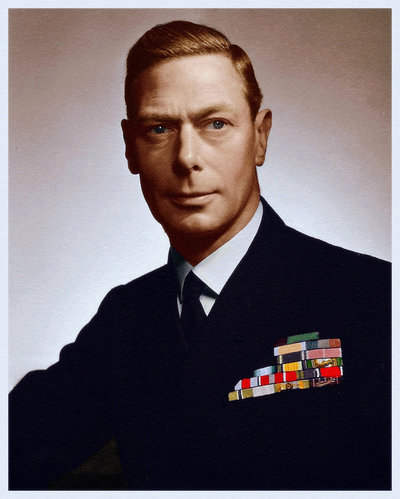
If you’re a royalty fan, you probably remember a famous story about King George VI (father of the present Queen) and an exchange with some of his subjects during the Blitz. On one of his visits to a bombed-out neighborhood, someone called out, “Thank God for a good king!” His quick-thinking response was, “Thank God for a good people!”

Most of us would have said “Thank God for good people” – but his choice of a good people reinforced the idea of British unity.

Back to peoples. Scientists often use plurals to signify diversity. If you keep goldfish in an aquarium, they’re fish. But if the tank holds several species – angelfish, tetras, and gouramis – they’re fishes.

One topic remains: That lesson in linguistics I promised you.

The Elements of Style by Strunk and White contains this astonishing injunction (which I’m going to debunk in a moment):  “The word people is not to be used with words of number, in place of persons. If of ‘six people’ five went away, how many ‘people’ would be left?”

There’s some linguistic history behind this silly rule. Our word people traces its origin back to the Latin word populum (“the population”). Clearly populum can’t be used with a number. The proper Latin word for an individual is persona. So it makes sense that you can’t talk about “six people.”

Except that you can.

The golden rule for language is that rules are made by the people (persons?) who use that language. If you do a Google search, you’ll discover that professional writers use people with a number all the time. Here’s an example from a March 1 article in the Washington Post:

Six people were shot and wounded — one of them critically — in Southeast Washington on Monday afternoon and early Tuesday, according to D.C. police.

If you check the Oxford English Dictionary, which traces the history of words in English, you’ll discover that writers have been using people with a number as far as Chaucer.

But what about that etymology problem? The answer is that a word’s origin doesn’t determine its meaning: Common usage does. Think of the word manuscript, for example. The original Latin means “written by hand.” But if you submitted a handwritten manuscript to a publisher today, it would be unceremoniously tossed in the trash.

I hope you enjoyed today’s triple lesson (and the nod to royalty!).

King George VI

    King George VI

Share

The “Because” Problem

Charlie used to have an editor who hated the word because. If because made its way into one of his gardening columns, she would call and ask him to change it. Luckily, after a short period she was promoted to a more important editorial position where she could presumably inflict her misinformation on an even larger group of writers. 

Because is a useful word, and a few minutes with a dictionary or Google could have cleared up that misguided editor’s mistake.

Where did her phobia come from? Very likely she’d had an English instructor who made the sensible observation that because ideas can be confusing. But that doesn’t mean you have to banish because from your writing. The remedy is to double-check the sentence for clarity.

I started thinking about the because problem this week when a confusing sentence popped up in an email I was writing. Oops! Here it is:

Charlie does as much of the palm pruning as he can even though a landscape crew comes every week because workers tend to butcher the trees.

Technically it’s a dangling modifier, sounding as if the crew comes every week because the trees are butchered. Wrong!

After some experimentation I came up with this solution:

Even though a landscape crew comes every week, Charlie does most of the palm pruning  himself. Workers tend to butcher the trees and can’t be trusted to do the job properly.

Here’s some writing advice you might find helpful: When a sentence is fighting all of your attempts to fix it, try rewriting it as two sentences. Often that trick works like magic.

And here’s some advice if you own palm trees: Never cut off a green or yellow leaf – and don’t allow landscape workers to cut off those leaves either. You can learn more here.

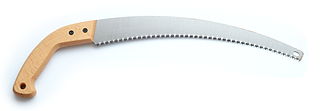
pruning saw Commons

Share

Updates

My friend Lois Smith had some interesting responses to two recent blog posts.

You may remember that I asked my husband to rescue a lizard that turned out to be a carpet stain in a hallway. I was impressed that Charlie made a connection to military camouflage, which often tries to make something flat look three dimensional.

Lois made another connection – to facial recognition, which she says “is why we see things in the dark, and in ink blots – see two women in hats, facing each other in that famous illustration, etc.  So I’m thinking our facial recognition slips over to other recognitions, like lizard stains.”

Intriguing! Thanks, Lois.

Lois also had some thoughts about a grammar issue I discussed in a recent post. I was comparing these two sentences:

The arena is big.

The arena is west of here.

In the first sentence, big is an adjective modifying a noun – arena. But in the second sentence, west is an adverb. Adverbs don’t modify nouns. What’s going on here?

Lois dug into her memory bank and came up with the term predicate adverb from grammar lessons in elementary school.

I looked it up, and Lois is right – but it seems to be a questionable term. Most grammar websites don’t mention it.

Here’s what I think happened: At some point a grammarian noticed this anomaly – an adverb with a copulative verb. Aughhh! Formal grammar doesn’t allow anomalies. And so the term “predicate adverb” was invented to cover this situation.

To put it another way: Language – not grammar – is primary. I suspect that many hallowed grammar rules were invented by grammarians trying to cover gaps in their theories.

There’s a lesson here for all of us: Language – not grammar categories – should always be our first priority.

And now I want to veer off to another topic: Feedback. Writing posts for this blog has show me again and again how important it is for writers to have a living, responsive audience (and not just a copyeditor or teacher who makes corrections).

Feedback for this blog shows up in the Comments section and in responses from friends in conversations and emails. Even though I have a plugin that gives me detailed statistics about activity on my blog, there’s nothing like a thoughtful response from a real, live reader.

You’re reading this post because you’re a writer. Who regularly gives you feedback? If the answer is “no one,” please find a support group!

compass-32477_640

Share