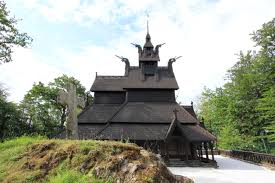
Fantoft Stave Church

My sister and I set out this morning for a stave church in Bergen – and it was a thrill to see it at last.

And exhausting and nerve-wracking. We followed some bad advice and ended up walking (mostly uphill) for half an hour – it was supposed to take 10 minutes – and no stave church in sight. We flagged a woman driving slowly down a side street and asked if she knew where it was. “It’s too far for you to walk,” she said. “I’ll take you there.” 

And she did!

My thanks to everyone who sent positive energy our way. Bergen gets rain 300 days of the year, and it poured twice today – both times while my sister and I were indoors.

Fantoft

Share

Kristin Lavransdatter

My sister and I are on a ship somewhere off the west coast of Norway. Tomorrow we will dock at a pier in the Norwegian city of Bergen and take a tram outside the city limits to visit a uniquely Norwegian building called a stave church.

I have been thinking about this trip for more than fifty years.

In high school I read – and reread – a novel called Kristin Lavransdatter, written by Norwegian writer Sigrid Undset. It’s the story of a woman who lived and loved in 14th century Norway.

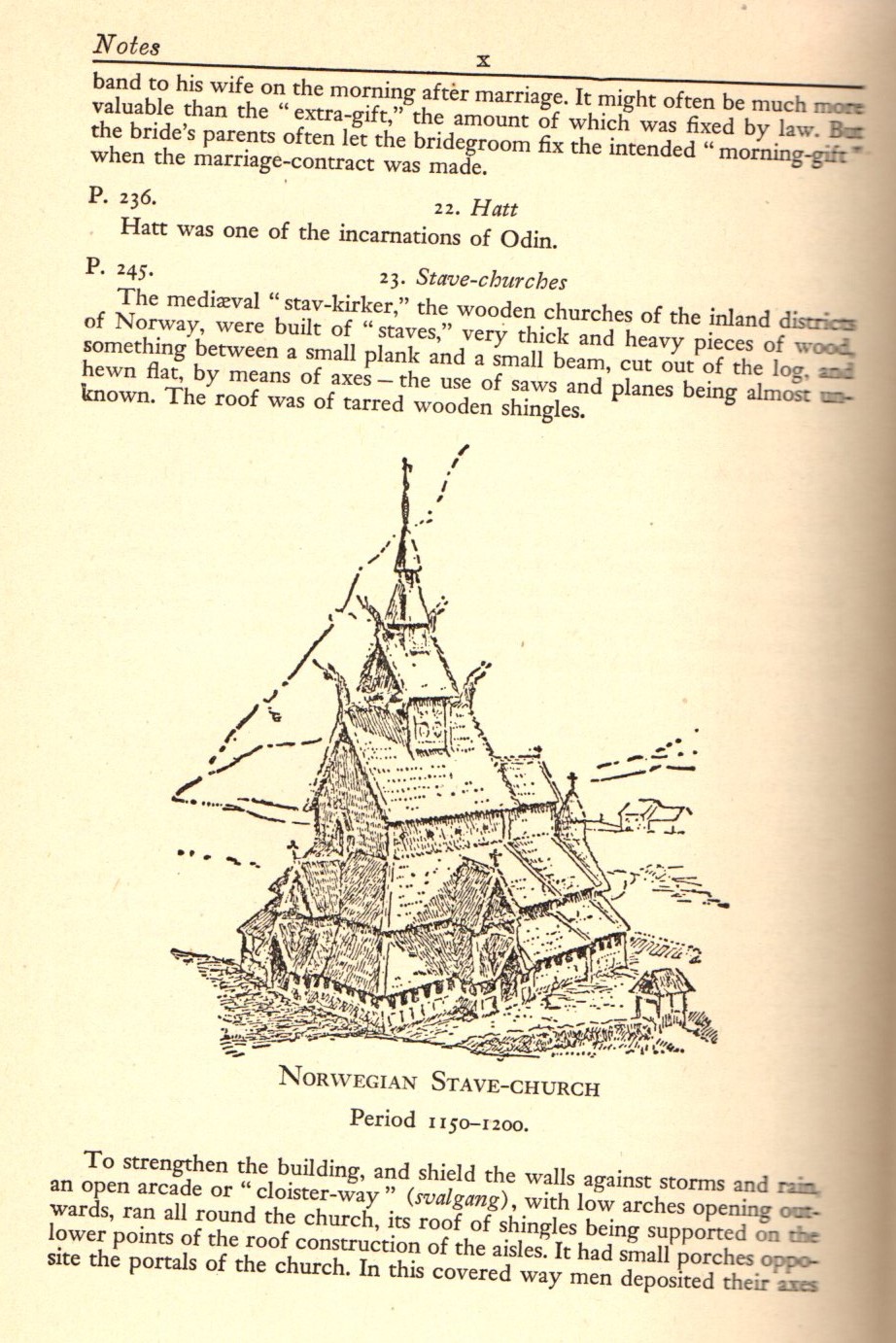
Undset, the daughter of an anthropologist, researched the historical period so thoroughly that there are endnotes at the end of each of the three volumes. (It’s a long book!) One of those notes describes a stave church that figures in the novel, and that’s where the determination to make this trip was born.

What I can’t explain – not even to my sister, who probably knows me better than anyone else – is why we’re making this pilgrimage.

It’s not that I think I’ll find Kristin and her family sitting inside the church when I open the door. I don’t need to. I already know them on a far more intimate level than I know many of my relatives and friends. No one will ever convince me that the people in the novel – Kristin, Erlend, her parents, and her children – are just fictional people.

Somehow – and I know how crazy this is – I feel an obligation to honor them by spending at least a few minutes in their world – for example, by opening the door to a stave church. 

And I’m far from the only person who feels such a strong connection to this novel. Kristin Lavransdatter won a Nobel Prize in 1928, and Sigrid Undset is such an important writer that she’s pictured on Norway’s currency.

So I’m not going to do a literary critique today. Instead I’m going to make an impassioned plea for all of us to have an encounter with a story, book, poem, or play that we can’t shake off afterwards. It doesn’t even have to be something brilliant or profound. I saw Nathan Lane and Matthew Broderick in The Producers on Broadway, and for a month I was lost in the New York of Max Bialystock and Leo Bloom.

I want everyone to have an experience like that, and there’s something else. I want all of you, the writers who read this blog regularly, to commit yourself to making that happen for someone else.

When I taught literature, I used to ask my students to do a presentation about a literary work that moved them. “Literary” could (and did) mean works as diverse as the Star-Spangled Banner, a rap song, a children’s book, or a Hollywood thriller. Some of those presentations were amazing, and I still think about them.

My own contribution was to read aloud (with my New York accent – sigh) Dylan Thomas’s “Fern Hill.” We never analyzed it. I just wanted students to hear the words. And for days aftewards I would hear inside my head, again and again, “And I sang in my chains like the sea.” (Some of my students told me that similar things used to happen to them after a class meeting.)

If you can hold tightly onto a line of poetry, or a snatch of a song or a story, you can start to find ways to use words to connect deeply with others. Please think about that – and don’t worry if it seems strange and difficult. On some level the doors will begin to open, and you’ll embark on an extraordinary journey – similar, in its own way, to what I’m experiencing as I wait for tomorrow to arrive.

Stave Church


Share

Shirley Jackson

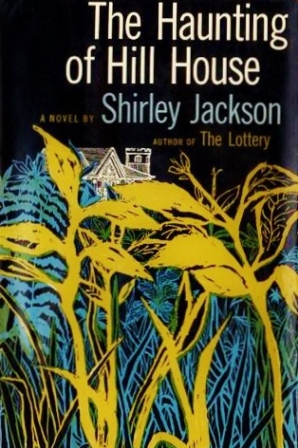
Last October I was listening to my car radio on the way to a dance lesson. I heard an intriguing teaser for an upcoming broadcast of the Diane Rehm Show: A panel of readers would be discussing a classic horror novel. “Please, PLEASE,” I said to the radio. “Let it be The Haunting of Hill House.”

It was.

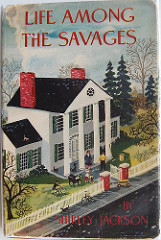
The Haunting of Hill House belongs to a genre I don’t usually read. But it also belongs to a genre (if you can call it that) I always read: books by Shirley Jackson. When I was in high school I read and reread her hilarious reminiscences about her family: Life Among the Savages and Raising Demons.

But here’s the thing. No one I know (except my older sister, who first brought Life Among the Savages home from the library) has ever mentioned reading anything of Jackson’s except her shocking short story “The Lottery,” which I read for the first time in high school. Not long after that I read The Haunting of Hill House and was absolutely terrified – the most frightened I’ve ever been by a book. But nobody else I know has ever mentioned it (not even the aforementioned sister).

So hearing that Diane Rehm was devoting an entire hour to Shirley Jackson was a delightful surprise. And then there was another one. A librarian friend saves discarded New York Times Book Reviews for me (I can’t afford to buy the Times because all my spare cash goes into dance lessons).

As I was leafing through an issue from last year, I found an enthusiastic article about Life Among the Savages and Raising Demons called “Household Words.” The author, Ruth Franklin, will be publishing a new biography of Jackson in September: Shirley Jackson: A Rather Haunted Life. (I’m so excited about the forthcoming book that I’m not even going to gripe about seeing “rather” – a word I hate – in the title.)

So it’s finally happened: People are talking about Shirley Jackson! (Life Among the Savages was published in 1953. She died in 1965 at the age of 45.)

Sometimes I feel so alone in my reading habits. I like Louisa May Alcott and James Hillman (talk about an odd couple!). I think Liberace’s autobiography was a wonderful book. My favorite mystery is The Hatter’s Phantoms by Georges Simenon. He was one of the world’s best-selling authors, but I’ve met very few people who’ve read his books.

I’m sorry to tell you that despite a sincere effort, I disliked all three volumes in Stieg Larsson’s Millennium Trilogy (The Girl with the Dragon Tattoo, etc.).

Listen: I love John Grisham’s books. Does that count for something? Is there a club I can join?

I’ve read almost everything that C.S. Lewis ever published. He probably had more influence on my thinking than any other writer. Who reads Lewis today? Only a small number of evangelical Christians, and I don’t include myself in that group.

Maybe you sometimes have that same feeling of living in a weird universe where you’re the sole inhabitant.

I think Shirley Jackson would say that you’re not really alone. Maybe the world is trying to catch up with you. Ruth Franklin, writing in the New York Times Book Review, says that Jackson’s family-themed pieces “feel surprisingly modern.” And – truth to tell – I shouldn’t have given you the impression that people didn’t like her writing. She made more money through those family stories (which were published in women’s magazines) than her husband did as a professor and literary critic.

But nobody – least of all Jackson herself – expected people to be reading Life Among the Savages and Raising Demons more than 60 years later. And now they’re out in new editions, waiting for you to enjoy them…and to be inspired (when you can stop laughing – they’re really funny) to use your writing to connect with people who are waiting to hear from someone as special as you are.

Life Among the SavagesHauntingOfHillHouse

Share

Copyright Law

In the US, copyright laws protect authors, artists, and composers. That means other people can’t make money from something you’ve created. You can copy snippets of another person’s work without permission (it’s called “fair use”). But anything larger than a snippet requires written permission and – in many cases – payment. The usual rule of thumb is 5% or 450 words – whichever is smaller. Be aware, though, that “fair use” has never been defined in any legal statute, so it’s wise to consult an attorney if you’re unsure about copyright protection in a particular situation.

I’ve used copyrighted materials in a number of books I’ve written. I always contacted the author to obtain permission (called a “license”). Usually the author will request a payment. I’ve also received payments myself from authors and editors who wanted permission to copy something I’ve written.

Copyright laws vary from country to country, causing additional complications. If you’re self-publishing, the best advice is to limit yourself to fair use content. In a previous post I listed some resources for royalty-free images.

(Here’s a link where you can read about an unusual experience I had while seeking copyright permission from a person whose name you’ll probably recognize.)

do-not-copy-Pixabay

Share

Graphics – Free or Inexpensive

I include a picture or image in most of my posts. Finding those visual features can be challenging because of copyright issues. If you’re going to post a graphic publicly, you need to make sure you’re not violating copyright laws.

Today I’m going to offer you some free and low-cost resources for pictures and other graphic elements.

Jing: by far my favorite resource. I use Jing almost every day to capture pictures on my desktop or the Web. Here’s how it works: I find something I want to copy – put a box around it – click – and then save it as a .png.
Because I don’t own the rights to most of those pictures, they’re only for my personal use. But Jing is a great tool for creating my own graphics.
So I sometimes use the formatting features in Word to make my own graphics. I can make letters glow or add shadows, for example.
Here’s how: I make a Word document, play with it to get the effect I want, and then use Jing to convert the graphic into a .png, ready to upload.
You can also use Jing to turn PowerPoints into videos. If you have a headset, you can add narration. www.techsmith.com/jing.html

Google: the Image search is another tool I use almost daily. Most images are protected by copyright law, but there’s a way to find images you can use without paying a royalty fee.
Here’s how: Go to www.Google.com and click Images. Then click Search tools. Then click Usage rights and Labeled for Noncommercial reuse.
Most of the images that show up fall into the “fair use” category – meaning you’re free to use them. But the search process isn’t infallible, so you should check the page where the image originally appeared to see if it is indeed copyright-free.

WikiCommons: if you need a picture of a historical event, a famous person. or a real place, you can probably find a royalty-free picture at WikiCommons (https://commons.wikimedia.org). Many other pictures are available as well. I even found a royalty-free .mp3 of a performance of the “Maple Leaf Rag” to use in a video.

Wikipedia: most of the pictures posted at Wikipedia entries are free. Click the picture to make sure – Wikipedia always posts guidelines for reusing a picture. www.wikipedia.org

Wordle.net: you can make eye-catching “word clouds” to illustrate a concept. You need to have the latest version of Java installed. I made the word cloud below. www.Wordle.net

Stock.Adobe.com: a great source for professional quality pictures: https://stock.adobe.com. This is the only resource in this list that isn’t free. My paid subscription entitles me to use up to 10 pictures a month. Unused pictures carry over to the next month. The website has a good search tool to help me find what I’m looking for. 

A Word Cloud I Made


Share

Struggling with Language

I subscribe to a daily electronic newsletter called Today in Literature. Each issue features several literary events related to the date. The stories are warm, revealing, and sometimes funny – and a bonus is that I’ve learned a lot about literature that wasn’t covered in my academic programs.

A recent issue commemorated the publication of Nathanael West’s novel The Day of the Locust in 1939. West chose the Hollywood film industry as his subject, and his novel is widely hailed as a searing critique of popular culture.

One point in the article particularly caught my eye. West intended to write a novel along the lines of Steinbeck’s The Grapes of Wrath…”but when he sat down at the typewriter, everything came out as satire.”

West was such a superb novelist that The Day of the Locust is listed in the Modern Library’s Top 100 Novels of the Century. Why wasn’t he able to write the novel he wanted?

The common-sense explanation is that West  – despite his gifts – was not a strong enough writer to complete the task. But there’s another possible explanation: West was struggling with language, and he came out on the losing side.

Crazy as it sounds, that’s the explanation I’m going with. And I’m going to push it further to argue that everyone who sits down to write – from high-school freshmen to Nobel Prize winners – sometimes gets caught up in that struggle.

When someone writes a weak paper or an unpublishable book or article, we usually diagnose immaturity or a lack of skill, experience, or discipline. We think of language as a tool, like a hammer or screwdriver. When something goes wrong with the writing process, it’s obviously our fault: Tools are lifeless and inert.

I’m going to argue otherwise. One of the most important insights from postmodernism is that language has powers of its own, along with a strong will that can resist our fiercest efforts to keep it under control.

I’ve often begun a writing task with a clear idea of what I wanted to write – only to see it wander off into parts unknown, despite my best efforts to steer it. Writers face this struggle all the time, and you can see the evidence in the unfinished projects that clutter our hard drives.

I want to focus on this problem today because I think we often misdiagnose our writing problems, blaming ourselves (or, if we’re English instructors, our students) for a problem that’s much bigger than we are.

As evidence, I’m going to cite a therapeutic tool favored by many psychologists: Freewriting about a problem.

A friend sought professional help in shoring up a foundering relationship. Her therapist told her to fold a piece of paper and write all the positives on one side, the negatives on the other side.

My friend was furious. She was paying $100 for advice that her mother could have given her! Besides, my friend had been thinking about the pros and cons for months. The exercise was clearly a waste of time.

But the therapist insisted, and my friend folded her piece of paper and started writing. Fifteen minutes later she looked up, astonished. “I’m breaking up with him,” she told the therapist. The act of writing released so many insights that she saw clearly – for the first time – what she needed to do.

I find it useful to think of writing as a kind of archeological dig – you never know what you’re going to find. Spoken words can work the same way: How often have you been astonished to hear a new idea or fresh insight coming out of your mouth in the middle of a conversation?

But there’s a downside too. That tendency to go deeper and farther is wonderful if you’re on a search for the unknown – but it can create huge problems if you’re aiming for a sharp focus.

The next time you’re stuck in the middle of a writing task, take a moment to ask yourself whether the problem lies not with you but with the mysterious medium of language. It’s even ok to get angry for a moment or two with Cadmus, the god of writing (and a lot better than getting mad at yourself!).

Defeated!

                                       Defeated!


Share

Dead Words

I just read an article with some advice for writers about avoiding “dead words” – words empty of meaning including very, funa lotsaid, nice, cool, and really.

As so often happens when someone pontificates about writing, the article features a mixture of good advice and absolute nonsense. Here’s a response I posted after I read the article:

“Said” is hardly a dead word. “Said” is the only word journalists use to introduce direct quotations. You’ll rarely see “replied,” “commented,” “noted,” or similar words in a newspaper article. Do readers object to the repeated use of “said” – sometimes a hundred or more times – when they read a newspaper? Few of them even notice. (I never did until someone told me about the practice.)

I could also have pointed out that alot is a common misspelling, not a “dead word.” And I use fun all the time. (The author probably meant that we should avoid using fun as an adjective – “We had a fun time at the party” – but I would call that a colloquialism, not a dead word.)

On the other hand, I agree with the advice about avoiding very, really, and nice. (“Cool” I would classify as another colloquialism.) Etiquette columnist Miss Manners recommends substituting charming whenever you’re tempted to use the word nice, and I think that’s an excellent suggestion (although I’ve never tried it).

I would have added rather and respective to the list of dead words. Every time my husband uses rather in one of his gardening columns, I wage a fierce battle to convince him to take it out. I’m happy to say that I usually get my way. Using respective in a sentence is grounds for divorce in our home.

There’s another, less obvious angle to consider when you start thinking about dead words: Even splendid words (like splendid!) lose their punch when you overuse them. If you come up with a powerful word that you’re dying (ha!) to use, limit it to one appearance in your writing task.

And you should think seriously about whether you want to use it at all. No one would call splendid a dead word. But wouldn’t you be better off writing about the specific qualities that evoked your admiration? 

Dead Words

Share

Writing about Major Barbara

A couple of days ago a friend emailed a complaint about my blog. “It’s called Write with Jean,” she said, “but we don’t ever get to see you writing.”

Fair enough.

Her timing was perfect because I’ve just started to work on a presentation for a Shaw conference a year from now. Or – more accurately – I’ve restarted. One morning during last fall’s dance cruise I wrote the first page of my presentation. I was delighted to get a head start on the project – and then I lost the page. Sigh.

Clearly I wouldn’t recommend my slapdash working methods to anyone, but they work for me. Advice books about writing always say you should start  by freewriting or talking into a voice recorder. You need physical movement – tapping a keyboard or working your vocal chords – to get the ideas flowing. They’re absolutely right.

I, however, am doing much of my planning driving back and forth to dance lessons. It’s an inefficient system at best: Ideas come and go as I navigate traffic, run errands, and stop to pump gas. But I don’t have time this month to sit down and do any formal planning.

An advantage is that I’m finding this system more relaxing than sitting in front of a computer – and the ideas really have started coming. Yesterday I finally came up with my thesis. (I know, I know – that’s supposed to be your starting point. My brain doesn’t work that way, alas.) I almost pulled off the road to call my husband with the news, but I know what he would say: “Forget about Shaw and concentrate on your driving.” Party pooper!

Of course every academic project relies on preliminary research. I’m already familiar with Major Barbara – the Shaw play I’ll be writing about – so there’s been plenty to think about between stop signs, left turns, and trips to the ATM.

My writing methods rely on something that’s harder to put into words: A strong feeling about some of the lines in the play. I know that they’re going to be important to my presentation, even though I have no idea why I chose them or what I’ll be saying about them. I suspect that many writers have similar instincts. Maybe it’s an innate part of who we are – like musicians born with perfect pitch or chefs who always know which flavors will meld into an irresistible dish.

The presentation for next July is going to be fun to work on. Unlike some recent projects I’ve done, I’ve chosen the topic myself and can do anything I want with it.

Yes, it’s flattering to be asked to review a book or write a chapter for a collection that a friend is editing. And it’s nice to be offered a paying job (I just finished a technical writing project for an educational company). But the real fun lies in discovering an idea, digging into it, putting it together, and then turning it loose to see how others react.

A friend suggested that I download a free trial of Scrivener, a software package that organizes outlines, research, and ideas so that everything is stored in one place. I think it will prove to be a godsend. I’m still learning how it works – more about that in a future post.

There’s a special feature of this presentation that I’m excited about: I’ll be doing a PowerPoint rather than a strictly academic paper. I don’t know if that sounds like fun to you, but I am positively kicking up my heels at the prospect. I’ll be able to joke with the audience, use graphics, and bypass some of the clumsy infrastructure required for academic publishing.

Funny thing, though. Last year I started working on a PowerPoint about Pygmalion for a Shaw conference in New York. I was reveling in my freedom – and then the project took a strange detour. I left the unfinished PowerPoint on my computer desktop and spent several months writing the whole thing up as an academic paper. (I’m proud to say that it’s going to be published in a few months.) After I was satisfied that every jot and tittle was in its proper place, I went back and finished my PowerPoint.

Maybe there’s so much academia wired into me after all these years that I can’t work any other way.

Meanwhile, Major Barbara awaits. Stay tuned for more progress reports!major-barbara-jxhpvwun.bub

Share

Build It and They Will Come

My theme today is “Build it, and they will come” – meaning that if you write with your ideal audience in mind, readers will show up. (The actual line from the movie Field of Dreams is “If you build it, he will come,” referring to baseball legend Shoeless Joe Jackson. But we’re not talking about baseball today.)

My previous post offered you an unconventional approach to a writer’s audience: I told you that writers often invent their readers. Today I’m going to give you another example of what that means, and then I’m going to offer you some writing tips.

_____________________________________________________________

When I was growing up, “made in Japan” meant cheap novelty items. But beginning in the 1980s it meant innovative and advanced automobile technology.

Here’s what happened, according to a Japanese automobile executive: American manufacturers were committed to giving consumers what they wanted. But the Japanese philosophy was to build a better car and then convince consumers that they wanted it. When consumers experienced the high quality of Japanese cars, American car manufacturers almost went out of business.

To put it differently: Japanese manufacturers invented the customers (“audience”) they wanted. Those prospective car buyers liked their new role as savvy consumers of excellent automobiles so much that they were no longer interested in American-made cars.

Build it, and they will come.

But how do writers accomplish that? Let’s take a memoir as an example. What writers typically do is choose a memorable story and then recount it from start to finish…only to find that none of their loved ones want to read it.

There’s a better way. (Build it, and they will come.) Visualize the readers readers you want, and write for them.

Do you want your family to be amused? impressed? touched? amazed? indignant? fascinated? Experiment until you find the feeling you want (it might not be obvious at first), and then write your piece accordingly.

I can’t guarantee that your teenagers are going to lay down their devices to devour your story. But somebody, sometime will enjoy reading it. By contrast, the “first-this-happened, then-that-happened” accounts I read so often are never going to find an enthusiastic readership.

Here are some possibilities to try:

  • Make an emotional connection by sharing your version of a universal experience (such as an embarrassing mistake, a love story, a defeat, a triumph, a doubt, or a fear).
  • Aim for a conversational tone that foregrounds your voice so that readers can hear you tell your story.
  • Begin with a teaser (“That was the night that I stepped up to my role as Katie’s big brother”).
  • Keep picturing your readers and their reactions. If you’re having trouble picturing them, that’s often a warning sign that your piece is wandering away from your goal.

Build it, and they will come!

320px-2007_Lexus_LF-A_concept


Share

Garrison Keillor’s Audience Says Good-bye

If you enjoy listening to the radio, you’re probably familiar with NPR’s Saturday evening show A Prairie Home Companion. For 42 years host Garrison Keillor has been transporting listeners to the imaginary Midwestern town of Lake Woebegone.

Here’s what happens if you’re part of his regular audience: It doesn’t matter if you’re Jewish, or Baha’i, or a Floridian (like me), or a New Yorker who does most of your shopping at the Macy’s flagship store (as I did years ago). You start pretending that you’ve eaten many potluck dinners in the basement of a Lutheran church, endured endless Midwestern winters, and made frequent trips to Bertha’s Kitty Boutique for last-minute gifts.

Last Saturday was Keillor’s last appearance as host of the show. Chris Niles will be taking over, and he faces a big challenge: Making loyal listeners feel that they’re still connected to Lake Woebegone.

Today’s topic is a writer’s audience. I used to find it a hard concept to teach because – ironically – it seems so simple: You should shape your writing so that you connect with your readers. Easy. Obvious. Why even talk about it?

But when you start digging into the concept of audience, it becomes much harder to understand – and even harder to explain. Here’s what makes it so difficult: Good writers invent their readers.

Egad. What does that mean?

Garrison Keillor to the rescue! When A Prairie Home Companion came along, many people (including me) enjoyed the show because it was fun to pretend we lived in Lake Woebegone. I would argue that this phenomenon often happens when we read.

Let me use this blog as an example. Online visitors come here because they want help with English usage. (My most popular post – by far – is about using a comma with although). But visitors who stick around and start reading my regular postings become (at least in their imagination) people who want to delve into the deeper mysteries of writing. (I know this is true because I hear about it from some of you.)

We have a partnership going: I address you as a serious writer, and you forget for a moment that all you wanted was an answer to a @#$%! question about apostrophes or capital letters.

Many forms of writing invent their audiences.

There are people who avidly read cookbooks even though they never so much as fry an egg. They enjoy pretending to be culinary experts. Others do the same thing with travel guides. They’re armchair travelers with no desire to spend hours in an airplane so that they can sleep in a strange bed in an unfamiliar city – but they love pretending to be tourists.

And then there are novels. Do you ever find yourself completely losing touch with your everyday life when we pick up a good novel? It happens to me all the time. (In three weeks I’ll be making a for-real trip to Norway to step inside a stave church in the hope of experiencing – for just a moment – the long-ago world of one of my favorite novels.)

If you’re an English major, very likely you’ve read a classic article that started many writers (including me) thinking more deeply about audience: “The Writer’s Audience Is Always a Fiction” by Walter Ong. (It’s sometimes available online, and you can access it through your local library’s databases.) 

I always encourage writers to read at least the beginning of this essay, where he talks about the strategies Hemingway uses to establish intimacy with him and his imaginary characters. (When you think about it, Garrison Keillor has been doing the same thing for 42 years.)

I was – frankly – puzzled when I first read Ong’s article. Thinking about it over the years (and those frequent visits to Lake Woebegone) helped me start to figure out what he was saying.

In my next post I’ll have some practical ideas about capturing the imagination of your readers – or, as Walter Ong would say – “fictionalizing” them.

A Prairie Home Companion

                        A Prairie Home Companion

Share