Christmas Eve Minus 1

I’ve become used to the shocked expressions on the faces of friends who stop by our condo in December. Welcome to wall-to-wall Christmas! Last week a neighbor asked how many grandchildren we have. She was clearly puzzled when I told her there weren’t any. All that Christmas stuff for just two adults?

Yes.

And there’s also non-stop Christmas music, courtesy of Pandora, which has a wonderful (and free!) traditional Christmas music station.

Here’s one reason why it’s wonderful: There’s plenty of holiday music by Perry Como. I loved him as a child – always watched his show with my mother – and he was like a member of the family because our piano usually displayed sheet music with his face on the cover.

One of the biggest thrills of my life was attending one of his Christmas concerts – his last, sadly. Perry Como was one of those people who should have lived forever.

But I’m taking too long to get to my point, which is that an incident at that concert is relevant to writers. And I have to apologize (in advance) for yet another detour.

Barbra Streisand reluctantly gave up performing live after she forgot the lyrics to a song at one of her concerts. Hold that thought.

So there’s Perry Como in Tampa, Florida, getting ready to sing his heart out to his rapturous fans (including me). But first he explained what all those pieces of paper were in front of him. “I forget the lyrics sometimes,” he said. So he had brought printed copies of everything he was going to sing that night – even familiar songs like “Silent Night” and “Jingle Bells.”

Let me tell you another story about Perry Como. Some years before that concert I saw him on TV doing a guest appearance at a Memorial Day show. He sang one of my absolutely favorite songs: “No Other Love.” Of course I know it well.

But wait! He sang two lines that I didn’t know.

When he finished, he told the host that he’d forgotten two of the lines – so, on the spot, he’d made up two different ones. Incredibly, they fit the music perfectly – they even rhymed.

Here’s my point (at last!). Perry Como did not let a problem stop him. Clearly he could not get away with making up new lyrics to “Silent Night” if he had a memory lapse onstage. So he used a resource – pieces of paper.

Back to Barbra Streisand. She didn’t have to give up performing. Opera stars have prompters. Teleprompters are available. Or she could have taken the low-tech route, as Perry Como did.

I know so many people who would love to write. Yes, they have an idea for a book, and they know that self-publishing is inexpensive and easy, but…

…and out come the excuses.

Sorry, my friend. There are no excuses. Identify the obstacles, gather your resources, and get going!

                                 Perry Como

Share

Dancing with the Stars

Everyone I meet soon finds out that I’m an avid ballroom dancer. Often the conversation turns to the TV show Dancing with the Stars with a question like this: “Did you see the episode when…”

I always answer yes before the sentence gets halfway there. I have never missed an episode. I vote for my favorite dancers. I copy the steps and pretend I’m on the show.

So I was delighted when a good friend (who’s also a ballroom dancer) gave me an early  Christmas gift with a DWTS theme: a copy of Derek Hough’s book Taking the Lead: Lessons from a Life in Motion. (Derek is a regular dancer on the show and a six-time winner.)

Although Derek is only 31, the book is packed with wisdom and experience. I tore through it last weekend and plan to read it again.

If I can claim some tiny trait that I share with Derek, it’s this: I constantly see connections between dance and many other aspects of life…

…including writing. Here’s something from the book that sent chills up my spine – advice from a successful songwriter who said, “When you write new songs, write for the trash can.” Derek paraphrased that advice this way: “Challenge yourself to think of five terrible, awful, oh-my-gosh-this-stinks ideas.”

Amen, brother – amen.

According to Derek, that advice works every time to get his creativity muscles warmed up and working. Every writer should do the same.

(I can’t resist taking a detour into similar advice from hockey superstar Wayne Gretzky: “You miss 100% of the shots you don’t take.”)

In other words: Get going.

You, reading this and dreaming of becoming a writer: Get out a piece of paper (or open up a blank document on your computer screen) and start writing. Anything.

(Of course it’s also ok to read something that inspires you, like Derek’s book!)


Share

In the Spotlight

Last week I was helping a friend write a report for her job. After about 10 minutes, she had a question for me – an important one. “You keep talking about showcasing myself,” she said. “What does that mean, and does it really matter in something I’m writing for work?”

Good questions!

“Showcasing” means crafting your writing so that readers are impressed (or intrigued or convinced, depending on your purpose) by what you’ve written. To put it more simply, it means selling yourself and your ideas.

“Showcasing” is essential to writing, but it’s often overlooked in traditional writing courses. When you’re writing in school about a topic that’s been assigned to you, your instructor is probably looking for unity, coherence, effective word choices, sophisticated sentences, and so on. There seems to be little need to “showcase” yourself and your ideas. (Actually there is, and I’ll get to that in a minute.)

Once you enter the working world your writing takes on deeper and broader purposes.  You’re promoting an idea or a project – or yourself. Often you’re trying to create an identity or brand for yourself:  “This is who I am. Look what I can do!” (And that strategy can be useful in school as well. It doesn’t hurt to make your instructor think you’re smart, or witty, or insightful – and a good writer can incorporate all those qualities into an essay or research paper.)

I can pinpoint the first time I began to think about a writing task as a showcase. I was teaching in the prison system and had some ideas about how officers could do their jobs better. They received little training in communication skills and problem solving, and the deficiencies showed  in their chaotic interactions with inmates.

But as a female English instructor I had little clout in the male-dominated world of corrections. So I didn’t even bother talking to the administrators about my observations. Instead I wrote an article for the statewide corrections newsletter. And I wrote it not from my point of view – “You guys need help!” but from theirs: Good problem-solving and communication skills would reduce officer stress and make them safer.

A few weeks after the article was published, I received a phone call from the state office of corrections. Soon I was traveling to prisons all over the state to conduct staff training in communications and problem solving.

On one of those trips I talked to an instructor who said she’d been trying for years to persuade administrators to offer the kind of instruction I was doing. “How come they listened to you and not me?” she asked.

“I wrote an article,” I said. “And I did a selling job.”

It worked for me. Will it work for you? Yes!

                    Showcase Yourself!

Share

How Many Ways Can You Tell a Story?

I taught in a state prison for three years, so of course I wanted to read a December 12 article in The New Yorker about former inmates who are pursuing college degrees at U.C. Berkeley. It’s a remarkable story about serious criminals who have dramatically turned their lives around.

The article brought back many memories of my own work with offenders. But it also started me thinking about…writing. More specifically, I was reminded of Ann Berthoff’s assertion that writing is about “making meaning.”

The ex-cons in the New Yorker article insisted that they don’t deserve credit for their success. They worried that amazing-success-against-all-odds stories about individual inmates might soften the harsh truths about crime and prisons in the US: That the system is inherently racist and tends to drive criminals ever deeper into despair, hopelessness, and further criminal behavior.

Here’s how one of the ex-cons explained it: “When someone reads a story about someone who made good—the redemption narrative—what that does is that lets society off the hook. Because we can say, Oh, look, it works! The system isn’t racist.”

To put it differently: The rare exception who bucks the system and makes a success of his life is paraded around as proof that prisons are doing a great job of rehabilitating lawbreakers. Which they’re not, according to the ex-cons at Berkeley.

What I want to do right now is look at a phrase that ex-con used: “redemption narrative.” We tend to believe that the meaning of a story is embedded in the events. A story can be told only one way. It really happened.

Or did it?

One of the important tenets of our postmodern era is the discovery that we create the meaning of our stories. Psychology has made wide use of this principle. If you seek counseling, very likely you’ll be encouraged to reframe your stories. Your miserable childhood, for example, may turn out to be the impetus that helped you figure out a better way to rear your own children. A seemingly beautiful love story might turn into a narrative of control and manipulation.

Back in August The New Yorker published another article that challenges a “redemption narrative”: The Perilous Lure of the Underground Railroad.

During the Civil War era, many brave people (Harriet Tubman is the most famous example) faced considerable risk to help slaves escape to freedom. The system of guides, trails, and hiding places was called the Underground Railroad, and it has been receiving much attention of late, with two recent novels and a TV series.

Harriet Tubman and other “conductors” on the Underground Railroad set a shining example for more ordinary mortals like you and me. But some historians are expressing concern about the fictionalized accounts that are so popular right now. Kathryn Schulz, who wrote the New Yorker article, cites numerous dangers.

One is that the “atrocities of slavery” tend to be attributed to “individual pathology” rather than widespread moral apathy. Schulz also discusses fears that these heroic stories will “assuage our conscience, distract us from tragedy with thrilling adventures, give us a comparatively comfortable place to rest in a profoundly uncomfortable past.”

Now let’s turn our attention to our own stories and our own writing projects. You – reading this – have stories to tell and wisdom to share. What meanings are you assigning to your stories – and are you sure they’re the meanings you want?

I encourage you to spend some time thinking about your favorite short stories, plays, novels, movies, memoirs – everything that contains a story. Dig deep. Analyze. Do your favorite authors ever tell their stories from an unexpected perspective? How do they do it, and what is the result?

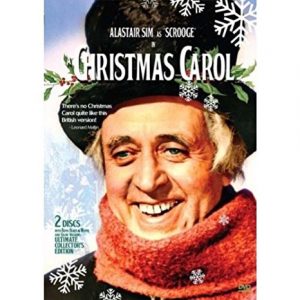
Here’s a seasonal example. Every year I watch Alastair Sim’s masterful performance as Ebenezer Scrooge in the 1951 film A Christmas Carol. Talk about a “redemption narrative”!

But when you watch the film (especially if you’ve seen it more than 50 times, as I have), something else emerges. One surprise is that the spiritual meaning of Christmas plays a much smaller part in the movie than you might expect. Far more prominent is its critique of England’s (and perhaps our) social problems.

Even more astonishing are the changes in the way we feel about Ebenezer Scrooge. Despite his stubbornness and meanness, we begin to like him and care about him, even before his Christmas-morning conversion.

To put it another way: Perhaps it is we – not Ebenezer – who need redeeming – who need to learn a new way to relate to people who seem inherently selfish and unlikable.

Great writers tend to prefer – even insist on – a fresh retelling of their stories. Can you follow their example? Try it!
 

Share

Writing (or Not Writing!) about Hamlet

It’s been a dream of mine for a long time: Write a scholarly article about Shakespeare’s Hamlet.

It’s easy to see that my dream is unlikely to come true, for two reasons. 1) I’m a Shaw scholar, not a Shakespearean expert. 2) So many articles and books have been written about Hamlet already that I’m unlikely to come up with an idea to write about.

(I do have one advantage: I spent several years obsessively reading about Hamlet. And I knew I’d be quoting from my favorite scholarly piece about Hamlet: “The Prince or the Poem” by C. S. Lewis.)

But I wasn’t really going to waste time on such an unlikely project, was I? My unconscious mind had an answer to that. A couple of mornings ago, it woke me up at 4 AM with the beginning of an article in my head. It’s a terrific idea – one I’d mentioned, in fact, in an article I just published about Shaw’s Pygmalion.

But there’s this teeny-weeny problem that I don’t know anything – big, fat zero – about the idea I want to pursue (here it is, in a nutshell: Hamlet as a student of literature). Where should I start my research? Jacques Derrida? Stanley Fish? Roland Barthes? There’s no guarantee they’d have anything useful to say.

And even if I were able to create a research plan, I don’t know if there’s enough content to warrant an article.

Nothing daunted, I started doing some research this morning. And what I found out – improbably – is that C. S. Lewis – yes, the same C. S. Lewis! – has written a book (not about Shakespeare – its topic is literary criticism) that might feed me some of the ideas I need.

I downloaded the e-book edition this morning and started reading. Yikes. I had forgotten what a fabulous writer Lewis is. (I used to be a Lewis maniac – have read almost everything he ever published. It’s so good to be spending time with him again.)

So thank you, Unconscious Mind, for an early Christmas present: I am having FUN! 


Share

Formatting a Manuscript

I’ve self-published five books through CreateSpace and helped several of my friends publish books they’ve written. So I consider myself an expert – able to leap tall buildings in a single bound, so to speak.

But I was stymied recently when a friend asked for help with a book he’d written. Everything worked fine through most of the formatting process. I even figured out how to insert the custom title page that another friend had done for him.

But when I tried to set up the copyright page, my software kept inserting a blank page. Despite all my computer smarts, I couldn’t solve the problem. I started thinking that I’d have to hire a formatting service ($200 and up) to fix that one mistake – or abandon the book project. (There’s no way he could pay that kind of fee.)

And then I remembered that Word often embeds hidden codes when you hit the Enter key at the end of a paragraph. I deleted the paragraph break (also called a “hard return”), and the blank page vanished. (Good riddance!)

___________________________________________

My point is that formatting a book requires discipline. You have to use the Styles feature in Word. You can’t blithely keep hitting the space bar or tab key to get the look you want. If you throw that advice to the winds (or never learned how to use Word properly – my friend’s problem), you’re likely to end up with a mess that only a wizard can straighten out.

I consider myself – ahem! – one step closer to wizard status. But I hope I never find myself in that situation again.

enter-key-pixabay


Share

Philip Larkin

If you’re a fan of The Big Bang Theory, you probably remember an episode when the gang plays a drinking game called “Never Have I Ever.”

Here’s how it works: Somebody makes a statement beginning with “Never Have I Ever….” If it’s something you’ve done, you take a shot of whatever beverage everyone is drinking. You can see a clip here: https://youtu.be/TspoW5yriH4

Let’s play! I’ll start: “Never Have I Ever used ‘that of’ in a sentence.’

Did you take a shot?

Sentences with “that of” are almost always clumsy, and I’ve come to hate that phrase. The “that of” construction is probably a residue of the discredited belief that language is supposed to be logical. (It’s not, in case anyone asks.)

Lately, alas, there seems to be a “that of” epidemic going around.

In fact I just came across a “that of” sentence, and the consequence is that I’m probably going to be cranky for the next 30 minutes. The sentence is about the poet Philip Larkin. Here it is:

Larkin’s day job was that of librarian at the University of Hull.

Gack.

What’s wrong with “Larkin’s day job was librarian at the University of Hull”? Or – better yet – “Larkin was a librarian at the University of Hull”?

Philip Larkin

       Philip Larkin


Share

An Unexpected Lesson from Sir Winston Churchill

I subscribe to Today in Literature, a free e-newsletter about books, poetry, and authors from around the world. (It’s amazing what I don’t know about literature, in spite of my doctorate!)

A recent edition featured an excerpt from My Early Years, a memoir by Sir Winston Churchill.

See if you notice the same thing I did. Churchill is remembering that the smart boys in his class were taught Latin and Greek. Duller boys – Churchill among them – were relegated to – gasp – an English class:

We were considered such dunces that we could learn only English. Mr. Somervell—a most delightful man, to whom my debt is great—was charged with the duty of teaching the stupidest boys the most disregarded thing—namely, to write mere English. He knew how to do it. He taught it as no one else has ever taught it. Not only did we learn English parsing thoroughly, but we also practised continually English analysis. Mr. Somervell had a system of his own. He took a fairly long sentence and broke it up into its components by means of black, red, blue, and green inks….It was a kind of drill. We did it almost daily. As I remained in the Third Form three times as long as anyone else, I had three times as much of it. I learned it thoroughly. Thus I got into my bones the essential structure of the ordinary British sentence—which is a noble thing.

Churchill is one of many people over the years who believe that good writing is grounded in a thorough knowledge of English grammar. I think they’re wrong (I still don’t know how to diagram a sentence!).

Obviously I don’t have the stature to argue with Churchill. But here’s what struck me when I read that excerpt: Churchill was arguing against himself. Take a look at these sentences:

He knew how to do it.

It was a kind of drill.

We did it almost daily.

I learned it thoroughly.

Now look at these sentences:

Mr. Somervell—a most delightful man, to whom my debt is great—was charged with the duty of teaching the stupidest boys the most disregarded thing—namely, to write mere English.

Thus I got into my bones the essential structure of the ordinary British sentence—which is a noble thing.

Despite those fond memories of Mr. Somervell’s classes, Churchill didn’t learn how to write that way in school. Churchill’s style features many straightforward declarative sentences (“We did it almost daily”) that any fifth grader could write without the instruction in sentence analysis that Churchill was subjected to.

But what about those long, fancy sentences? Here’s the other thing that struck me about Churchill’s writing: He was addicted to dashes. (So am I, by the way.)

I can just about guarantee that Mr. Somervell didn’t allow his students to use dashes, which are spontaneous punctuation marks that don’t work with formal sentence analysis. (Personal testimony: I graduated from a Catholic college in 1967. We weren’t allowed to use dashes.) 

My suspicion is Churchill left out an important feature of Mr. Somervell’s classes: Actual writing. I would bet the farm (if I owned one) that students spent hours and hours writing and revising essays for Mr. Somervell. And that, ladies and gentlemen, is how you learn to write. You plop into a chair, pick up a pen (or put your fingers on a keyboard), and get to it.

____________________________________

I can’t resist offering one more example to argue my point. Take a look at these sentences from this post and see if you notice anything:

Personal testimony: I graduated from a Catholic college in 1967. We weren’t allowed to use dashes.

There’s an indefinite pronoun reference! If you tried to diagram the second sentence, you’d notice that we has no antecedent. A grammarian would say that the word students has to appear somewhere in the previous sentence.

I say…bosh. Precision is a wonderful thing, but lively writing should always take precedence.

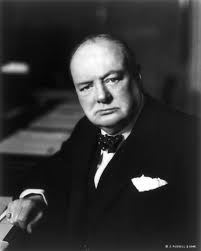
Sir Winston Churchill

            Sir Winston Churchill

Share

Inertia Pays Me Another Visit

Here’s the problem I was facing: a December 1 deadline for a proposal to do a conference presentation in the spring.

And here’s what’s amazing: despite a really tough struggle with inertia, I just sent it off.

Maybe the problem was the holiday preparations (we’ve shipped all our gifts and done most of our decorating). Maybe I just needed a break. Or it might be simply that I lost my momentum when I stopped thinking about writing and started focusing on Thanksgiving and Christmas. Whatever it was, I couldn’t get past it…until yesterday, when I used a favorite trick to get my writing engine started – two tricks, actually.

The first was a reward (or self-imposed threat, depending on how you look at it). A friend loaned me a crime novel that I was eager to read – Hell Fire by Karin Fossum. I told myself that I couldn’t start reading it until I’d spent some time on the proposal. (And now that I’ve read the book, I kind of wish I hadn’t: it’s sad.)

The second strategy was something that time management experts call a “leading task” – a non-threatening chore to get myself moving. I challenged myself to type some quotations I wanted to use in my proposal.

Total time invested: about 20 minutes. Bonus: I was so proud of myself – and so energized – that I drafted almost the entire proposal in one sitting. I was typing away, starting to really get into it, and I suddenly realized that I had my required 250 words.

That was yesterday. Today I did some revising and then sent it off.

Now comes the fun part – putting a PowerPoint together. The presentation is about Village Wooing, a playlet by Bernard Shaw about a man and woman who meet on a cruise ship and eventually decide to get married.

I’ve already found a picture of two deck chairs to use in my presentation! 

deck-chairs-adobe


Share

Who’s the Person You Used to Be?

A few years ago I started reading books by Joan Didion, an important contemporary American writer. Her memoirs about the deaths of her husband (The Year of Magical Thinking) and daughter (Blue Nights) are extraordinary books – honest, deeply personal, and yet universal.

Didion is most famous for writing books that combine social commentary with reflections on her personal life. I have not yet read any of these, but her name is high on my To Do list. A couple of weeks ago I came across a paragraph from her book Slouching Towards Bethlehem that reminds me of James Hillman, my favorite author:

I think we are well advised to keep on nodding terms with the people we used to be, whether we find them attractive company or not. Otherwise they turn up unannounced and surprise us, come hammering on the mind’s door at 4 a.m. of a bad night and demand to know who deserted them, who betrayed them, who is going to make amends.

There’s an entire book in that paragraph. Yours. Mine.

Years ago, when I was recovering from a severe case of shingles, I made a couple of appointments with a psychologist friend to try to figure out what had triggered my illness. (Shingles is widely regarded as a stress-related disease.) Part of the intake procedure was a decade-by-decade survey of my life, and the name Richard Burton inevitably came up when we talked about my college years. I lightheartedly recalled how besotted and silly I had been – a foolish college girl who knew very little about life.

To my astonishment, my psychologist friend was intrigued by my imaginary love affair – even respectful of it. And so I gradually began to revise my attitude towards the Jean-I-had-been. She knew some important things that I’d forgotten about. She was someone important, even if she sometimes embarrasses me today.

Our relentless march toward a New and Improved Self is often a…mistake. Didion is right: The people we used to be need to be welcomed back into our lives.

I really like the disciplined and hard-working person I’ve turned into. It’s a thrill to open my mailbox and find a scholarly journal that features an article I’ve written. (That happened to me earlier this week.)

But so much has been pushed aside, buried, forgotten. Did you know that one Saturday, years ago, I watched a live performance of Swan Lake not once but twice? That I’m gradually filling a metal dollhouse with vintage Renwal plastic furniture? That Bill the Cat is my favorite cartoon character? That I read The Boxcar Children over and over when I was a child?

Not everything I used to love has held up well over the years. But – Thomas Wolfe notwithstanding – often you can go home again. At least I can. Swan Lake is still my favorite ballet, The Boxcar Children is still a wonderful book (I reread it recently and loved it all over again), and Bill the Cat is back with us again, courtesy of Facebook, and as funny as ever.

If you want to be a writer, the first step is to become an interesting person. You can always hire someone to fix your punctuation and sentence structure. But nobody can fix you – that’s a task you have to do yourself.

The good news is that you already are an interesting person. If you sometimes feel empty, or lost, or useless, welcome to the human race. We all feel that way. But there’s a remedy. The energy reserves you need are hidden inside you. Start looking for them, and start writing!

Joan Didion

              Joan Didion


Share