Category Archives: Writing Skills

Existing or Pre-existing?

Suppose you’ve had diabetes for three years, and you want to switch to another health insurance policy. Do you have an “existing condition” or a “pre-existing” condition?

They’re the same thing.

I hate pre-anything. Well, most of the time. You can make a case for “preview” and “pre-publication” and similar words and expressions.

But yesterday – I am not making this up – I heard someone on the radio say she was “pre-preparing” for an event.

And of course there’s pre-plan, pre-register, pre-arrange. What, pray tell, is the difference between registering for an event and “pre-registering” for it?

None.

I’m going to have a nervous breakdown this election season from hearing “pre-existing” thousands of times on news shows about the candidates.

I have two requests for you: Be ruthless about eliminating “pre” from your conversation – and make sure you’re ready to vote in November.

Follow @JeanReynolds


Share

A Good Night’s Sleep and an Apostrophe

A good night's sleep

A good night’s sleep

Should you use an apostrophe when you write about “a good night’s sleep”? Yes.

You’ve probably heard a teacher say that an apostrophe signifies ownership. That statement is correct, but it’s only part of the apostrophe story.

Apostrophes signify “of” ideas. Mary’s car means “car of Mary.” Dennis’ dog means “dog of Dennis.” Three weeks’ pay means “pay of three weeks.” And so on.

The apostrophe in “a good night’s sleep” means “sleep of a night.”

Time expressions often use apostrophes. A day’s pay means “pay of a day.” Two weeks’ vacation means “vacation of two weeks.” A moment’s delay means “delay of a moment.”

“Before the s or after the s?” If you take a minute to look at the example, you’ll have the answer: Spell the word (day, days, weekweeks, night, nightsmoment, momentsDennis, Mary) and put the apostrophe after the last letter.

Here are some examples:

a day’s delay

two days’ delay

a week’s pay

two weeks’ pay

a good night’s sleep

two nights’ dreams

a moment’s delay

several moments’ anxiety

For more practice with apostrophes, click here. You can watch a short PowerPoint about apostrophes here.

Follow @JeanReynolds

Share

Theater or Theatre?

Which spelling is correct: theater or theatre?

That used to be a simple question. “Theater” is American usage (thanks to Noah Webster, who established the first American spellings back in the 1780s). Americans write “center,” not “centre,” as the British do, and “theater,” not “theatre.”

Except that isn’t true anymore, at least not about “theatre.” I was startled recently to see “theatre” in an article in The New Yorker, which is usually meticulous about copyediting (although I did see “Dumpster” once without its capital D – it’s a trademarked word). Then I saw “theatre” in a comic strip. Then I saw it all over the place.

A friend who’s head of a college theater department explained to me that a “theater” is a building and “theatre” is an art. Or maybe it was the other way around. I couldn’t find those distinctions in any dictionary. But since he’s a professional, he must be on to something.

The New York Times still uses “theater,” the American spelling, unless an organization uses the British spelling. So it’s American Ballet Theatre or Alvin Ailey American Dance Theater. Tomorrow evening I’m going to the Eugene O’Neill Theatre to see The Book of Mormon. Wednesday afternoon my sister and I are going to the Richard Rodgers Theatre to see Porgy and Bess. Both are in New York.

Bottom line: You can take your pick – just be consistent after you make your choice. I’m sticking with theater, at least for now.

One more comment: On a TV news show recently I was startled to hear an educated person pronounce the word “thee-AY-ter.” She did not make a good impression. Here’s another bottom line: Hang around some educated people and imitate what they do. (Just don’t imitate her.)

Share

British vs American English

British vs. American English: The age-old debate.

Here’s how the argument goes: The English language originated in Great Britain. Obviously British English is more correct than American English, right?

Wrong.

They’re simply different–and we’ll be taking a look at some of those differences today.

It would be natural to assume that England has preserved the real thing, and that America has corrupted the English language. The truth, though, is much more complicated. American English has actually preserved some words and expressions that were gradually forgotten in the British Isles. For example, Americans still use “fall” to refer to the season after summer; in UK, most people use “autumn.”

Another factor to keep in mind is that English has changed drastically over the past 1500+ years. What’s correct at one time is wrong at another. For example, the word “silly” originally meant “innocent.” Today it means foolish. Which is right? The answer is that both are correct – at different times in the history of the language.

But let’s stick to today’s subject: The differences between American and British English. Here are a few of the most important ones. You can learn more at these links:

Punctuation

  • The British tend to use more commas than Americans do, especially with introductory words and phrases.
  • The British often use ‘inverted commas’ for quotations.
  • In the UK, periods are called full stops.
  •  In the US, periods and commas have to be placed inside quotation marks:

Joe said, “Let’s go out for a pizza.”  AMERICAN

The UK uses a different system and offers several choices for quotations and direct speech. You can learn more here: https://www.sussex.ac.uk/informatics/punctuation/quotes/marks

WORD CHOICES

This chart lists some of the most common differences between British and American words:

American

British

vacation

holiday

diaper

nappy

cent

pence

toward

towards

among

amongst

while

whilst

hood (of a car)

bonnet

trunk (of a car)

boot

elevator

lift

truck

lorry

mail

post

soccer

football

Spelling

Noah Webster (1758 – 1843) was an American lexicographer and spelling reformer who simplified some English spellings. Those changes live on today. For example, the British centre became center, theatre became theater (although many American institutions still use theatre, as does The New Yorker magazine), colour became color. All right is often spelled alright in the UK, even in formal writing.

Usage

In the UK, collective nouns often take a plural verb: The team are ready to play. In the US, they rarely do. Technically a plural verb can be used to signify disagreement (The team are quarreling about the proposed new rules), but most American writers would simply write it this way: The team members are quarreling about the proposed new rules.

Slang

Common expressions can have very different meanings when you cross the ocean in either direction. In the US, knock up is a vulgar expression meaning to get a woman pregnant. In the UK, knocked up can mean tired; knock up can also refer to knocking on a door to wake someone up the morning.

Which is Better? Neither!

If you (like me!) speak American English, don’t apologize. Our version of our wonderful language is just as rich and valid as the British version. Different doesn’t necessarily translate into one-is-better-and-one-is-worse.

Share

A Pronoun Problem: “That” is a Tricky Word

If someone asked me for a list of the most troublesome words in the language, I’d put “that” high on the list.

Don’t get me wrong. “That” is a wonderful word that I use all the time (notice the that there?). But that also causes more than its fair share of its problems – something I was reminded of again in this morning’s newspaper.

In an article about the nation’s debt, a senior fellow from the nonpartisan Tax Policy Center had some cautionary words for both parties–and a sentence that illustrates why that is a problematic word. 

What’s so interesting is that the speaker – Roberton Williams – used that correctly. Still, I would have rewritten the sentence to eliminate a pronoun problem I’ll explain in a moment.

Let’s take a look at Williams’ sentence. After warning the president that he needs to be more realistic about raising taxes “across the board on a broader group of people,” Williams had this message for Republicans:  “On the other side, the Republicans are going to have to realize that not increasing taxes requires the very, very large cuts in spending that disproportionately benefits low and middle-income households.”

My husband, who read the newspaper before I did, pointed out the sentence to me. “Shouldn’t it be benefit?” he asked.

Makes sense–but no. He (like me and everybody else who has ever taken a writing class) was taught that you ignore the prepositional phrase when you choose your verb. So the sentence would essentially read like this: “very large cuts that disproportionately benefit low and middle- income households.” You would skip over “in spending” because it’s a prepositional phrase.

But sophisticated sentences don’t always work that way. Sometimes the prepositional phrase (“in spending”) is connected to something important.

I instantly knew something was wrong. Nobody in this political climate is talking about cuts that would make life better for low and middle-income households. Well, there’s been some talk about cutting oil subsidies, but that ain’t gonna happen.

What’s really on the table is cutting spending that disproportionately benefits low and middle-income households.

To put it in another way: Are we talking about “cuts that benefit” or “spending that benefits”?

Good writers care less about grammatical correctness and more about clarity. Yes, Williams got it right. But I would have rewritten the sentence so that the meaning would be clear the first time you read it:

On the other side, the Republicans are going to have to realize that not increasing taxes will require very, very large cuts in spending and, as a result, disproportionally cut benefits for low and middle-income households.

I suppose you could use Williams’ sentence to argue for a return to sentence diagramming. Anyone diagramming that sentence would have immediately seen the difficulty–what’s the antecedent of benefit?–and fixed it.

But there’s an easier and better way that’s especially beneficial to people like me who don’t have time to diagram sentences and (frank admission here) don’t know how to do it. If a sentence seems complicated or confusing, rewrite it.
Share

Is It Who or Whom – And How Do You Know?

Here’s a tidbit from “After Deadlines,” an ongoing commentary about writing issues in the New York Times:

Still, in what might be a combination of generosity and caginess, Mr. Guettel helped supply Prospect with a music supervisor, Robert Meffe, whom Ms. Lucas said “has sort of been the ear of Adam” at “Myths and Hymns” rehearsals.

Whom has? No. Make it “who,” subject of the verb in the relative clause.

* * * * * * 

I’m grinding my teeth. Despite having a Ph.D. in English and the authorship of two English textbooks under my belt, I have to stop and think about what “subject of the verb in the relative clause” means. Surely I can’t be the only who struggles with explanations like this one!

Here’s how I do who and whom: I substitute “he” for “who” and “him” for “whom.” (Yeah, it sounds a little like “Tea for Two.”)

So let’s try it again:

Him, Ms. Lucas said, “has sort of been the ear of Adam”…

He, Ms. Lucas, said “has sort of been the ear of Adam”…

“He” works better, so “who” is the correct choice. (Commas around “Ms. Lucas said” would help, wouldn’t they? You drop your voice there.)

Still, in what might be a combination of generosity and caginess, Mr. Guettel helped supply Prospect with a music supervisor, Robert Meffe, who Ms. Lucas said “has sort of been the ear of Adam” at “Myths and Hymns” rehearsals.  CORRECT

One more point: This sentence is much more complicated than it needs to be. Simplify it, and you accomplish two wonderful things: The who or whom problem disappears, and the information is easier to read. Here’s how I would fix it:

Still, in what might be a combination of generosity and caginess, Mr. Guettel helped supply Prospect with a music supervisor, Robert Meffe. Ms. Lucas said that Meffe “has sort of been the ear of Adam” at “Myths and Hymns” rehearsals.  BETTER

And I can’t resist making one more point: When in doubt, use who. Whom is gradually disappearing (hooray!).

whom

                                      Whooom?

Share

Writing about Laura Dekker: Even Pros Make Mistakes

I just finished reading about a teenager who’s the youngest person to sail solo around the world. It’s a remarkable story and – if you read it in today’s newspaper, as I did – an instructive one for those of us who get our kicks at a writing desk rather than a sailboat.

Point #1: Teenagers should not follow Laura Dekker’s example – missing school to take a risky lone voyage around the world.

Point #2: The Associated Press feature about Laura Dekker would have benefited from an editor’s sharp eyes.

Take a look at the first paragraph:

Laura Dekker set a steady foot aboard a dock in St. Maarten on Saturday, ending a yearlong voyage aboard a sailboat named “Guppy” that apparently made her the youngest person ever to sail alone around the globe, though her trip was interrupted at several points.

TMI, as young people today are fond of saying: Too Much Information.

  • Laura Dekker ended a yearlong voyage around the world on Saturday
  • she landed in St. Maarten
  • she sailed alone
  • her sailboat was named The Guppy
  • her trip was interrupted several times
  • she’s probably the youngest person to make the journey solo

My husband, who shares my TMI complaint, suggested a better opening sentence for the story:

Right now most 16-year-old girls are probably thinking about their next text message. 

That’s a succinct attention-getter that prepares you for a story about an unusual 16-year-old girl.

And that brings me to my second suggestion: The AP story takes 242 words (in a 653-word article) to get around to telling you how old Laura Dekker is. That information should have appeared in the first paragraph: After all, Laura’s age (16) is the reason her accomplishment is newsworthy.

There’s a lesson here for all of us: Even topnotch writers like Judy Fitzpatrick, the reporter who wrote this story, can benefit from having another reader take a look at what we’ve written.

Share

Parallelism, Anyone?

I taught parallelism (parallel construction in sentences) to college freshmen for many years. I don’t recall ever having a student who couldn’t figure out how to write parallel sentences.

So I continue to wonder why so many professional writers produce sentences that aren’t parallel. Here’s one I came across just this morning:

She was a talented graphic designer, a great writer, and was the president of a student club.  INCORRECT

Perhaps the pros had English teachers who decided to skip the chapter on parallelism. Or writers today just don’t want to bother. Or they’ve forgotten how to do parallelism.

Let’s remedy that. One of the best ways to fix one of these offending sentences is to imagine it as a little poem:

She was

a talented graphic designer

a great writer, and

was the president of a student club.

You can easily see that item #3 doesn’t match #1 (a talented graphic designer) and #2 (a great writer).

That’s generally true, by the way. Ninety-nine percent of the time, item #3 is the problem in a non-parallel sentence.

So let’s fix it:

She was

a talented graphic designer

a great writer, and

the president of a student club.

Easy, isn’t it? Here’s our new sentence:

She was a talented graphic designer, a great writer, and the president of a student club.  CORRECT


Share

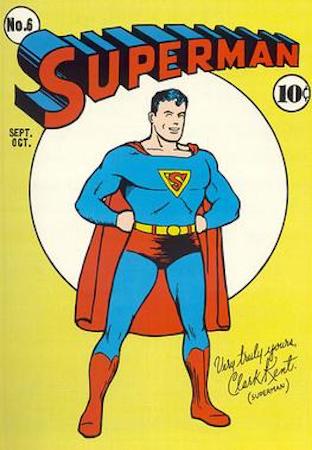
Superman Teaches Comma Rule 3

Non-restrictive clauses are hard to teach! But they got much easier when I let Superman take over the job.

No kidding. All I did was play the introduction from the wonderful old Superman show (the black-and-white series from the 1950s, starring George Reeves).

Notice how the announcer’s voice drops after who (“and who, disguised as Clark Kent…”) and rises again after newspaper (“great metropolitan newspaper”).

Click here to listen!

It’s like clothespins, I would tell my students. One comma takes your voice down, and another comma brings it back up again. (The grammatical term is an “interrupter.”)

Want another example? Try this famous line from Mission Impossible (but be sure to read it aloud – you’ll hear the commas):

Your mission, should you choose to accept it, is to intercept the enemy plane.

Mission accomplished!

You can download by clicking the link.

Superman comic book cover

Artwork Courtesy of Joe Shuster

Share