Category Archives: Writing Skills

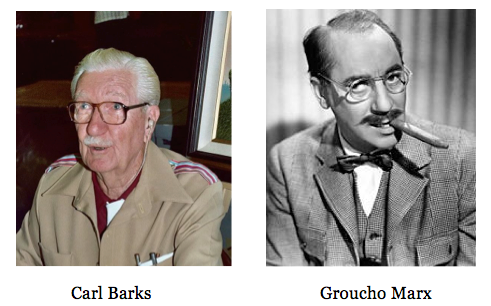
Carl Barks and Groucho Marx

Today I’m going to write about an unusual writing practice: Counting syllables.

Last week I came across a reference to counting syllables in an anecdote about Groucho Marx in a delightful book by Dick Cavett, the former host of a popular TV talk show. Cavett was interviewing Marx, a comic actor who also used to host a TV show.

Cavett asked Groucho if he’d seen the musical play Hair, which featured Broadway’s first frontal nudity scene with both sexes.  “No,” Groucho answered. “I was going to see it, but I went home, took off my clothes, looked at myself in the mirror, and saved seven dollars.”

The audience roared. But Groucho deliberately got the ticket price wrong, according to Cavett: “The figure he chose for the price of an orchestra seat was of course not the correct figure, but it had the right number of syllables for the joke.”

Cavett went on: “People will think an old comedian is crazy when he tells a young writer to change a line from ‘There are twelve chickens on the lawn’ to ‘There are fifteen chickens on the lawn,’ but he’s right. Because of the rhythm, fifteen is a funny number and twelve is not.”

How many people count syllables?

I don’t, but some writers do. There’s a rhythm to good writing, and you may have to experiment – even fudge a detail or two, as Groucho did – to get the rhythm right.

Let’s hear from another successful writer, Carl Barks. He was the cartoonist who did Donald Duck and Scrooge McDuck comic books for Disney for many years. (Don’t underestimate Barks and his work: George Lucas called Barks’s comics “a priceless part of our literary heritage.”)

Here’s Barks talking about his working method: On many pages of his stories, he said he had “two climaxes, one at the end of the first four panels, and at the bottom of the page. The reason: He felt he needed “something to cause the person to read on further.”

I was impressed when I read this. Climaxes are a hugely important writing concept – one that I didn’t hear much about until my Ph.D. program.

But Barks did something else as well. Any guesses about what it was? According to Barks, “At times I would count the syllables in the words, to make sure that the dialogue would flow like music, from one panel to another.” Barks said he would sometimes use a word his young readers didn’t know “because I was counting syllables, and that particular word happened to have the right number to cover the exact meaning.”

I think these two men were on to something. Sometimes teachers and editors forget that the sound of a sentence is just as important as the grammar. I often spend five or ten minutes revising a sentence to get it exactly right – and then recoil the next day when I go back to read it. “Who wrote that?” I ask, with gritted teeth. The unpleasant truth is that I did.

Just a moment ago I revised this sentence: I’ve never counted syllables, but I think Barks and Marx were onto something. Why? “Barks and Marx” are rhyming words, and I didn’t want readers distracted while they were reading this post. Here’s the revised sentence (I substituted “these two men”): I’ve never counted syllables, but I think these two men were on to something.

The nugget of gold here isn’t really about climaxes or counting syllables. What impressed me about both men is that they didn’t settle for the first thing that came into their heads. They found a way to make it better.

When I was a college instructor, many of my students were weak writers. That wasn’t surprising, since they had landed in my developmental writing class because they couldn’t pass the college entrance exam in writing.

But so often I felt that they could do perfectly well if they would just spend a little more time on an assignment:  Experiment. Try a different approach. Ask someone else (it doesn’t have to be an English major) for feedback. Even little changes -the difference between twelve and fifteen – could be the first step on the road to success.

Barks & Marx (hah!) figured it out. Have you?
Carl Barks and Groucho Marx 2

Photo of Carl Barks by Alan Light, CC BY 2.0, https://commons.wikimedia.org/w/index.php?curid=3366723

 

Share

Does Sentence Diagramming Help?

I sometimes talk with people who assume that I must yearn for the good old days when students learned how to take sentences apart.

They’re partially right. Many of my college students had never spent any time thinking about how language works and how sentences are put together. Teaching them to slow down and notice language was both a challenge and a pleasure.

But sentence diagramming is not the answer. And – truth to tell – it’s a skill I never acquired.

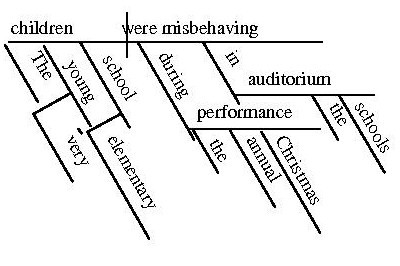
Below is a sentence diagram I found online. Let’s take a close look to see if it would help students sharpen their writing skills:

The very young elementary school children were misbehaving during the annual Chistmas performance in the school’s auditorium.

Sentencediagram 2

Suppose you dictated this sentence to – say – a class of eighth graders. What mistakes would they be likely to make – and would sentence diagramming help them do better?

Based on 40 years as an English instructor, I can tell you that these students would probably:

  • misspell “elementary,” “annual,” “performance,” or “auditorium” (and perhaps other words)
  • forget to capitalize “Christmas” (and perhaps mistakenly capitalize “school”)
  • omit the apostrophe in “school’s”
  • insert an unwanted comma somewhere for the dubious reason that this is a long sentence, so surely it needs a comma

Would a background in sentence diagramming help those students avoid any of those mistakes? No.

More important, though – would any of those students know that this is a static sentence that should be rewritten? No again.

The sentence is perfectly grammatical, but it’s weak. The words “were misbehaving” don’t help us see and hear the chaos in that auditorium. We need to substitute details like these:

  • flipped the auditorium seats up and down
  • climbed over the seats
  • shouted to their friends
  • ran up and down the aisles
  • threw spitballs at their classmates

I would encourage students to write at least two sentences about the misbehavior so that they can include several examples without making the sentence uncomfortably long.

Basic English usage isn’t hard to master. There are four pronoun rules, five subject-agreement rules, three comma rules, and two ways to use an apostrophe. A semicolon is like a period. There are a few rules for capital letters…and not much more. Even advanced usage doesn’t have a burdensome amount of content.

Does sentence diagramming instill any of those skills?

The answer, sadly, is…no.

Students need English teachers who can efficiently teach the usage skills needed for effective writing. More important, students need to learn how to use language to communicate ideas and experiences – express themselves vividly and powerfully – and showcase what they know.

C

Share

More about Passive Voice

In a recent post, I noted that writers disagree – sometimes fiercely! – about passive voice. 

I came out sort of in the middle – passive voice can be useful, but there are risks.

One troublesome feature I mentioned was that passive voice tends to omit the subject of the sentence. Compare these two sentences:

Joe threw the ball.  ACTIVE VOICE

The ball was thrown.  PASSIVE VOICE

Both sentences are perfectly grammatical – but the second one doesn’t explain that Joe did the throwing.

Today I want to look more closely at this feature of passive voice, and I want to focus on something that might surprise you: Magical thinking.

Language, we think, is a pretty straightforward affair. We talk about everyday life: I went to the movies. Larry and Susan split up. A cold front is coming. Where’s the magic?

Take a closer look, though, and you’ll see that we often attribute magical properties to language.  Here’s something that happens to my husband and me all the time: We want to know what kind of weather we’ll encounter on an upcoming trip. A weather forecast predicts mild temperatures and sunny weather. I turn to my husband and say, “Great! No rain!” And then gloom descends. “Uh-oh – I shouldn’t have said that.”

I’ve called up the jinx, and he and I know there will be a deluge during our whole vacation.

Another example: During the trip he comments that our car has been wonderful – not a speck of trouble since we drove it out of the dealership. Uh-oh: Before we’ve driven another 100 miles, the transmission will fail, or the radiator will overflow, or the serpentine belt will break.

If you’re a baseball fan, you’re familiar with the jinx. Many sportscasters won’t mention that there’s a no-hitter in the works for fear of spoiling the pitcher’s chance for a perfect game.

What does this have to do with passive voice? Criminal justice experts used to believe that you could magically ensure an officer’s honesty by banning the words “I” and “me.” If a police report said “I saw a bulge in the suspect’s right pocket,” the officer might be lying. The remedy was passive voice: “A bulge was seen in the suspect’s right pocket.” 

If you spend even a minute thinking about this, you’ll see how ridiculous it is. Honesty and integrity are hard-won character traits. You can’t instill them with verbal tricks.

But generations of police officers were taught to write reports this way, and the tradition has stuck. Police trainers are still struggling to reverse course and persuade officers that it’s ok to write in active voice.

Because I have a report-writing blog, I read many police reports. I’ve found that the effort to undo the passive-voice habit has been only partially successful. Many reports start out in active voice (“I interviewed MacKay”). But near the end, passive voice invariably finds its way back in, with sentences like these:

The suspect was handcuffed.

The evidence was logged into the Evidence Room.

Barton was transported to jail.

An essential piece of information is missing in each sentence: Who handcuffed the suspect, logged the evidence, drove Barton to jail?

Imagine that you’re an officer testifying in court about a crime you investigated. The defense attorney has some questions about an injury related to the way handcuffs were used on her client. You gulp and realize that you weren’t the one who did the handcuffing – another officer at the scene did it

Your mind races. Who was it? Everyone in the courtroom is staring at you. You look hopefully down at your report, and here’s what you find: The suspect was handcuffed. No name.

Finally you remember that it was Officer Peterson. You look desperately around the courtroom, and then you sigh. No, he’s not here. The trial has to be postponed, and you’ve embarrassed yourself and your agency.

Let’s review what we learned today:

  • Passive voice is grammatical but risky
  • It sometimes omits the person who performed the action
  • Magical thinking about language is very common

It’s a fascinating topic, this language of ours!

Magic Wand Pixabay ok

Share

Let’s Not Lose These Words!

Early in my career as an English teacher, the All in the Family TV show premiered and became a huge hit. In an idle moment one day I looked up “dingbat” – Archie Bunker’s endearing term for his muddle-headed wife – in the dictionary. I was astonished to learn that a dingbat was a printer’s ornament. Really?

Fast forward to 2011, when I published my book Gretel’s Story: Finding the Way Home and used a decorative dingbat at the beginning of every chapter:

Gretel's Story: Finding the Way Home

                                             Gretel’s Story: Finding the Way Home

Fast-forward again, to 2016: I just looked up dingbat in the latest edition of the American Heritage Dictionary and found that “silly person” was the first definition. “Printer’s ornament” has dropped to definition #4.

Deploring this kind of change is about as futile as shaking your fist at the sky because a sudden thunderstorm has disrupted your plans to go swimming. Language changes. That’s a fact of life. Get over it!

But now I’m going to argue against myself. Sometimes we need to fight – mightily – against those changes, forestalling them as long as we can. I’m talking about the danger of losing useful words from our language.

Here are four words that – count on it – won’t be around much longer:

disinterested   infer   unique   comprise

I don’t mean that people are going to stop using them. What I’m talking about is the loss of their special meanings.

  • Disinterested is not the same as uninterested – but more and more people are using the words as synonyms. Disinterested means “impartial.” You would want a disinterested judge if you went to court to settle a dispute.
    “Interest” in this context means “involvement,” as in “She has an interest in that software business.” When we use disinterested to mean “not interested” or “not caring,” we’re losing a useful word from our language.
  • Similarly infer does not mean “imply.” Infer means “deduce.” But those two words are gradually acquiring the same meaning – and there goes another useful word. (Here’s an example of how to use infer correctly: When Carole came to work without her wedding ring, I inferred that she and Joe had split up.)
  • Unique is another word we’re probably going to lose. Unique does not mean “unusual.” Unique means “one-of-a-kind.” My fingerprints (and yours) are unique – but they’re not unusual. (Well, I just looked at mine, and they’re pretty ordinary – I can’t vouch for yours.)
    Many people say “very unique” when they mean “very unusual.” You can’t have “very unique” fingerprints or snowflakes! They’re either one-of-a-kind or they’re not. (In the same way, you can’t be “very pregnant” or “very dead.” You either are or you’re not.)
  • Today’s final word is comprise, which does not mean “compose,” even though it’s often used that way. Comprise means “include.” Here’s an example: The committee comprised two residents from each floor. If you say “is comprised of,” we’ve lost another useful word from our language.

Let’s keep these wonderful words going as long as we can, ok?

Archie and Edith Bunker

Archie and Edith Bunker

Share

Passive Voice

Last week I had two reminders that passive voice is a controversial topic. A friend gently chided me about a passive voice sentence I’d included in a law enforcement newsletter I’d just sent out. Here’s what he wrote:

Had I been the officer’s supervisor, I would have suggested active voice, from “Richard is enjoying his new job as a school resource officer ” to “Richard enjoys his new job as a school resource officer.”

A few days later, passive voice was the subject of a Grammarly quiz question honoring National Grammar Day. The quiz was designed to determined how fanatical you are about grammar (I scored high). One of the questions asked whether I considered passive voice a) outdated b) acceptable sometimes c) incorrect or d) confusing. I chose b, for reasons I’ll explain in a moment.

Twice in one week…hmmm. Seems the grammar gods want me to weigh in on passive voice.

So, what is passive voice – and why do writers argue about it?

Whenever you’re writing, you can choose to write in active voice or passive voice. Active voice is much more popular, but passive voice is equally correct.

Passive voice is a grammatical construction that emphasizes the receiver of the action, not the doer. In simple English, passive voice flips sentences around. Take a look at these examples:

Joe threw the ball.  ACTIVE

The ball was thrown by Joe.  PASSIVE

Pam drove me to the mall.  ACTIVE

I was driven to the mall by Pam.  PASSIVE

The first point I need to make is that my friend was wrong: “Richard is enjoying” is still active voice. (Technically it’s called progressive present tense.) Passive voice would be “The new job as school resource officer is enjoyed by Richard.”

Now we’re going to turn to another, more problematic aspect of passive voice. Often it omits the doer completely:

The ball was thrown.  PASSIVE

I was driven to the mall.  PASSIVE

Who threw the ball, and who drove me to the mall? The sentences don’t tell you.

And that’s where today’s topic starts to get interesting – and complicated. Passive voice tends to be impersonal, clumsy, and unnatural – pompous, even. Writing experts generally recommend avoiding it. I’ve run into people who believe that passive voice is always wrong. If you use the grammar checker for Microsoft Word, you’ll receive a warning every time you write a sentence in passive voice.

Passive Voice Is Impersonal

But the impersonality of passive voice can be useful – and that’s why I chose b (“acceptable sometimes”) as my answer for the Grammarly quiz.

Suppose, for example, someone has been leaving dirty dishes in the sink in the break room at work. You’re the supervisor, and you don’t want to name the person – you just want the problem to stop. So you post a sign in the break room that uses passive voice:

Dirty dishes have been left in the sink three times this week.  PASSIVE VOICE

You haven’t accused anyone. Passive voice solves the problem nicely!

But that impersonality can create problems – huge ones. Last October the New York Times published an article about the weak portrayal of slavery in Texas textbooks. Take a look at this sentence:

Families were often broken apart when a family member was sold to another owner.  PASSIVE VOICE

Who conducted the sales and broke apart the families? There’s no subject in this passive-voice sentence. That impersonality sucks energy out of the sentence. By contrast, notice the power you feel if the same sentence is written in active voice:

Slaveholders often broke families apart by selling a family member to another owner.  ACTIVE VOICE

Here’s what the Times writer said about the way the Texas textbooks presented slavery:

Though we don’t always recognize it, grammatical choices can be moral choices, and these publishers made the wrong ones.

Are you as astounded as I was? When was the last time you heard someone talk about grammar as a moral issue?

Bottom line: If you choose to write a sentence in passive voice, be sure you have a good reason.

Grammatical choices can be moral choices.

Share

Misty Copeland’s Notoriety

Today’s word is notoriety.

I’m a fan of Misty Copeland, the first black ballerina to be promoted to principal dancer by the American Ballet Theatre. Last year I thought Misty was a marvelous judge for the So You Think You Can Dance TV show, and I enjoyed seeing her do the peasant pas de deux in a performance of Giselle that I saw in New York.

So I was very interested in A Ballerina’s Tale, a recent documentary about her life that was broadcast on PBS. But at one point I was puzzled: The documentary said that Misty had trouble dealing with the notoriety that followed a European tour.

Notoriety? The documentary didn’t mention anything scandalous.

And then I realized that the film makers were using notoriety as a synonym for “fame.” But the two words have very different definitions. Fame is positive; notoriety (related to the word “notorious”) is negative.

Here’s how you could use notoriety correctly in a sentence:

Donald Trump’s notoriety is causing anxiety for some Republican leaders.

If you want to use the word fame, you could write this sentence:

Donald Trump’s fame is helping him win Republican primaries.

It looks as if these two words are blending into one, and we are gradually losing a useful word from our language. I’m sorry that is coming.

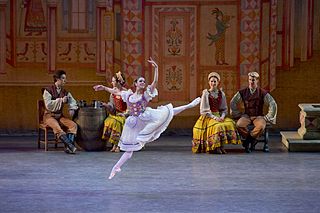
Misty Copeland in Coppelia

                         Misty Copeland in Coppelia


Share

Dr. Seuss Raises Some Questions

Today is Dr. Seuss’s birthday.

Of course I read Dr. Seuss (1904-1991) as a child. My mother liked to shop at thrift stores, and one day she came home with a pile of Children’s Digest magazines. It’s hard to imagine it now, but Seuss (who hadn’t yet achieved superstar status) allowed Children’s Digest to publish condensed versions of To Think That I Saw It on Mulberry Street and some of his other books.

I grew up and became a teacher, and one of my gigs was teaching second grade for half a school year when the regular teacher was ill. It was an opportunity to discover some of the marvelous children’s literature that had arrived on the scene while I was busy with college, Shakespeare, and the Beatles.

Dr. Seuss, I learned, had found a way to burst through the strait jacket of limited vocabulary lists for beginning readers. Even my struggling second-grade readers (the “Bluebird” group, I think they were) could read and relish The Cat in the Hat.

I haven’t heard about a movement to canonize Dr. Seuss (his real name, incidentally, was Theodor Seuss Geisel) – but I’ll gladly sign on if someone wants to take up the cause.

But I’m going to swerve off course and talk about some issues that popped up this morning when I read an article about Dr. Seuss’s birthday. Here’s a Seuss quotation that set me thinking:

I like nonsense, it wakes up the brain cells. Fantasy is a necessary ingredient in living, it’s a way of looking at life through the wrong end of a telescope. Which is what I do, and that enables you to laugh at life’s realities.

I like to imagine that Dr. Seuss and another favorite writer of mine, post-Jungian psychologist James Hillman, are off in a corner of heaven somewhere having a marvelous talk about the power of imagination.

But I’m going to focus on grammar. (Did you know that Friday is National Grammar Day? Are you excited?) Take a look at this sentence:

I like nonsense, it wakes up the brain cells.

It’s actually two sentences. When a group of words starts with a person, place, or thing, you can count on it – it’s a sentence. (It falls into the “thing” category.) So the sentence (and the one that follows) needs a period. (A semicolon would also work nicely.)

I like nonsense. It wakes up the brain cells. Fantasy is a necessary ingredient in living. It’s a way of looking at life through the wrong end of a telescope.

Regular readers of this blog know that I use a red typeface when a sentence is wrong and blue for the correct version. So how come I didn’t use red for “I like nonsense, it wakes up the brain cells”?

It’s because I tremble at saying that Dr. Seuss made…gasp…a mistake. If those commas were good enough for him, who am I to argue?

But how do we know he really wrote those sentences that way? On the first page of The Cat in the Hat, Seuss punctuated a similar sentence correctly:

The sun did not shine.
It was too wet to play.

The obvious next step for me was to check the original source for today’s quotation. I wandered around Google Books this morning and found that Seuss quotation dozens of times – but not one of the books I checked gave a source.

Remember back in high school when you learned how to do citations – and how tedious it was? There’s a reason for that drudgery. Mention the word “sources” to any scholar, and you’ll hear a long tale of woe about the quotations that got away – or were captured only after an arduous pursuit that rivaled the search for Dr. Livingstone.

One more thing: Readers with an eye for grammatical correctness are wondering if I’m going to mention the fragment in the Seuss quotation:

Which is what I do, and that enables you to laugh at life’s realities.

I just did.

Have fun celebrating Dr. Seuss’s life and work today! (And if you’re wondering about that extra “s” after the apostrophe in “Seuss’s,” yes – it’s legal, though not required. You’re allowed to add that “s” when a name ends in s, like mine: Jean Reynolds’s wonderful blog.) (Just kidding.)

Dr. Seuss

                  Dr. Seuss

Share

Here Comes the Bride

Here is a question I get all the time: Is it correct to say “Here comes the bride”? And what do you say if you want to include the groom?

Here are the answers: “Here comes the bride” is correct. If you want to include the groom, you should say “Here come the bride and groom.”

Here is how you do it. (It’s easy!) Just flip the sentence around. This will work with any sentence that starts with “here” – and it also works with sentences that start with “there.” So you’re getting a two-for-the-price of one deal.

Flip the sentence around!

                         Flip the sentence around!

Let’s see how this “flip” works:

Here (comes, come) the bride.

The bride COMES here….Here comes the bride.  CORRECT

Here (comes, come) the bride and groom.

The bride and groom COME here….Here come the bride and groom.  CORRECT

Here comes the bride!

                       Here comes the bride!

Did you notice that I’ve sprinkled a few of these “Here…” sentences in today’s post? Let’s look at them.

Here (is, are) the answers.

The answers ARE here….Here are the answers.  CORRECT

Here (is, are) how you do it.

How you do it IS here…Here is how you do it.  CORRECT

(Grammar books love to make this sound hard with a lot of talk about demonstratives and singular and plural subjects and verbs. But none of that jargon is necessary. My “flip” trick will work every time.)

Let’s try a few with “there”:

There (is, are) a problem with your order.

A problem with your order IS there…There is a problem with your order.  CORRECT

There (goes, go) my ex with her new boyfriend.

My ex GOES there with her new boyfriend…There goes my ex with her new boyfriend.  CORRECT

One more thing: You can change here is to here’s and there is to there’s if you like. 

You can download a free subject-verb agreement handout that covers this rule and others by clicking here.

(Is, Are) there any questions?

Any questions ARE there…Are there any questions?  CORRECT  

Share

Finesse!

Here’s something I do often: read books about writing. Here’s something else I do often: gripe about books about writing. I’ll be talking about some of those complaints in upcoming posts.

Today I want to offer a general observation (okay, a gripe) about these books: Even the famous ones tend to dance around the topic of writing without really telling you what to do. (Adair Lara’s wonderful book Naked, Drunk and Writing is a notable exception.)

For example, here’s something I hear all the time from writers who are headed in the wrong direction: “I want readers to make up their own minds about ________.” (Fill in the blank – a character, action, or situation).

Translation: You haven’t really worked your material. You don’t yet know your characters, or you haven’t really dug into your plot. Good writers care – a lot – about what’s happening to the people they’re writing about. If you’re not deeply involved with your characters, why on earth should your readers care about them?

One remedy is to have the other characters react to what’s unfolding. In fact this is a handy rule of thumb for anyone who’s writing fiction, a personal essay, or a memoir. If you’re creating a scene where several people are present, each one should react to everything that happens.

Of course then you’re faced with another problem – potential chaos as responses fly from one person to another. But skillful writers pull this kind of thing off all the time.

Here’s an example from Ernest Hemingway’s masterful story “The Killers.” Two thugs have just walked into a diner to kill a man named Ole Anderson. They’ve heard that Ole comes to the diner every evening at six. George, who waits on customers, sends young Nick Adams to find Ole and warn him.

“Mixing up in this ain’t going to get you anywhere,” the cook said. “You stay out of it.”

“I’ll go see him,” Nick said to George. “Where does he live?”

The cook turned away.

Hemingway moves the story along by having Nick decide to deliver the warning to Ole. But we’re not allowed to forget about the cook – and it takes just four words: The cook turned away.

(How many of us are afraid to write short sentences because we’re worried about sounding juvenile? But Hemingway didn’t worry about it!)

Here’s something else I hear from writers that immediately raises a red flag: “My story is going to build up slowly.” So will your readership! You have to sell whatever you’re writing quickly. Readers who don’t feel engaged are going to start looking for something else that’s more interesting.

I used to ask my college students to find the first interesting word in an essay they were handing in and then count how many words it took to get there. Skilled writers usually put an attention-getter into the first or second sentence.

Other sins are telling readers what they already know and doing readers’ thinking for them. I’m going to address these in a future post, but for now I’m going to suggest that you do what I did – think about those warnings.

“Don’t do your readers’ thinking for them” is an idea I first came across in Stephen King’s On Writing. He offers only one brief example – but it’s a principle I’ve thought about again and again, in all kinds of contexts, and I’ve learned a lot that way.

And now I’ve arrived at my most important point: You know more than you think you do. You’ve been reading for almost your entire life. As a kid you probably read books under the covers when you were supposed to sleeping. Decades later, you’re still reading voraciously (all writers do it).

Maybe you’ve even done what I did – sneaked away from a dinner party because you were so absorbed in a book (in my case it was Emma Donoghue’s Room) that you couldn’t wait to see how it turned out.

Before I finish this post, with its list of no-nos and don’ts, I want to leave you with an example of what writers should be doing. Here’s a sentence written by Ryan King, a member of a prison writing group I used to sponsor.

“With the other inmates, I finesse my way through the shoulder-butting and out the door.”

Suddenly you’re there in the prison dorm, and you know what kind of person Ryan is, and you understand what kind of people his inmate companions are, and it hits you what he’s up against. All of that happens in only 16 words. Whew.

That’s exactly what we’re talking about, isn’t it?

Bunk beds prison Wikipedia


Share

Arguing with Myself

I often argue with myself when I’m writing. Here’s what’s really awful: Sometimes I lose the argument.

Here’s what I mean. There are a few words and phrases I absolutely hate and have vowed never to use – for example, being, he or sheaffect. But occasionally these offenders show up in my writing, and I can’t get rid of them no matter how hard I try.

I think I need to explain why I have a problem with these particular words. Being tends to gum up sentences, in my experience. One problem is that it often introduces noun phrases, and they’re too static for really good writing. (“The fact that” falls into the same category.)

Here’s an example: The parking lot next door is being used as a hangout by some teens who live in the neighborhood.

I think the sentence would be livelier if it were rewritten: Some teens who live in the neighborhood are using the parking lot next door as a hangout.

So: Being is not welcome in my sentences. But it often finds its way into my writing anyway in sentences like this: Being late for the meeting caused so many problems that I’ll never do it again. I’ve wasted a lot of time trying to get rid of that pesky being – but dammit, the sentence worked better that way. So sometimes it stays on, mocking me every time I reread it.

He or she is an expression I particularly hate, and I waste big blocks of time trying to get rid of it. Usually I just make the sentence plural, like this:

Be sure to ask suspects to cooperate before you put handcuffs on them.

But there’s a problem: I write law enforcement articles, and sometimes I want to talk about one suspect in a particular situation. I made a New Year’s resolution to start using “they” in these sentences, but that can be awkward too. So all too often, with a sigh, I write sentences like this:

Watch the suspect carefully for signs that he or she might be reaching for a hidden weapon.

The last @#$%! word in this group is affect. Unlike many people I know, I don’t have any problem distinguishing between affect and effect – one of the benefits of years of reading.

But there’s a serious problem with affect: It’s vague. “The new tax proposal is likely to affect your tax rate.” Will it benefit me or make me pay higher taxes? That blasted affect doesn’t give me a clue.

So affect isn’t welcome in my sentences either – except that sometimes affect turns out to be exactly the right word, despite my protests:

The unexpected snowstorm affected everyone’s weekend plans.

I could use changed, but that’s another vague word. (I used to beg my students not to use affect in their essays, and of course I carefully explained why. “Use benefited, or worsened, or damaged, or improved,” I would plead. “Find a word that tells me more about what happened.” Invariably – 100 times out of 100 – the papers would come back with the word change substituted for affect.)

But maybe there’s a way to summon all my writerly powers and banish these these three offenders forever. I’m going to try to put them into a single sentence. Maybe they’ll feel that they’ve had their moment to shine and won’t come back to pester me. Here goes:

Everyone who’s busy being a writer already knows how clumsy words can affect his or her writing and should do his or her best to avoid them.

Done! Poof – begone!

Confused ok


Share