Category Archives: Writing Skills

Omit Needless Words

What popped into your head when you read the title of today’s post? If “Strunk and White” wasn’t your answer, you have some serious reading to do.

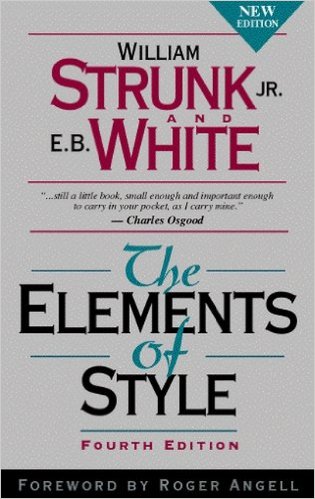
“Omit needless words” is one of the writing rules included in The Elements of Style, a classic writing guide by William Strunk, Jr. and E. B. White. (Strunk was the original author; after his death, White made some revisions and updates.)

Although I have a couple of quibbles with the writing advice, I continue to venerate The Elements of Style as the best book on writing ever written. Most writers do. You can find it in any library – but what you really need to do is purchase your own copy and reread it until you’ve memorized its content. (My copy is only 85 pages long. This is doable.) If you’re as broke as I was when I decided I wanted to be a writer, the full text of Strunk’s original 1918 version is available online at Bartleby.com.

I started thinking about the injunction to “Omit needless words” while I was reading a first-person essay by an Ethiopian refugee that was published in the New York Times Magazine this June. The author, Sehba Sarwar, used to work as a medical interpreter in Houston. The essay recounts a humorous conversation she had with a patient who was experiencing difficulty with an – um – intimate part of his body.

When Strunk and White urged writers to “Omit needless words!” they were thinking about expressions like “the reason why is that” (you should substitute “because”) and “used for fuel purposes” (you should substitute “fuel”). But I thought about another application for their useful advice. Here’s an excerpt from the beginning of Sarwar’s essay:

A local doctor, Dr. R., was on the line. “I need a favor,” he said. “I have this Amharic-­speaking gentleman. He has limited English. Can you come now to help with interpretation?” I told Dr. R. that I could be free in 30 minutes. When I was sure my client understood what she had to do, I let her go and walked to his office three buildings away.

A couple of those details – she was seeing another client, Dr. R’s office was three buildings away – have nothing to do with the story. Why slow down the tale by mentioning them? And there’s another problem: She’s setting up the expectation that the time and distance elements somehow affected her story. They didn’t, and readers are apt to be confused (I was, anyway) that they’re not mentioned again.

I often read personal essays that make the same mistake. Here’s how writing (good writing) works: Every detail helps create the effect you’re working for. It’s sort of like constructing a building, brick by brick. If the detail doesn’t help you communicate your message, delete it.

I should add a caveat here. When you start writing your piece, you should include everything, for two reasons. First, you don’t know what will turn out to be important later. Second, you shouldn’t block the flow of ideas by editing prematurely.

But when you’re working on your final draft, be sure to heed that useful advice from Strunk and White: “Omit needless words.”
51q3typgjnl-_sx313_bo1204203200_


Share

Is Sentence Diagramming Helpful?

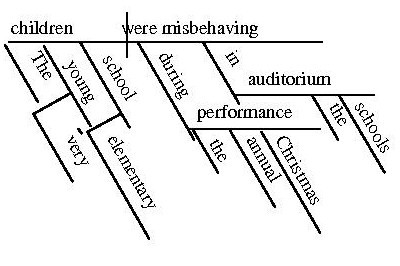
Marilyn vos Savant is reportedly the smartest person in the world – but she doesn’t know a lot about writing. In one of her columns she advocated studying grammar (especially diagramming sentences) in order to “express yourself clearly and well.”

Sounds like common sense, doesn’t it? But problems abound.

Not everyone agrees about what constitutes the rules of grammar. I’m careful to use possessives with gerundives, for example – but many professional writers don’t bother with that rule any more. The same goes for misplaced modifiers, indefinite pronoun references, and errors with parallel construction. Many professional writers occasionally sacrifice grammatical correctness in order to make a sentence sound more natural. (I do it myself.)

Marilyn vos Savant does make a good point about pronouns: “Misplacing even one pronoun can totally confuse a listener.” Yes! Yes! But you don’t have to spend hours diagramming sentences. What you need to do is a) learn how to recognize pronouns and b) make a habit of slowing down to double-check them.

Here are some pointers. Any writer can easily master these principles in far less time than it takes to learn how to @#$%&! diagram sentences.

1. Learn how to recognize common pronouns: he, him, she, her, it, we, us, they, them, this, that. These are the pronouns most likely to cause problems.

2. Double-check pronouns during the editing step. Pronouns are so common that we tend to skip over them.

3. Always follow this and that with a noun (a person, place, or thing). This handy rule automatically eliminates most indefinite pronoun reference errors. (I wish I could remember who taught me to do this. That person deserves canonization, in my opinion.)

Main Street was closed for an emergency this morning. That’s why I was late for work. INDEFINITE PRONOUN REFERENCE 

Main Street was closed for an emergency this morning. That problem caused me to be late for work.  CORRECT

You don’t have to be fussy about this rule in conversation and informal writing. But you should be careful any time you’re writing for publication.

4. Don’t use he/him if there are two males in a sentence. (The same principle applies to using she/her when there are two females.)

John and Sam spent Saturday morning getting his house ready for cold weather. [whose house?]  CONFUSING

John spent Saturday morning helping Sam get his house ready for cold weather.  BETTER

OR 

Sam spent Saturday morning helping John get his house ready for cold weather. BETTER

Bottom line: There’s a lot to learn about writing. Invest your time wisely!

Sentencediagram 2


Share

Time Travel

This month I’ve been working hard on a big writing project. The upside is that it’s been fun. The downside is that it’s been eating up a lot of my time and energy.

Saturday night I decided I deserved a break, and I spent some time on YouTube looking for videos that might be fun to watch. Egad. I found several new-to-me videos of talks by James Hillman, a psychologist who had a profound effect on my thinking.

When Hillman died almost five years ago, I figured I was done…I’d read and heard all of his work. This is one time I’m glad I was wrong.

I’m saving these Hillman videos for a YouTube binge when my project is finished in a week or two. But I did take a few minutes to watch the beginning of one video where Hillman is a featured speaker at a psychology conference. Everything came flooding back – the exhilaration I used to feel when I cracked open a new Hillman book or pressed the button to listen to a new audio tape.

Hillman took up a huge amount of space in my brain (and my time) for years. It was frustrating because I was writing my book about Shaw and supposed to be focusing my attention there. Hillman at times felt like a guilty pleasure.

Maybe I shouldn’t have felt so guilty. Although Hillman is mentioned only a few times in my book, he was a huge influence on what I was thinking and writing. Other writers have told me about similar experiences – some unconscious forces seem to be shaping our choices, although we may not understand what’s going on until much later.

That moment of time-travel set me thinking about why Hillman was so exhilarating to read. Here’s what I’ve come up with so far: He never told me something I already knew. In fact he often challenged what I already knew.

Isn’t that what every writer should be doing?

Now think about a typical English class and a weary instructor marking up piles of students’ papers. Imagine having your paper handed back with a comment like this from your instructor: “I’m bored, Jenny. Start over and give me something interesting to read.”

Do English teachers ever write comments like that one? (I never did, I’m sorry to say.)

Everyone agrees that too many people write poorly. Perhaps the solution isn’t more workbooks, more grammar, more tests. Maybe we need to find new ways to stimulate students so that they have something powerful and important to write about.

The TARDIS

                           The TARDIS

____________________________________________________________

Short Pencil Point Deviant Art okUSAGE NOTE

Consider this question: Where did you use to live?

Instead of a quiz today, I’m going to explore a usage issue that has no definite answer. Take another look at the question I just asked. Is use to live correct – or would you make it used to live?

Every good writer knows that used to requires a -d at the end:

I used to live in New York.  CORRECT

But what if the sentence includes did or didn’t? I prefer to omit the -dWhere did you use to live?

But I’ve seen many writers add a -d to the end. Where did you used to live?

If you do some research, you’ll find there’s no definitive answer to which is right. I’m happy to say that The Cambridge Dictionary does it the same way I do (no -d). You can read what they have to say about it by clicking here.

How did you use to handle this issue, and what do you do about it now?

Share

A Sentence I Read Twice

“Readers shouldn’t have to read a sentence a second time.” What a useful guideline for writers!

But some sentences compel a second reading for a good reason: They’re so well written that they’re worth a second look. I came across one of those sentences yesterday in a book I’m enjoying very much: Unorthodox: The Scandalous Reject of My Hasidic Roots, by Deborah Feldman.

I no longer remember how I heard about the book or why I initially wanted to read it – but I’m realizing that I was on to a good thing.

It’s a memoir written by a woman who was reared in a strict Jewish sect and made a dramatic decision to leave. What’s really astonishing is that her mother had taken the same step earlier, even though it meant abandoning her children. As I said, it’s a powerful book.

But let’s look at the sentence that hit me so hard:

After two antsy days of my helping Bubby serve the holiday meals, carrying the trays of food from the kitchen to the sukkah and back, Chol Hamoed is finally here.

[I’ll offer you some help. Chol Hamoed is a four-day break in the middle of the strict Jewish observance of the Sukkot holiday. A sukkah is a temporary wooden structure where meals are eaten during Sukkot. Bubby is the author’s grandmother.)

Now I have three questions for you: Which word stopped me in my tracks, why, and what did I do after I’d read the sentence a second time?

Did you figure out which word sent me reeling? My (“my helping Bubby”).

Why? Because without it, the sentence would be a dangling modifier. (Chol Hamoed is a holiday, so it couldn’t help serve the holiday meals.)

After two antsy days of helping Bubby serve the holiday meals, carrying the trays of food from the kitchen to the sukkah and back, Chol Hamoed is finally here.  DANGLING MODIFIER

What did I do next? Mumble “Simon & Schuster?” to myself, and then check the spine of the book to see if I was right about the book’s publisher.

I was.

Most publishers would probably have left the dangling modifier alone. The sentence sounds more natural without the added my. (I might have omitted it myself.)

But a meticulous copyeditor decided to add that extra speck of quality to the sentence. Simon & Schuster is the only publisher I’m familiar with that still does that kind of copyediting.

Wouldn’t it be nice if we all had that kind of reputation? “Of course the apostrophes are right. After all, [insert your name] wrote this piece!

Careful attention to detail is rare in our increasingly laid-back, take-it-easy approach to life. (When was the last time you dressed up to go out to eat? Do you remember when people wore corsages for airplane trips?)

I’m not trying to persuade you to make ultra-formal choices whenever you’re writing. I often choose the casual option myself.

Here’s the thing, though. I think through my options. I try not to settle on the first thing that comes into my head.

To put it another way: I’m looking forward to the day that my delete key is worn out.

Are you?
feldman_unorthodox-rep-jpg-opt325x493o00s325x493


Share

About that Indefinite Pronoun Reference…

A recent Instant Quiz sparked some useful comments that I want to talk about today. Here’s the controversial sentence:

When I fell for Jimmy, it seemed that my love for him would last forever.

If you’re a strict grammarian, it has to refer to the closest preceding noun. (If you were using formal grammatical terminology, you’d say that it needs an antecedent.)

In the Instant Quiz, the closest noun (antecedent) is Jimmy. Since it clearly doesn’t refer to Jimmy, a grammarian would say that it is an indefinite pronoun reference.

Or maybe a grammarian wouldn’t say that.

My friend Janis Koike noted that sometimes it doesn’t need an antecedent: It’s raining. It seems to be a bit cool in hereThe Cambridge Dictionary agrees with Janis (so do I, incidentally). This usage is called an “empty subject or object” or an “anticipatory it.” It’s perfectly grammatical.

Let’s push on. Another visitor to my blog offered this useful example:

Christmas falls on a Sunday this year. Did you know that?

A strict grammarian would probably circle that in red. But since there’s no confusion about what that means, does the sentence really contain an error? Of course not.

_________________________________________

So I’d like to spend a few minutes looking at this notion of an indefinite pronoun reference and trying to figure out what writers need to know about it.

Let’s begin with a sentence that clearly has a problem with pronoun reference:

While Sally was shopping with her mother, she selected a perfect dress for her to wear to Joe’s wedding.  INDEFINITE PRONOUN REFERENCE

Who selected the dress, and who was going to wear it to the wedding? Not clear. My hunch is that Sally selected the dress for her mother, but there’s no way to be sure.

Here’s a rewrite that clears everything up:

During their shopping trip, Sally selected the perfect dress for her mother to wear to Joe’s wedding.  CORRECT

Now let’s look at a different issue with pronouns. Here’s a sentence fragment – and a question: What is it?

Although the Financial Committee approved the budget, it

The logical answer is…the budget. Here’s how the complete sentence might read:

Although the Financial Committee approved the budget, it didn’t win the Planning Board’s approval.

But it could have a different meaning if you finished the sentence this way:

 it looked like the Planning Board would ask for changes.

Now it is an “empty subject” – a perfectly respectable construction, as explained in the Cambridge Dictionary.

_________________________________________

But I wouldn’t use Version #2 of our sentence in a professional writing task.

Here’s why. When you read Version #2, your brain automatically decides that it refers to the budget. So there’s a millisecond of confusion when your eyes come to the next word, looked.

Although the Financial Committee approved the budget, it looked

Wait a minute! A budget can’t look.

Of course your brain quickly figures out what’s going on: “it looked like the Planning Board would ask for changes.”

That millisecond of confusion is nothing to be concerned about, right? It’s like a tiny burst of static when you’re listening to a radio broadcast – or a blip on a computer screen.

images

But think about this. Isn’t it annoying to listen to a broadcast that really interests you – and then miss a couple of words because of that burst of static?

_________________________________________

Few things please me as much as hearing someone say that a piece I’ve written is easy to read. (I still remember with pleasure a compliment from one of the members of my dissertation committee: “Although the ideas in Mrs. Reynolds’ doctoral dissertation are very complex, her sentences are clear and readable.”)

Strangely enough, the words most likely to gum up a sentence are the easy ones we don’t worry about. I’d put and, it, and that at the top of my list, and you would probably be surprised if you saw how much time I spend trying to get those words to behave themselves. 

To my way of thinking, that effort is worth it. I know how annoyed I feel when I have to reread a sentence or paragraph to decipher its meaning. Do unto others is a sound ethical principle – and it works just as well for writers.

Share

Are You Enthusiastic about the Word “Enthuse”?

In yesterday’s post I commented on an awkwardly punctuated sentence in the September 12 issue of The New Yorker magazine. About an hour ago I found another astonishing sentence in the same article:

He has at times enthused about good-natured restaurants with inexact kitchen standards, like Sammy’s Roumanian Steakhouse, on the Lower East Side.

You might be thinking that I’m bothered by the comma after Steakhouse – and you would be right. I think that comma is optional, and I prefer to omit commas unless they’re absolutely necessary.

I don’t like the bouncy feeling I get when I read a sentence with many commas. (My own rule of thumb is “No more than three commas in a sentence.” It’s a rule I frequently break, but it’s also prompted me to simplify many a tangled sentence.)

But my real problem is with “He…enthused.” If you asked me to predict something that will never, ever happen (“Donald Trump will never be elected,” “Queen Elizabeth II will never abdicate,” “the word enthuse will never find its way into The New Yorker“), I would have put all my chips on the last one.

But there it was, on page 51 of the September 12 issue.

I hate the word enthuse.  That sentence on page 51 prompted me to ask myself why I feel so strongly about it. I came up with two reasons for hating it:

  1.  It doesn’t have a respectable pedigree. Language experts say that enthuse is a back formation – a made-up word derived from the legitimate word enthusiasm. To put it differently: You’re not allowed to make up new words.
  2. Enthuse is a weak word. Say it aloud: You’re not going to hear any enthusiasm in those two syllables. That long u vowel doesn’t work (at least not for me).

But are those valid objections? Many words we use every day are back formations. Escalate is one: Back in the 1960s it was a suspect word. Everyone knew what an escalator was, but English teachers were horrified when people started to turn that useful noun into a verb.

Fast forward to 2016, and we all use escalate without thinking twice about it.

What about my complaint that enthuse is a weak word? Clearly that’s an opinion that probably wouldn’t count for much with many people. But I’m going to take a moment to defend my position.

I wish writers would pay more attention to the sounds of words, and I have a good example for you. Back in the 1960s, the Avon cosmetics company marketed an appealing fragrance called Occur!

I would have fired the person who came up with that name. Occur (a short word with two short vowels) does not convey excitement, or fascination, or romance. Adding the exclamation mark doesn’t help.

Back to enthuse. Here’s a question for those of you who want to sharpen your writing skills. What steps did I take to research enthuse?

  1.  I used a library database to read the entry for enthuse in the Oxford English Dictionary. Turns out it was first used in 1827, and it’s appeared in a number of respectable publications over the years. That’s a reason to allow enthuse.
  2. I checked the American Heritage Dictionary to see if its Usage Panel has an opinion about enthuse. They sure do: In 2009, 67% of the panel rejected enthuse. That’s a majority and an argument for prohibiting enthuse.

What’s the bottom line? I would say that enthuse is ok for ordinary conversation, but I would advise professional writers to avoid it.

I’m a member of the editorial board for Shaw: The Journal of Bernard Shaw Studies. Based on today’s research, I’d put a red line through enthuse if it showed up in a submission I was evaluating. More important, I’d be able to back up my decision – even if a copyeditor at The New Yorker argued differently.

The_New_Yorker_wordmark 2

Share

What Was the Copyeditor Thinking?

A recent issue of The New Yorker (a meticulously edited magazine that I look forward to each week) featured a lively article about food critic Pete Wells.

It also included this problematic sentence. What do you think of it?

This reasoning seems civil, though, as Wells acknowledged, it means that his pans focus disproportionately on restaurants that have corporate siblings.

(I should explain that pans here means “negative reviews.”)

There are two commas around though and as Wells acknowledged. They convey a clear message: Change your voice there. (Try reading the sentence aloud, and you’ll see that the commas work fine.)

But I maintain that the sentence should have been revised. Why? For one thing, it’s confusing. I don’t think it makes sense the first time you read it. Red flag!

I don’t care how sophisticated and successful you are: No one should have to reread one of your sentences to figure out what you’re saying.

And there’s a usage problem. Two commas signify that optional words can be omitted. Let’s try reading the sentence this way:

This reasoning seems civil, though, as Wells acknowledged, it means that his pans focus disproportionately on restaurants that have corporate siblings.

It’s a run-on! There should be a comma after civil.

There’s a simple fix: Delete the comma after civil. Here’s the result – a perfectly readable sentence:

This reasoning seems civil though, as Wells acknowledged, it means that his pans focus disproportionately on restaurants that have corporate siblings.

restaurant-pixabay


Share

An Encounter with the Unconscious Mind

Today I’m going to write about something odd that happened last week. My hunch is that many writers have had the same experience.

Wednesday morning I suddenly woke up, wide awake and raring to go, at the ridiculously early hour of 5 AM. I lay there for about 15 minutes trying to go back to sleep and finally gave up.

What woke me up were ideas about a writing project. I don’t mean that I was facing a deadline. The project that woke me up is due in January, for heaven’s sake.

I’d been thinking about that project for several weeks. Apparently my unconscious mind (where a lot of my writing takes place) finally decided enough of this and insisted that I download the ideas for the project from my brain onto my computer. 

Here’s what’s really interesting. (Crazy is probably a better word.) I have another project – an urgent one due this month – that I’ve been pushing to finish. Get it done, get it done, get it done.

Unconscious Mind wouldn’t let me work on the looming project that morning (or the next day, when I finally finished writing up my ideas for January). It was easier to stick  with the January project than to waste time arguing with my unconscious.

If you’re a writer, you probably have these encounters with the psyche all the time. And if you’re a poet or a fiction writer, you’re positively haunted.

The first step, of course, is to start believing that part of your mind really does all its thinking in a secret place hidden from your awareness..

Here’s a story I used to tell my college students. It’s from Vance Packard’s Hidden Persuaders, a book that was a bestseller in the 1950s. In a market study, consumers were given three packages of laundry detergent and asked to record the results.

The consumers’ comments showed that Detergent #1, in a light-blue box, didn’t thoroughly clean the clothing. Detergent #2, in a bright-yellow box, did a better job but faded the colors. Detergent #3, in a yellow-and-blue box, did an excellent job.

Here’s the rub: It was the same detergent. Only the colors on the box were different.

Strange and wonderful are the workings of our brains!

____________________________

Most people are slow to discover the amazing powers of the unconscious mind. One reason is that most of us did our first writing in school – under duress – at the direction of an English teacher with a red pen. That partnership with the unconscious doesn’t begin until you give yourself permission to write for pleasure, exploring the things that interest you.

And that’s a shame, because so many would-be writers never arrive at that wonderful place where the adventures begin.

hypnosis-flickr-ok

Share

The Tunnel

I’m feeling at loose ends right now.

Last Sunday night I watched the final episode of The Tunnel on PBS. It was a 10-part crime drama about a murder victim – two victims, actually – found in the middle of the tunnel between England and France.

I was intrigued by Else and Karl, the two detectives who worked together to solve the mystery. So tonight I’m feeling a little sad that I have no TV show to look forward to.

Wikipedia tells me that a second series has already been made, and I’m sure many viewers will want to see Else and Karl again. But I won’t be tuning in even though I usually enjoy crime dramas. (I thought the Prime Suspect series with Helen Mirren was the best TV I’ve ever seen.)

I had two problems with The Tunnel. One was that I missed a lot of the dialogue. The show aired at 10:30 PM, too late for me to turn the TV volume way up. (We live in a fourth-floor condo). Making matters worse, I couldn’t get the caption feature on the TV to work. Couldn’t the director have insisted that the characters speak clearly?

The second problem was too many characters.  Ye gods and little fishes – new characters came (and went, often via the morgue) every week. I couldn’t keep them all straight. I started rereading the episode summaries on Wikipedia every Sunday night just before the latest episode aired.

OK, maybe I’m not the ideal viewer for a series like this. But my husband and I watched all the Prime Suspect episodes (twice!) without the benefit of captions or a Wikipedia summary – and we had no trouble following the plots.

Here’s something you may remember my mentioning recently: Walt Disney is supposed to have insisted on making the drawings for his animated features so vivid that children could follow the story without words. That strikes me as a worthy goal for TV as well.

Since writers don’t have the luxury of explanatory pictures, we have to achieve the same clarity through words. Not easy – but I have two suggestions. (Warning: They’re not the typical advice about plot, character development, and so on.)

  1.  Have someone else read and comment on what you’ve written. Take that feedback seriously. If you’re anything like me, you’re going to want to defend what you’ve written. Resist that temptation. Your attitude has to be that if even one person misses the point of what you’re trying to say, it’s time to revise.
  2. Watch your reactions as you read. When you’re caught up in something you enjoy, take it apart to see how the author did it. When something isn’t working for you, figure out what’s wrong and what’s missing.

Breaking news: My husband (who’s been watching me mope around) just suggested that we watch a rerun of Death in Paradise (another PBS crime series with a lighter touch).  Since it’s a series I already know well, maybe I can focus some of my attention on figuring out how the production company has been able to keep the series going strong for five seasons. Something to think about!

The_Tunnel_Sky_Atlantic_Logo


Share

Gaslighting

Here’s a question for you: Is gaslighting a word? It’s a term I first came across in Carolyn Hax’s advice column in the Washington Post. Gaslighting refers to manipulative behavior that makes people think they’re crazy. But if you check a current dictionary, you won’t find that definition of gaslighting there.

The term harks back to Gaslight, a 1944 thriller starring Ingrid Bergman, Charles Boyer, and Joseph Cotten. The movie depicts a villain who marries a beautiful woman and tries to convince her that she’s insane. One tactic is to insist that the gas lighting in their home is working just fine when in fact the lights often dim and flicker.

(Bergman, incidentally, is my favorite actress.)

Before I get into the is-it-a-word issue, I’d like to take a moment to look at the phenomenon of gaslighting. Ask yourself whether this has ever happened to you: You’re having an impossibly hard time with someone who’s behaving badly – but everyone else thinks you’re the one with the problem.

It could be a teacher (she frequently mistreats her students, but parents and administrators insist that she’s doing a great job), a parent (the kids are miserable, but Mom or Dad is highly respected in the community), a relationship (you were supposed to be the perfect couple, and everyone is shocked when you finally break up), or someone you used to hang out with (a charming enemy who spins endless tales about what an awful person you are).

If you’re a student of postmodernism, you know that naming these forms of manipulation empowers victims to fight back. (I keep thinking about a professor I once had who kept talking about the power of naming. You can’t combat a problem if you don’t know it’s there. Naming it is the first step to victory.)

But then there’s my original question: Is gaslighting even a word? The dictionaries don’t list it, and my spellchecker displays an angry red line every time I type it. What do you think?

I’m going to argue that gaslighting is indeed a word, and I’m going to call on the American Heritage Dictionary to back me up. Here’s their definition of what constitutes a word:

A sound or a combination of sounds, or its representation in writing or printing, that symbolizes and communicates a meaning….

There’s nothing here about proper grammar, or English teachers, or a panel of experts who bestow word status. And there’s no mention of inclusion in a dictionary. If a sound or a group of letters communicates meaning, it’s a word. (Hello, gaslighting!)

At least once a month I come across a Facebook post or a blog entry declaring that irregardless (or anyways or bestest or some other nonstandard expression) isn’t a word.

I have two things to say about the people who make these pronouncements: First, they’re wrong. Second, they’re betraying their ignorance of basic linguistics.

Just for the record: I don’t like any of those words myself. (I don’t say binky or tum-tum or yukky either.) But they’re all words. (I just thought of something: I hate the word respective. Can I say that it’s not a word?)

We English teachers would be doing everyone a big favor if we taught our students the categories that professionals use to classify words: standard, nonstandard, colloquial, slang, and so on.

Back to gaslighting. (There’s the angry red line again, even though I’ve added gaslighting to my online dictionary.) I’m fascinated that a movie dating back before I was born has been resurrected in our everyday conversation, and I’m wondering what the future status of gaslighting will be.

Will it make its way into a future edition of our standard dictionaries? Very possibly. But that won’t make it a real word. Gaslighting achieved that status the first time someone used it in speaking or writing.

Can we all please stop the nonsensical “it’s not a word” talk? 

IngridBergmanStamp

Share