What popped into your head when you read the title of today’s post? If “Strunk and White” wasn’t your answer, you have some serious reading to do.
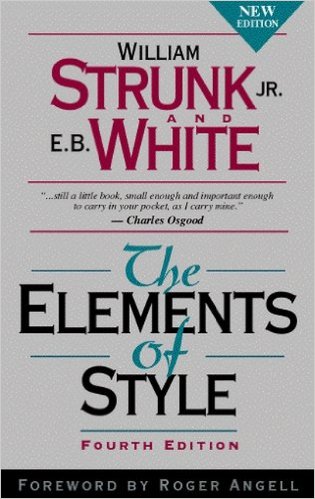
“Omit needless words” is one of the writing rules included in The Elements of Style, a classic writing guide by William Strunk, Jr. and E. B. White. (Strunk was the original author; after his death, White made some revisions and updates.)
Although I have a couple of quibbles with the writing advice, I continue to venerate The Elements of Style as the best book on writing ever written. Most writers do. You can find it in any library – but what you really need to do is purchase your own copy and reread it until you’ve memorized its content. (My copy is only 85 pages long. This is doable.) If you’re as broke as I was when I decided I wanted to be a writer, the full text of Strunk’s original 1918 version is available online at Bartleby.com.
I started thinking about the injunction to “Omit needless words” while I was reading a first-person essay by an Ethiopian refugee that was published in the New York Times Magazine this June. The author, Sehba Sarwar, used to work as a medical interpreter in Houston. The essay recounts a humorous conversation she had with a patient who was experiencing difficulty with an – um – intimate part of his body.
When Strunk and White urged writers to “Omit needless words!” they were thinking about expressions like “the reason why is that” (you should substitute “because”) and “used for fuel purposes” (you should substitute “fuel”). But I thought about another application for their useful advice. Here’s an excerpt from the beginning of Sarwar’s essay:
A local doctor, Dr. R., was on the line. “I need a favor,” he said. “I have this Amharic-speaking gentleman. He has limited English. Can you come now to help with interpretation?” I told Dr. R. that I could be free in 30 minutes. When I was sure my client understood what she had to do, I let her go and walked to his office three buildings away.
A couple of those details – she was seeing another client, Dr. R’s office was three buildings away – have nothing to do with the story. Why slow down the tale by mentioning them? And there’s another problem: She’s setting up the expectation that the time and distance elements somehow affected her story. They didn’t, and readers are apt to be confused (I was, anyway) that they’re not mentioned again.
I often read personal essays that make the same mistake. Here’s how writing (good writing) works: Every detail helps create the effect you’re working for. It’s sort of like constructing a building, brick by brick. If the detail doesn’t help you communicate your message, delete it.
I should add a caveat here. When you start writing your piece, you should include everything, for two reasons. First, you don’t know what will turn out to be important later. Second, you shouldn’t block the flow of ideas by editing prematurely.
But when you’re working on your final draft, be sure to heed that useful advice from Strunk and White: “Omit needless words.”

I’m afraid not everyone is as enamored of Strunk and White as you are, Jean. For one critique, go to http://www.chronicle.com/article/50-Years-of-Stupid-Grammar/25497.
That’s not based on the latest version of the stylebook, so maybe some improvements have been made in the last few years. I hope so.
I read Geoffrey K. Pullum’s critique several months ago, and he’s right! (I did say in my post that I had some quibbles with Strunk and White.) Still, “The Elements of Style” is an excellent starting point for anyone who wants to be a better writer. My hunch is that Pullum is overstating his case because – face it – an article about “some quibbles” wouldn’t make much of a splash.
You might also be interested to know that elsewhere Pullum (or one of Strunk and White’s other critics) issued a retraction. The alleged mistake about passive voice in “The Elements of Style” isn’t really a mistake. If you read what S&W actually said, they didn’t really label the supposedly offending sentence as passive.