Category Archives: Writing Skills

Test Yourself on Some Tricky Words

Here’s a chance to test your knowledge of some tricky words. Which sentences do you think contain errors? When you’re finished, scroll down for the answers.

1.  The new agency is comprised of five departments.

2.  Because Jack was disinterested in college, he dropped all four of his courses.

3.  I try to use the same PIN number for all my accounts.

4.  Babette’s writing skills are excellent, but she needs to improve her verbal presentation skills.

5.  The continual stream of soothing music helped Faye fall asleep quickly.

6.  I set aside time for a long walk everyday.

7.  The criterion for hiring a new manager need to be stated more clearly.

8.  You should wear that shade of blue more often; it compliments your eyes.

________________________________________________

Here are the answers:

All eight sentences contain misused words!

1.  The new agency is composed of five departments.  (Comprised means “includes”) You could also write the sentence this way: The new agency comprises five departments.

2.  Because Jack was uninterested in college, he dropped all four of his courses.  (Disinterested means “impartial” or “unbiased”)

3.  I try to use the same PIN for all my accounts. (PIN number is redundant. A PIN is defined as a Personal Identification Number.)

4.  Babette’s writing skills are excellent, but she needs to improve her oral presentation skills. (Verbal means “referring to words.” A written document is considered “verbal.”)

5.  The continuous stream of soothing music helped Faye fall asleep quickly. (Continual means “continuing with occasional interruptions.” Continuous means “continuing steadily.”)

6.  I set aside time for a long walk every day. (Everyday is an adjective and has to be followed by a person, place or thing: My everyday routine was interrupted by a power outage.)

7.  The criteria for hiring a new manager need to be stated more clearly. (Criterion is singular.)

8.  You should wear that shade of blue more often; it complements your eyes.  (Complements means “enhances” or “completes.” Compliments – spelled with an “i” – means “praises.”)


Share

Untangling a Problem with Commas

Last week a friend and I had some fun trying to untangle the punctuation in a complicated sentence. Here it is – see what you think:

We are happy to welcome two new members, John’s friend, Tony, and Linda’s cousin, Martha, to our group.  CONFUSING

Whew. Five commas! Too complicated. And there’s a hidden problem: Anyone reading the beginning of the sentence can’t be sure how many people are being welcomed. Are we talking about just two new members – or other people as well?

We are happy to welcome two new members, John’s friend, Tony, and Linda’s cousin…

We could be talking about:

  • two new members
  • John’s friend
  • Tony
  • Linda’s cousin

That’s five people instead of two.

So we have a confusing sentence. Is the confusion our fault, because we didn’t read the sentence carefully? The writer’s fault, because the sentence is clumsily written? Maybe.

Or…is it the fault of our language, which uses the same punctuation mark for appositives and lists?

(I need to explain that constructions that involve a voice drop – like “John’s friend, Tony” and “Linda’s cousin, Martha” – are called appositives. Read those phrases aloud and you’ll hear the voice change. I never used the term appositive with my students – we used the label Superman, and you can find out why if you click the link.)

Both appositives and lists work very differently – but they both use commas. Geez Louise. How are you supposed to tell what a sentence like today’s example means? You have to read it twice to figure it out.

And there’s still another knot to untangle. If you write “John’s friend, Tony,” you’re saying that poor John has only one friend. The same applies to “Linda’s cousin, Martha.” Linda has only one cousin. What if she has several cousins?

So – how to fix it?

We could diagram the sentence and drive ourselves crazy. Or (my preference) we could use common sense to simplify the sentence.

My rule of thumb is “no more than three commas per sentence.” The truth is that often I use more commas than that. But my rule-of-three helps me spot sentences that are too complicated and fix them.

Here are some possibilities:

We are happy to welcome two new members to our group: John’s friend Tony and Linda’s cousin Martha.  CORRECT

This is my favorite solution. A potentially confusing sentence like today’s example really shouldn’t be split in half:  “We’re happy to welcome two new members, blah blah blah blah blah blah blah, to our group.”

If you want to be more informal, how about this? I love dashes – they solve many sentence problems.

We are happy to welcome two new members to our group – John’s friend Tony and Linda’s cousin Martha.  CORRECT

Dashes can also come to the rescue if you really, really want to split the sentence:

We are happy to welcome two new members – John’s friend Tony and Linda’s cousin Martha – to our group.  CORRECT

Not difficult, is it? And we didn’t have to call upon any grammatical terminology! You and I have been using the English language all our lives. All the sentence patterns we need are embedded in our heads. We just need to practice using them!

(Click to download a free handout that explains commas without grammatical jargon.)


Share

Challenge Them!

Last week, while I was waiting to meet a friend at a coffee shop, I picked up a flier for a couples workshop. The title was ‘C’ Your Way to a Better Marriage, and it promised to cover the “3 C’s of Relationships: Courtesy, Communication, and Commitment.”

I am quite happy with my marriage (43 years and counting!). But even if I were looking for ways to improve our relationship, I wouldn’t have signed up for that workshop. The reason? It violates one of my most important rules for living (and, incidentally, writing): Never tell people what they already know.

Now I’ll readily admit that my communication skills could use some work, and I could be more courteous when I’m talking to Charlie, and there are moments when we both question our commitment to each other (like when he talks too much about hockey and I forget to put gas in the car).

But both of us – and just about everyone who’s serious about marriage – already pays lip service, at the very least, to Courtesy, Communication, and Commitment. As Gertrude Stein said about Oakland: “There’s no there there.”

I once heard a minister – I’ll call her “Julie” – talk about her experiences with counseling troubled couples. She said she avoids offering conventional advice (“be more loving,” “practice listening”) because couples immediately tune her out.

Instead she always begins by imposing a rule: The spouse who brings up a complaint is allowed to talk only about their own behavior. So if I complained about Charlie’s endless talk about Sidney Crosby and Mike Babcock, “Julie” might ask me what  strategies I – myself – have tried to make our conversations more lively.

This isn’t a column about marital advice (well, it is, sort of), and I want to add that “Julie” was well aware that her rule could open the door to victim-bashing and other evils. She had many tools in her counseling toolbox.

But here’s the thing. Her counseling strategies were designed to catch couples off guard. She aimed to shake up the people she was working with and challenge them to think in new ways.

Folks, those are the very things that writers are supposed to do.

Some years ago someone hired me to copyedit a novel. I read the first chapter and immediately returned it (reluctantly – I could have used the money).

The novel was about a man who’d lost his job. With no money for rent and groceries, the family temporarily moved in with Grandma and Grandpa. At the end of Chapter 1, the unemployed man and his wife were sitting alone at the kitchen table, talking about what lay ahead. In spite of their worries, they were confident about the future. “We’ll make it somehow,” the wife said, squeezing her husband’s hand.

It was warm and wonderful – and dull. Why on earth would you turn the page to start reading Chapter 2? You’ve already learned that everything is going to be ok. There’s nothing to drive the rest of the book forward.

Everything you write should have an edge – something unexpected that keeps readers interested. (To experience what I’m talking about, read Chapter 1 of any novel by John Grisham.)

If you’re writing about a familiar topic (like marriage!), find an unusual angle. Dig below the surface to find a contradiction or conundrum. Here’s an example: Everyone agrees that communication is vital for a healthy relationship. (Ho-hum.) But should a husband tell his wife that he’s attracted to, say, a hot-looking woman he’s just seen on TV? In other words, are there things that are better left uncommunicated – and if so, what are they?

What about courtesy – is it 100% necessary? Am I allowed to be in a bad mood because my favorite dancer just got booted off Dancing with the Stars, and is Charlie allowed to be annoyed because I’m not my usual charming self (hah!)? And are there any limits to commitment? What if she habitually abuses one of the kids, or he refuses to quit gambling?

Writing is – first and foremost – about thinking. If you don’t have something fresh to say, find another topic or another approach. Here are some suggestions:

  1.  Stories are solid gold. Every writer should have a large repertoire of provocative stories stored somewhere in your brain.
  2. Watch your own reactions as you interact with other people. What surprises or puzzles you? Life’s little mysteries can open the door to terrific writing.
  3. Read, read, read. How long does it take for you to realize that a particular writer has (or doesn’t have!) something worthwhile to say?

                 August 4, 1974

Share

Fudging

Last week several friends and I did some emailing back and forth about a legitimate use of quotation marks that I had glossed over. Or you could say that I fudged it. So today I’m going to cover a legitimate but widely misunderstood way to use quotation marks.

A story might help. Last week my husband and I came across the word pusillanimous and realized we weren’t sure about the meaning. (I just checked the dictionary: it means “timid.”) I was annoyed because I remember struggling with pusillanimous when I took my SATs as a senior in high school. Some people never learn.

(Here’s another word I have to look up every time: nonplussed. Even though I know it means “surprised” and “confused,” I don’t trust myself.)

You probably noticed that I used quotation marks around “timid,” “surprised,” and “confused.” That’s because I had departed from the usual way of using those words. And that’s where we run into problems.

Writers often use quotation marks to signal an unconventional use of a word:

Many people mispronounce “nuclear” and “mischievous.”  CORRECT

But that doesn’t mean you can use quotation marks willy-nilly!

Dr. Caldon is researching the problem of nuclear waste.  CORRECT

With a mischievous smile, Sandra handed me the box.  CORRECT

What you don’t want to do – please, please! – is overuse this handy form of punctuation. Earlier in this post I said I’d fudged my previous explanations about quotation marks. Yes, that’s a departure from the usual meaning of fudge – but there’s no need to apologize for it.

I think observation is one of the best ways to learn how to use quotation marks (and to pick up many other writing skills). Pick some good role models and study them. You’ll learn a lot!


Share

Down with Lists!

Everybody knows what a list is, right? Wrong. Many’s the time I’ve sat down to edit an article or memoir for a friend or client – only to discover that I was actually reading a list. Not fun, and not what the writer was trying to do.

It’s easy to be fooled, especially when you’re the writer. You think your piece sparkles. It’s charming and lively. It couldn’t possibly be a list, right?

Wrong.

If the piece you’ve written doesn’t make a point, chances are it’s a list. An essay about a visit to Costa Rica might actually be a list. So could an account of your family reunion last summer, or an examination of the pros and cons of small-ship cruising. If what you’ve written doesn’t make a point – if it just stacks up a series of events or facts – it’s probably best described as a list.

So what constitutes a point? It’s an idea with an attitude. “My trip to Canada” isn’t a point. “I was amazed by the wildlife in Canada” is.

Your point doesn’t have to be a lesson. In fact often you’re better off if you’re not trying to convince your readers that you’re passing on age-old wisdom. It’s hard to pull off that kind of writing without sounding stodgy and superior.

I remember a conversation I overheard once between two young mothers – “Carol” and “Betty.” Carol had a six-month-old infant, and she was asking Betty – who had four children – to share the best parenting advice she’d ever heard.

Betty was thoughtful for a moment. And then she said, “Always make your children sit down while they’re eating something messy. Especially chocolate.”

Not profound – but you get a feeling for the kind of mother Betty is. She sounds real. And that’s what you want your writing to do – and what won’t happen if you recount, in order, the 15 places you visited on your last visit to Chicago. (I’m going to add some practical advice of my own: If you have a sinking suspicion that you’ve written a list, you probably have.)

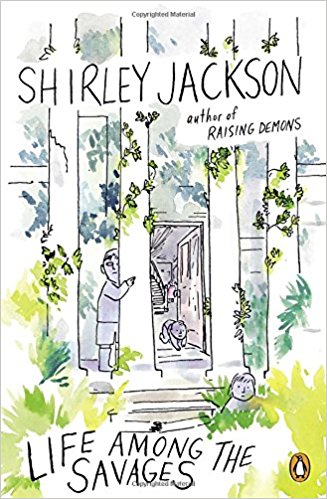
Lists have been on my mind this week because I’ve been reading a wonderful new biography of one of my favorite writers – Shirley Jackson. In an earlier post I remarked that I’d read Jackson’s memoirs Life Among the Savages and Raising Demons over and over. She was a writer, not a list-maker.

Jackson enjoyed motherhood and was fascinated by her children – which doesn’t mean that she went on and on about what a good mother she was. I don’t think there’s a single piece of parenting advice in either of those books. Often she’s looking wryly at either her own foibles as a mother or the odd behavior of her children.

There’s Jannie, for example, who had a string of imaginary friends, all named Marilyn. And Sally, who was a practitioner of magic. There’s also Barry, who insisted on having a fried egg for dessert every night while everyone else had chocolate pudding, and Laurie, who – after recovering from a serious accident – insisted on taking another ride in an ambulance because he’d been unconscious during the first one.

You get the idea.

So what is Jackson’s point? I’d venture that it’s something like “this is what families are like.” Every tale in Life Among the Savages takes a fresh look on the four children and two adults who live in Jackson’s large and disorderly New England house. The family members all have distinct voices, and the two adults (who strive mightily to keep the household in order) have a completely different outlook from the four children (who couldn’t care less about brushing their teeth and helping out in the kitchen).

When Jackson makes a list, it always a point. For example, on pages 18 and 19 Jackson describes an old house they were renting. She mentions a desk, a clothesline, a rocking chair, and a highboy. Not interesting at all – except that this house, in Jackson’s telling, had strong preferences about those four things, and Jackson and her husband finally stopped fighting the house and simply let it have its way.

I’m remembering an article that Maya Angelou wrote about houses she’d lived in. She thought one of her marriages might have survived if she and her husband hadn’t been living in a house that hated the two of them.

Could you find a way to give a house a personality? More important, can you give yourself a personality? On paper? It’s easy to come across as an interesting person when you can use your voice, mannerisms, and facial expressions in a conversation. But can you do it solely with words on paper or a computer screen?

If you can do that, you can ignore my warnings about writing lists. You writing will be alive and real – still worth reading, decades later, like Jackson’s wonderful family memoirs. 


Share

Writing Secrets

A couple of weeks ago, a friend and I were talking about some writing tips we’d picked up – almost by luck or by accident – on our way to becoming professional writers. We both came up with a list of “I wish someone had told me sooner” pointers. Today I’m going to talk about four of them.

1.   Break up long paragraphs.

Somewhere along the way both my writer friend and I started breaking long paragraphs in half (in defiance of what English teachers always tell you about unifying a paragraph). Nobody – as far as we can remember – ever told us that it’s ok to just split a paragraph into two shorter ones. Any writing task is much more readable that way. What we find really funny is that nobody – not even the most sharp-eyed editor – has ever caught on to what we were doing.

 2. Use dashes to enliven your sentences.

This was another practice we were surprised to discover that we had in common: dashes. We use lots of them. (Confession: sometimes I overuse them.) Alas, I’ve never been able to work out a system for teaching writers how to use dashes. But I can tell you this: if you do a lot of reading, you’ll figure it out. Give yourself permission to use dashes – they’re wonderful!

3.  State ideas strongly.

There’s nothing new about this gem of advice, which you’ll find in most books that teach writing. But it’s easily overlooked. Avoid writing “This was not easy” or “I didn’t like to do those tasks.” State what you DID feel: “This was difficult” or “I disliked doing those tasks.”

4.  Beware of joining sentences with and.

I wish I could thank the professor who urged me to break my and habit – and I wish I hadn’t had to wait for graduate school to be told that it was a problem. Joining sentences with and is easy, and most beginning writers overdo it. (There’s an example for you.)

Here’s the problem: It’s juvenile. If you listen to small children talk, you’ll hear strings of sentences – one after another – joined with and. Strive to use more sophisticated joiners: if, when, because, although, and so on. Show relationships between ideas rather than just gluing them together:

Clouds were rolling in, and I grabbed my umbrella.  JUVENILE

Because clouds were rolling in, I grabbed my umbrella.  SOPHISTICATED

I just reread this post, and I was struck by the simplicity of these bits of writerly wisdom. Try them – you’ll quickly see a big improvement in your writing!


Share

What Do Quotation Marks Mean?

You don’t see many news stories about punctuation marks! But the Huffington Post just published an article about the unconventional ways that President Trump uses quotation marks (“”) in his Tweets.

Questions about quotation marks started flying when a recent Presidential Tweet alleged that the Obama White House was “wire tapping” the Trump campaign. When reporters pressed for evidence, the White House pointed to the quotation marks and explained that the Tweet wasn’t really about wiretapping – it was about surveillance.

But that only created more confusion, because other Presidential Tweets frequently used quotation marks for emphasis – when discussing “big stuff” or a “bad” situation, for example. And a linguistics expert who studied a series of recent Tweets noticed that sometimes the President seemed to be trying to tag words and expressions that he doesn’t use very often. For example, “carnage” had quotation marks in one recent Tweet.

I’m not a political insider, so I’m not going to try to offer any interpretations about what the Tweets might mean – or not mean. What I want to do here is plead for clarity.

Clear communication should always be a writer’s top priority. That means you shouldn’t use unconventional punctuation (such as ?!) that might confuse readers.

And you shouldn’t use words loosely or ironically. Let me give you a common-sense example. Young children sometimes don’t understand figurative language. So if your five-year-old is helping you put glassware onto the dinner table, don’t say “Drop what you’re doing and look at this, Susie!”

Crash. Tinkle. Shattered glass everywhere.

Quotation marks properly mean that you’re quoting someone’s exact words, and they’re used for titles of poems and short stories – and that’s about it. But – alas – many writers think quotation marks are cute – or a handy way to call attention to a word – or a signal that a word is being used in an unusual way.

Serious writers never use quotation marks in those ways, and you shouldn’t either.

I hope you’ll bear with me while I give you a non-political example that makes the same point. Some of you know that I often help police officers with their paperwork. Here’s a problem I gripe about all the time – officers who use advise when they mean said:

Jones advised me that he arrived home at 6:20 PM.

I once did an editing job for a former cop who was working on a doctorate. I had to explain to him that his doctoral committee was going to have a big problem when they reviewed his dissertation: how did he manage to complete years of graduate work without learning that advise means “counsel” or “suggest”?

Professionalism – that’s the bottom line. If you’re not aiming for professionalism in everything you write, when do you plan to start?


Share

Some Writing Advice Isn’t Useful

I started teaching English in 1969, and I’m still at it. Although I’m officially retired, I facilitate a local writing group (and have a lot of fun doing it).

That means I’ve spent a huge part of my life thinking about writing, talking about writing, and critiquing what other people have written. Sometimes I wonder if I should have tried to make a detour somewhere.

Well, actually I did. I taught basic skills in a prison for three years. I was a vet’s assistant for a while. I taught in a police academy.

But most of my career has focused on one narrow groove – helping people with their writing. Not only did I have a wonderful time: I learned a lot. And I kept learning.

What I’ve discovered is that writing is bottomless. It’s a topic you just can’t use up. There’s always something new to learn…if you can find resources that know what they’re talking about. (Here’s a good one: Naked, Drunk, and Writing, by Lara Adair.)

Unfortunately I’ve found that much advice about writing isn’t very helpful. This morning I came across yet another article that promises more than it delivers: “8 Things We Can All Learn from Elizabeth Kolbert.” 

The article is exhilarating, well written, and fun to read. But (and this is a big but) I’m wondering how anyone could to turn the advice into something practical and useful.

For example, advice #1 is “Leave Home. Talk to Strangers.” Elizabeth Kolbert is a journalist who’s traveled to far-flung and fascinating places to write lively pieces about the Great Barrier Reef and the Amazon. Applause, applause!

But what am I supposed to do with that advice? Travel – where? Talk to – whom? Write about – what? I can’t just pack up and head for Greenland, as Kolbert did. Is there a way to apply this rousing advice close to home? Instead of digging in to the “Leave Home” idea, the article rushes on to #2: “Show – and Also Tell.”

Applause again! But how do I do that? The article says that Kolbert put on a wet suit and explained ocean acidification by writing about scuba diving. Good for her! But what about people like me who don’t write about the ocean and have never gone scuba diving? (Does snorkeling count? I love snorkeling.)

But before I can figure out how to integrate “Show – and Also Tell” into my writing, we’ve raced on to #3 (“Be Adaptable”). And so it goes. 

The article is fun to read, and it might motivate a writer who’s feeling sluggish and bored. But let’s get real. Writing usually doesn’t feel like an exhilarating dash around the world. It’s a slow, careful process requiring a lot of thinking, experimenting, and craft.

Yes, writing can be exciting and, more often than you’d think, it’s great fun. When one of my writing tasks is heating up, I can’t wait to put my fingers on the keyboard and start tapping.

But how do you get ideas, and how do you organize them? And how do you make readers care about them? There are very few resources to tell you how to do those things, and the article about Elizabeth Kolbert – alas – isn’t one of them.

Here’s a piece of writing advice that doesn’t get much coverage in articles and books about writing: Don’t get ahead of your reader. It’s not as exciting as a trip through the Amazon, but it’s an important concept – as I realized this week while I was editing a book for a friend.

He’s an expert on his subject (keeping tropical fish). The people who will buy his book are not. Yet he kept using terms that a newbie would find puzzling. What are “community fish”? What does “substrate” mean? And he keeps urging readers to control the lighting, temperature, and water chemistry – but he doesn’t explain how to do these things.

After I started editing, I called him to talk about the book. Chagrined, he admitted that he hadn’t tried to picture his readers while he was writing. Keeping tropical fish is such a familiar topic to him that he couldn’t wrap his head around the fact that other people don’t have the slightest idea of what’s involved. (Right now, while I’m typing this, he’s going back over what he’d written and filling in the details. At least I hope he is.)

Let’s not get sidetracked here. Yes, you need to keep your readers in mind when you’re writing. But the takeaway I’m hoping for today is bigger than that. Here it is: Don’t confuse a pep talk with genuine writing advice. They’re not the same thing!

If you sit down to write and find that you keep hitting your delete key, and you’re struggling to find the words you want, and your piece sometimes feels like a dog pulling on a leash – congratulations! Now you’re in the realm of real writing. No, it’s not always fun. But the reward – a finished piece that others find worth reading – is worth it.

 

Share

Alexander Hamilton

Every week I spend several hours driving back and forth to ballroom lessons. For the past month I’ve been using that time to listen to the Hamilton cast album from the hit Broadway show.

I’ve spent most of the time listening to Disc 1, which tells the story of Alexander Hamilton’s role in the fight for American independence. (I didn’t like Disc 2 as much because Hamilton went through some bad times after the Revolution.) The show is upbeat and exhilarating. (I had quite a shock when I found myself enjoying rap!).

Of course I’ve watched (twice) the PBS documentary about the making of Hamilton. I was particularly struck by some advice that Broadway legend Stephen Sondheim had for Lin-Manuel Miranda, the creator of Hamilton.

The amount of biographical detail that Miranda had to deal with was overwhelming – Hamilton led an extraordinary life packed with adventures. Sondheim’s advice was to look for events that lent themselves to musical treatment.

I have no idea how you would do that. But what intrigued me was that I wouldn’t have approached the creative process that way. I would have made a list of the important events in Hamilton’s life and turned each of them into a song.

Sondheim’s advice is (not surprisingly – he’s Broadway royalty!) much better. And there’s a lesson here that all writers can learn: Finding a focal point for a writing task should always be a priority.

That probably sounds obvious, but I don’t think it is. Many writers (including me!) think they’re finished when their content fills a piece of paper or a computer screen. That’s only the first step, folks. You have to decide what your purpose is and then shape your material to serve that purpose.

If you’re a lively and interesting person with lots of ideas and stories, your first draft is probably going to wander all over the place. (If your name is Jean Reynolds, you may have many drafts that behave the same way.)

No problem. In fact “the more, the merrier” is a great principle for writers. You want a rich storehouse of content to work from.

But at some point you have to find a focus – and be ruthless about it. You may have to cut, cut, cut. Perhaps you’ll have to turn your piece into two pieces. You’ll almost certainly need to do some reorganizing.

A good way to start the reshaping process is by asking yourself some questions. Do you want your piece to be brisk and informative? Tender and touching? Funny? Brilliant? Startling? Every sentence must match that purpose. Anything that starts to go off the rails has to be reshaped or removed.

Lin-Manuel Miranda’s purpose was to create a musical play about the life of Alexander Hamilton. That meant Miranda could never stray from the idea of music. Every incident in the play needed a musical setting. If an incident from Hamilton’s life didn’t lend itself to music, it had to go.

And what did Miranda end up with? One of the biggest hits that Broadway has ever seen. Let’s all make a resolution to be just as smart when we sit down to write!


Share

Good Writing Habits

My husband no longer watches as much football as he used to. One thing that turned him off was the endless celebrating – high-fives and dancing not just after a touchdown, but after every successful pass, catch, and tackle. My husband likes to quote football legend Vince Lombardi: “When you go into the end zone, act like you’ve been there before.”

The same principle applies to writing. Act like you’ve been there before! Adopt writing habits that make you look like a pro, even if you’re not.

Today I’m going to discuss some common writing practices that might label you as an amateur:

1.  Using British writing practices even though you’re an American.
British writers use single quotation marks (often called ‘inverted commas’) for quoting someone’s exact words. But double quotation marks, “like this,” are standard practice in the US. American writers use single quotation marks only for
quotes-within-quotes and for named plant varieties.
If you’re a British writer who’s publishing in the UK, go ahead and use single quotes. But if you’re an American publishing (or hoping to publish) in the US, use double quotation marks and other American practices.
And don’t fool yourself into thinking that British writing habits will make your writing sound elegant. You’ll just seem confused.

2.  Using quotation marks for emphasis, cuteness, or an inexact word choice.
Quotation marks are properly used when you record someone’s exact words. They’re also used for titles of short works of art (songs, poems, short stories).

Many amateur writers have the unfortunate habit of using quotation marks to signify that a word or phrase doesn’t quite mean what it says:

My “job” pays me so little that after I buy gas and uniforms, almost nothing is left. [Message: It’s not much of a job.]
Why don’t you come over for a “cup of tea” this afternoon? [Message: I’ll be serving something else besides tea.]
Our “hostess” treated us like we were an unwelcome nuisance instead of cherished guests. [Message: She was a terrible hostess.]

Professional writers don’t use quotation marks this way, and you shouldn’t either. Your choices are to use the word without apology or to find the exact words you want.

3.  Using slashes, which should be reserved for business writing.

You can have cake and/or ice cream.
You can have cake, ice cream, or both.  BETTER
She’s a cook/housekeeper.

She works as a cook and a housekeeper.  BETTER
He’s majoring in biology/chemistry.

He’s doing a double major in biology and chemistry. BETTER

4.  Overusing would.
I’ve had many students who repeatedly used would for actions that happened in the past. Of course it’s correct to use would this way! But overdoing it looks amateurish. You’ll sound more professional if you use past-tense verbs most of the time.

Kay would get up early every morning to study a College Boards review book. She would work the sample problems over and over until she got each one right. Sometimes she would ask friends who were good at English or math to help her with difficult questions. Her hard work paid off: She was offered generous scholarships to three colleges.  OVERUSE OF WOULD

Kay got up early every morning to study a College Boards review book. She worked the sample problems over and over until she got each one right. Sometimes she asked friends who were good at English or math to help her with difficult questions. Her hard work paid off: She was offered generous scholarships to three colleges.  BETTER

     Vince Lombardi


Share