Category Archives: Writing Skills

Anne Wilson Schaef

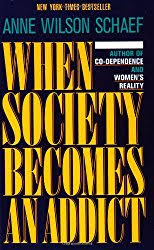
For some time now I’ve been working on a post about psychologist Anne Wilson Schaef. (It’s still not finished, so you won’t be reading it today.) Her provocative book When Society Becomes an Addict argues (convincingly, I think) that hidden addictive patterns are rampant in our culture. According to Schaef, our “Addictive System” smothers and silences everyone outside the power matrix…unless, that is, they insist on having their voices heard.

It’s clear that writers – people like you and me – have an important role to play in this struggle. We can give a voice to feelings and ideas that the Addictive System doesn’t want to hear. But today I want to talk about Schaef and her work from another angle.

I’ve read a number of her books and listened to several of her tapes…with mixed feelings. I think she’s an insightful commentator about some of the problems our culture is facing. But I also think she’s too quick to put the “addiction” label on feelings that should be valued – even cherished. (Please note that I’m not referring to the very widespread and serious problem of people addicted to alcohol, drugs, pornography, sex, gambling, and so on.)

For example, Schaef has diagnosed herself as a”romance addict.” Yipes! I think most people are “addicted” to romance. Yearning for an attractive person you’ve just met is perfectly normal. Yes, it complicates life – but it also enriches it in countless ways. (I’ve written a free ebook called Impossible Love.) 

Another example: one of Schaef’s books quotes a woman who confesses that she’s “addicted” to music and uses it to change her moods. Good grief. Isn’t chasing after a feeling one of the best reasons ever for listening to music? And why would anyone not want to be “addicted” to music?

And there’s something else I find odd about Schaef. I think it hints at an issue that’s both interesting and important.

Schaef has led a long and productive life (she’s in her 80s now). Throughout her career she often moved from place to place. At one point she was working at a big hospital in New York City. Soon after that she moved to a rural setting…and so on.

It’s puzzling: for Schaef, one place seems to be just like another. She never mentions missing the vitality of New York – or (the opposite feeling) relief at finally getting away from the Big Apple’s noise and congestion. There’s no nostalgic looking back at a place she’s leaving, and no joyful anticipation about the next move. She just seems to pick herself up and move on.

I live – by choice – in a lovely Central Florida town, so I understand – sort of – why someone might not want to live in a huge metropolitan area. And of course I can understand why city dwellers love their lifestyle. (If it weren’t for the brutal winters in the Northeast, I’d still be living on the Upper West Side of Manhattan.)

What I don’t understand is not caring about where you live.

Schaef strikes me as a person who isn’t grounded. Sometimes she sounds like the spiritual writers of old who preached detachment from everything – you weren’t even supposed to notice that you were hot, or cold, or in pain. You just kept trying to reach the next rung on the spiritual ladder.

Yet Schaef is still an engaging and insightful writer. There’s so much vitality crammed into her soul that she can’t completely turn it off. But what – I wonder – would her books and her tapes (and her life!) be like if she gave herself over to the mysteries within – started loving them instead of labeling them?

And that brings me back to the topic of a writer’s voice. What thoughts and feelings do you (and I) routinely try to turn off and get rid of? Is there untapped energy hidden somewhere in your soul (and mine) that’s waiting to be discovered? What truths are concealed inside our dreams,  jealousies, joys, and rages?

All of those questions can be starting points for finding your unique voice.
Share

Writing and the Brain II

In my last post, I said that the brain works in mysterious ways to shape all our experiences and actions. Today I want to follow up with a story (one of my favorites) about the workings of the brain, and then I’m going to talk about writing.

Two men were walking along Fifth Avenue in New York City. One was an ornithologist (a scientist who studies birds). The other was a businessman. Fifth Avenue is one of the busiest streets in the world, and the men were surrounded by urban noise: engines humming, horns blowing, people talking, feet clattering, brakes screeching.

Suddenly the ornithologist stopped. “That sounds like a wooded warbler,” he said. “I wonder how it got here.”

“You’ve got to be kidding,” his friend said. “There’s no way you could hear a bird – much less identify it – in all this noise.”

The ornithologist reached into his pocket and dropped a quarter on the sidewalk. Instantly about 30 people stopped to look down at their feet.

The point, of course, is that long years of study had instilled complex bird-related software into that ornithologist’s brain. In the same way, long years of handling dollar bills and loose change had instilled complex money-related software into the brains of the other New Yorkers on that sidewalk. (Have you ever noticed that even people who swear they’re hopeless at math can calculate discounts in their heads – and always know how much change is due after a purchase?)

So let’s talk about the language software inside our brains.

If you grew up speaking English, you had a vast amount of English language software installed in your head by the time you entered kindergarten – and it continued to become larger and more complex as you grew older.

But there’s a problem: most of the software in our heads is related to talking. And so, when students sit down to write a high school or college essay, they tend to fall into their familiar speaking patterns – with disastrous results. “I guess I’m just not a writer,” they think. They’re dead wrong. The problem is that they haven’t yet made the transition from conversational English to formal writing. To put it another way: they haven’t yet developed the software needed to be effective writers.

Think for a moment about all the ways that talking is different from writing:

  • Casual conversations don’t require punctuation.
  • You don’t have to worry about homophones (sound-alike words like your/you’re and rain/rein/reign).
  • You’re allowed to jump from topic to topic.
  • Sentence fragments are ok.
  • You don’t have to formally introduce an idea and then develop it with examples.
  • You can repeat a familiar word as many times as you like.
  • You can use regional and colloquial words and expressions.

Most important, conversation doesn’t allow do-overs. Once you’ve said it, it’s out of your control.

Avid readers have two huge advantages. First, they quickly develop additional software for writing. Without realizing what’s happening, readers gradually master complex sentence patterns, punctuation rules, sophisticated vocabulary words, and systems for organizing ideas. Second, they feel empowered to make changes in what they write. There’s always a sentence that can be improved, an idea that can be sharpened, a mistake that can be corrected. Non-readers, by contrast, often feel helpless when they’re faced with a writing task. They write as quickly as possible and hand in their work without checking it over. 

* * * * * *

Last month I conducted a grammar workshop for an enthusiastic group of people who work for a local government agency. One participant told me she’d had an English teacher who required her students to memorize all the forms of the verb to be: am, is, are, was, were, be, been, being.

Sigh. How is reciting that string of words going to make anyone a better writer? The time spent drilling those words into students’ heads – and memorizing other grammatical jargon – would have been much better spent on reading (or writing!).

If you’re a teacher, what are some strategies you could use to empower your students to feel empowered – and to build on the language software already installed in their heads?

If you’re a parent, what are some strategies you can use with your children?

If you’re a writer, what are some strategies you can use on your own?

Be creative, and have fun!

                                   Wooded Warbler

Share

Writing and the Brain I

Because our town has a busy Lighthouse training center, I often see blind persons who are learning how to safely navigate sidewalks, traffic, and intersections. I sometimes wonder what it would be like to lose my sight – would I ever be brave enough to walk around by myself? And I’m equally curious about what it would be like for a blind person to suddenly regain their sight. Would that be a glorious experience – or a confusing one?

In 1993 The New Yorker published an account of a 50-year-old masseur who suddenly – thanks to advancements in surgery – regained his sight after almost a lifetime of blindness. Noted neurologist and author Oliver Sacks described what life was like for “Virgil” both before and after his operation.

It’s a story that’s exhilarating at first and then takes a depressing turn. “Virgil” indeed had his sight restored, but he never was able to see his surroundings the way you and I do. Turns out that “seeing” involves much more than optic sensors and a functioning eye: We need to develop an elaborate brain network that’s capable of interpreting the visual stimuli in front of us. Virgil – blinded as a young child – never had an opportunity to develop that network, and at 50 he was unable to restart the process. He couldn’t judge distances, and he couldn’t make sense of the colors and shapes in front of him. A nose, a hand, a shoulder: how did they fit together? His brain couldn’t figure it out. 

 *  *  *  *  *  * 

Postmodern theory can seem abstract and irrelevant to everyday life, but Virgil’s story confirms what the postmoderns keep telling us: We can never have a totally objective encounter with reality. Our brains have to interpret everything we experience.

And that brings us to writing – and all the hand-wringing despair that many students and newbie authors feel when they face a writing task. Because we use language almost every day of our lives, it’s a shock to discover just how hard writing can be. After a long career as a writing instructor, I can testify to the truly awful essays that many first-year college students write – and to the dismay they feel when I mark up and return their work.

Why is writing so hard for so many people? Blame the brain.

Most of the language hardware in the human brain gets organized and developed in early childhood. By the time children go to school, they’ve mastered many elaborate sentence patterns and grammatical constructions.

But then – as they get older – they learn that writing is different from everyday conversation. Good writers need large vocabularies, a knack for organizing ideas in sophisticated ways, and a familiarity with a complicated punctuation system that has little connection to everyday speech…

…unless you happen to be a voracious reader. My next post will discuss some of the differences between everyday conversation and formal writing and – no surprise – I’m going to suggest that reading (rather than learning sentence diagramming and grammatical theory) is one of the best ways to develop better writing skills.

Share

A Writer’s Voice

Most great writing shares a common feature that isn’t often discussed in writing classes: a strong voice.

That’s a tough concept to get across to a bunch of high-school students! How can you put your voice into something you’re writing?

The easiest way is to write as if you’re talking. You can use I, me, you, and similar words to write from your personal perspective.

But what if you don’t want to write so intimately?

Luckily there are other strategies. But first I would ask if you’re absolutely, positively sure you don’t want to use I and me. Many teachers discourage students from first-person writing, and that’s a shame. Topnotch professionals often write from an I/me standpoint, even when they’re tackling a serious subject. So don’t be too quick to assume you can’t use your own point of view.

Let’s say, however, that you’re writing a travel piece that isn’t supposed to include details about your own visit there. Even if you don’t talk about your own memories, you can inject feelings into the places you’re describing.

For example, an article about Paris could describe what visitors might see, hear, and feel during a visit to the Eiffel Tower. Choose intriguing details and evocative words, and readers will get a sense of who you are and what excites you. In other words, they’ll be hearing your voice.

Still another strategy is to discuss a problem or concern that your readers may have  experienced themselves:

“It’s the end of the month, there are two more bills to be paid, and the checkbook balance is close to zero. Many families dread those last few days before payday.”

 “As Election Day draws near, many Americans secretly wonder whether it’s really worth the bother to stand in a long line waiting for their turn to vote.”

A writer’s voice is a huge topic – one you should think about and experiment with as often as you can. Here are four more suggestions:

  1. When you’re reading something you enjoy, try to hear the writer’s voice in your head. Then reread the piece and try to figure out how the writer created that voice.
  2. Practice writing about events in your own life that are linked to an attitude, feeling, or belief.
  3. Try writing the same story from different viewpoints.
  4. Keep a self-discovery journal where you explore your personality from as many angles as you possibly can.

Share

Shaw’s Saint Joan

A concept called “the writer’s voice” has been on my mind ever since I saw Bernard Shaw’s Saint Joan during last month’s Shaw conference. I love the play, and I was fascinated by Sarah Topham’s portrayal of the Maid of Orleans. “Luminous” and “radiant” are the words most often used to describe Saint Joan, and they perfectly describe Topham as well.

But several times during this performance I was bored – sleepy even. I’ve always vehemently defended Shaw against the critics who say that his characters are nothing more than mouthpieces for his ideas. But during that performance I started thinking there might be some truth in those complaints…

…until the next morning. On the way back to our hotel after breakfast, my sister and I ran into a Shaw friend, Peter Gahan, who’s a much more perceptive critic than I am. I mustered enough courage to make a guilty confession: several times during Saint Joan I’d found myself dozing off.

Peter’s response helped me feel less guilty. The problem – in his view – was that the production played down the personalities of Joan’s enemies. According to Peter, the arguments against Joan aren’t just abstract ideas: they’re closely tied up with the values and life histories of the men who wanted to burn her at the stake.

To put it a different way: What I heard during the play was a chorus of voices wanting to put Joan to death. What I should have been hearing were five or six distinctly different men arguing their own viewpoints about why Joan was a problem and what should be done with her.

In my next post I’ll suggest some ways to help readers hear your voice in your writing.

Saint Joan at the Shaw Festival

         Saint Joan at the Shaw Festival

Share

Dancing at Lughnasa

Last month I traveled to Canada for a Shaw conference in Niagara-on-the-Lake, a beautiful little town that hosts  the Shaw Festival every year. Our group saw two Shaw plays (of course!), and many of us used our free time to see additional plays by other playwrights.

My sister and I decided to see Dancing at Lughnasa, a play about five sisters who lived in a small Irish town in the 1930s. It’s based on playwright Brian Friel’s actual family and their lives in Ireland almost 100 years ago. True to its title, Dancing at Lughnasa features some marvelous Irish dancing. Four of the five sisters want to attend a local dance festival, and they twirl wildly around their kitchen in anticipation. Even the fifth sister, who serves as a kind of mother figure for the family, is eventually drawn in.

But then the music ends, and the five women decide not to go to the festival after all. Where did all that ecstatic energy (one of my Shaw friends described it as “Dionysian”) go?

Nowhere. It’s forgotten as life returns to normal, which – in pre-WWII Ireland –  means a depressing and increasingly desperate quest for survival. Michael, the son of one of the sisters, grows up to be the play’s narrator. He recounts how he “selfishly” left the town as soon as he was old enough. “Selfishly”? There was nothing for him there – no hope for a career and a decent life.

After my sister and I left the Royal George Theatre that night, my thoughts kept returning to the idea of energy. I was disappointed that the dancing of those five women filled that theater with energy – and then, in a flash, it was gone. I wanted the women to hold on to that energy – struggle with it – and go wherever it wanted to take them.

Dancing at Lughnasa won both Tony and Olivier “best play” awards and was subsequently made into a movie that starred Meryl Streep – so clearly mine is a minority view. But I think that feeling I had in the Royal George Theatre – like watching the air fizzle out of a balloon – is worth thinking about.

It seems to me that life is all about energy. If you’ve ever been depressed (and that’s just about everyone), you know the force of will that’s needed just to get through your daily routine – and you may also remember how wonderful you felt when your energy started to trickle back into your life.

I’m thinking that energy is just as essential to writing. If I were writing a composition textbook now (and I’ve published two of them), I think I’d make energy my central focus. Find a topic that energizes you, and then explore ways to transfer that energy to your audience. (It ain’t easy, folks!)

This is clearly a new direction for me, and I’m not yet sure where it’s going. But here’s a list of suggestions for creating and sustaining energy in a writing task. (I hope there will be more to come!)

  • build momentum into the structure of your piece – by working towards a climax, for example
  • tell stories
  • search for fresh ideas and unfamiliar examples

And here’s the most important thing: you need monitor your own energy while you’re writing. If you’re starting to get bored, your readers are going to pick up that feeling.

I ran into that problem while I was putting together a presentation for this year’s Shaw conference. The solution (luckily I was doing a PowerPoint) was to make create some illustrations of my own – Playbills and Actors Equity cards to emphasize my point that Major Barbara is all about theatricality. (You can watch my presentation here.) Having fun is a great way to energize a writing task!

So much writing instruction plods along with advice about outlines, topic sentences, and the like. Of course those concepts are important. (I constantly think about topic sentences when I’m writing. I know how dull that sounds, but it’s a big help!)

Here’s the thing, though: before you even think about making an outline or writing a thesis statement, you should be gathering energy into a big ball that will explode into something lively and engaging for your audience to read.

What ideas and experiences are energizing you right now? Can you write about them?

Dancing at Lughnasa

                              Dancing at Lughnasa

Share

Plain Language

In my previous post, I talked about the Plain Writing Act passed by Congress in 2010. I often conduct writing workshops for government employees who are all for clear, direct, timesaving writing. “Down with gobbledygook and jargon,” they’ll say. “We want clarity and simplicity.”

But when I ask them to do some writing, what I get are sentences like “The fluid supply in my writing implement is exhausted.” (Translation: “My pen is out of ink.”) And when I insist on simple sentences, the room resounds with protests, arguments, and yelps of pain.

Why are fancy words and tangled sentences so popular? There’s a reason, and it’s embedded in the history of England.

 *  *  *  *  *  *  *  *

The British Isles have been invaded again and again. With each conquest, the victorious army brought its own language, such as Latin (under the Roman invasion), and French (during the Norman Conquest). Workers soon discovered that the best jobs went to the people who were willing to learn the conquerors’ language.

That’s why – more than a thousand years later – words derived from Latin and French sound elegant and sophisticated to us. Attorneys talk about juvenile offenders (derived from French and Latin) rather than young people who break the law (English). A physician will say, “She’s experiencing respiratory distress” (French and Latin) rather than “She’s having a hard time breathing” (English).

The problems are obvious. Picture frantic parents trying to find a doctor for their sick child. They stand in front of a sign that says “Pediatrics Department.” Wouldn’t it be more helpful to have a sign that says “Children’s Health”? (The word pediatrics, incidentally, goes back to a time when most wealthy Britons studied Greek in school.)

 *  *  *  *  *  *  *  *

Now I want to return to the topic of resistance – readers and listeners fighting back when we try to win them over to an idea. In my previous post I suggested a way to overcome that resistance: drill down into an idea to uncover its complexity.

It’s a strategy I’ve used in my own Plain Language workshops. Here’s how it works:

If you ask most people the purpose of language, the likely answer is “communication.” Simple enough!

But when you think more deeply about language, you realize that that speech and writing have many other uses. We often – especially in the workplace – use language as a badge, a test, and a gatekeeper.

Think about these four situations. What purposes does language serve in each one? Is it just communication – or something else as well?

  1. A physician is telling a worried mother how to help her son get well.
  2. An engineer is interviewing for a research position.
  3. An exclusive country club is hosting a meet-and-greet event for prospective new members.
  4. Two scholars are exchanging small talk at a wine-and-cheese reception.

Here are my answers. (Let me hasten to assure you that yours may be different!)

  1. A physician is telling a worried mother how to help her son get well. I would call this pure communication. The physician doesn’t need to prove anything; she just wants to help the boy recover from his illness.
  2. An engineer is interviewing for a research position. The interviewers may be using language to test the engineer’s knowledge. Does he understand engineering vocabulary? Is he familiar with new terms that other engineers are talking about?
  3. An exclusive country club is hosting a meet-and-greet event for prospective new members. In this situation, language might serve as a gatekeeper. The screening committee might be watching for language habits that don’t match the ideal candidates they’re looking for. The committee might also use sophisticated terms for jewelry, investments, boats, and automobiles to make unsuitable candidates feel uncomfortable and decide to withdraw their applications.
  4. Two scholars are exchanging small talk at a wine-and-cheese reception. Here language is likely to serve as a badge. The scholars can instantly tell that they have similar backgrounds and interests. All is well! A bond develops between them.

The point here isn’t whether my answers are right or wrong. When I use this activity at a workshop, I’m encouraging participants to think about language in a more complicated way. Words can have hidden agendas.

Let’s go back to that physician in the first example. She doesn’t need to use language as a badge: “Trust me, I’m a doctor!” But many physicians really do display that language badge with every patient. It never occurs to them that ordinary language would serve them better.

I’m going to give one more example that came up at the Shaw conference I attended last week (where I had a marvelous time, incidentally!). We had a lively debate about the word “Shavian” (an adjective describing the works and thinking of Bernard Shaw).

Tim Carroll, director of the Shaw Festival where our group met, has taken the word “Shavian” off the Festival’s website. He feels that it sometimes functions as a gatekeeper or a test. On the other hand, some members of our group felt that “Shavian” is a useful badge. And still others think it’s an effective communications tool and nothing more.

I’m not going to take a stand on this. My big point today is that something that seems quite simple and obvious can have hidden layers of meaning and complexity – solid gold for successful writers!

Share

More about That Piano Student

Earlier this month I edited three sentences from a wonderful short story by William Trevor. I invited visitors to this blog to offer feedback and edits of their own. One particularly impressive response came from my friend Margaret Swanson. I asked Margaret to write a guest post about the story, and I’m very pleased that she agreed:

A Good Muse is Hard to Find
R.I.P. William Trevor                                                       by Margaret Swanson

The Piano Teacher’s Pupil was found on William Trevor’s desk after his death in 2016. It’s his “swan song,” his final work of art, and can be seen as a review of his life through the eyes of Miss Elizabeth Nightingale, the piano teacher. Trevor probably considered it finished.  As the story’s last line says, “it is enough.”

The title has a double meaning: pupil=student and pupil=the eye. The minimal action is confined to the room where “all of her life, she often thought,” had been. We are inside Nightingale’s head. With the arrival of her new pupil, she starts to view things from a new perspective. She reassesses her relationships – with her father, her lover, her student. Her contemplation is triggered by the “genius” of her flawed new pupil, “the boy.”

When the boy plays for her the first time, she is stunned, managing only a gentle, innocuous critique. She sizes him up, slowly, thoroughly: “His dark hair, not too short, was in a fringe….” The sentence is awkward, slowing us down in sync with her thoughts. She goes on for a paragraph appraising him. He waits, smiling. He knows she’s impressed. And he knows he’s going to steal from her, as he has from previous teachers. No doubt they praised his prowess, but didn’t value it enough to put up with him. When she later discovers his theft, Nightingale agonizes, but decides to overlook it.  She leads him to the front door after each lesson, her back turned, while he slips something into his bag.

At last she has a worthy pupil. Nightingale sits, surrounded by her lifetime of treasures, inventoried as she sips her sherry on the April evening after the boy’s lesson. “Daffodils in vases were on the sofa table and on the corner shelf near the door.” It goes without saying that they’re beautiful, just as it goes without saying that the boy’s playing is inspired. Nightingale decides “She would say nothing to the mother if the mother telephoned to ask how the boy was getting on.” Repeating “the mother” emphasizes Nightingale’s contempt for the “foolish” woman who “rattled on.” The “if” shows doubt that she will even ask. The mother is also a bird, a long-beaked one, feeding her young on the emblem – ugly in Nightingale’s opinion – repeated on the boy’s school uniform.

Is Nightingale a muse? In poetry, nightingales represent art, beauty, creativity, yearning, and sometimes the Muses, the Greek goddesses of the arts. Nightingales sing their sweetest where the Muses buried Orpheus. In psychological terms, the muse is the female, creative part of the mind. Nightingale’s beauty is deepening even in her fifties. She’s unmarried, like the Muses; their “children” are artists, like Orpheus. Nightingale was the inspiration for her father’s chocolates; she evoked her lover’s passion; she motivates the boy. She never teaches or praises him. The only way “the boy” (Trevor?) knows she approves of his work is that she doesn’t throw him out for stealing. As an artist, he has to settle for that.

The boy’s thefts cause Nightingale to doubt her prior relationships and question whether she has deluded herself. She muses: Did her father use her? Did her lover deceive her? Has she been gullible? (Is Trevor also the unnamed father and lover?) In the years after the boy’s lessons end, time “quieted her unease.” She becomes again content with her memories, but something still nags.

When the boy returns to play for her, she sees that the mystery of life’s pleasures is all that counts. She can’t bemoan the price paid or question origins. How beauty comes via a rough, coarse, ungainly adolescent thief cannot be fathomed. “The mystery there was in the music was in his smile when he finished, while he sat waiting for her approval.”

She is silent. Her appreciation of his art was a “secret… to be taken for granted between them, not to be gone on about.” William Trevor ‘gets it;’ hence the story. “There was a balance struck.” But he’s never satisfied with his work. At heart he’s still the ungainly adolescent craving praise from his muse.

Margaret Swanson says she had fun getting her bachelor’s degree in English Literature. Now, retired from community planning, she can spend all the time she wants reading.

Share

Henry David Thoreau

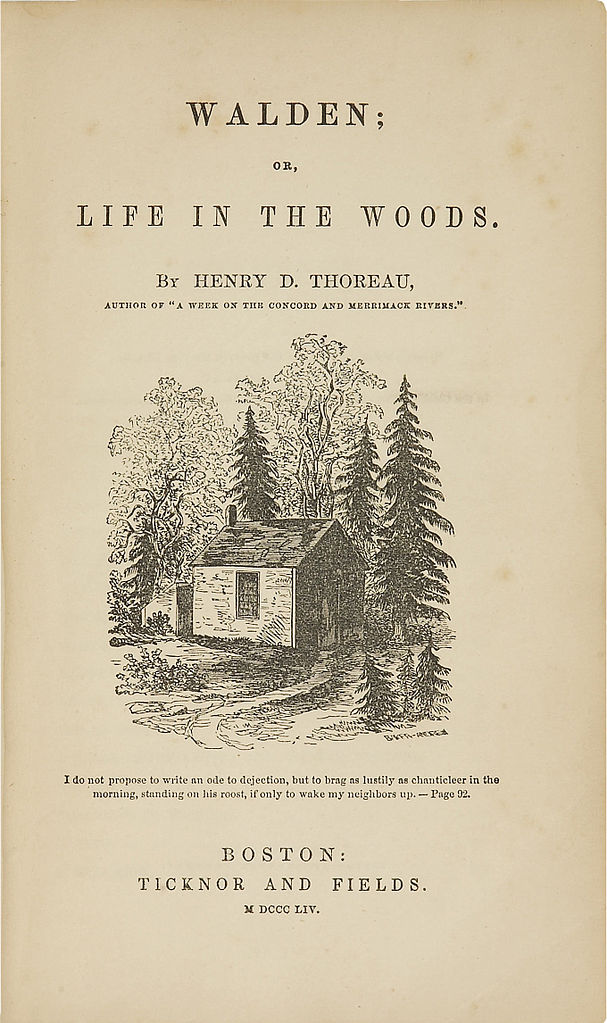
July 12 marked the 200th anniversary of the birth of Henry David Thoreau. I first read Walden and Civil Disobedience in high school. Like many readers, I was hugely impressed by Thoreau’s abolitionist convictions and stubborn insistence on living life on his own terms.

Civil Disobedience served as an instruction manual for the Civil Rights movement in this country and Gandhi’s fight for independence in India. So it was appropriate that last week the Washington Post honored Thoreau’s 200th birthday with a wonderful essay about his life and thought.

Of course not everyone likes Henry. Earlier this year the New Yorker published an essay that described him as “self-obsessed” and “narcissistic.” The author, Kathryn Schulz, was appalled by Thoreau’s “cold-eyed” detachment when confronted by human suffering.

So – is Henry a good role model for us today? I continue to admire him, despite Schulz’s catalog of his alleged sins. I’m sure there’s some self-obsession and narcissism hidden away in most people’s souls (including my own).

Cold-eyed detachment was a common trait among the New England Transcendentalists. Perhaps that’s inevitable if your spiritual goal is to “transcend” familiar, everyday life. Ralph Waldo Emerson confessed to being frightened by his disconnect from the rest of humanity. And then there’s Bronson Alcott, who dispassionately watched his wife and daughters struggle with poverty because his Transcendentalist principles did not allow him to work for money. One of the daughters who did heavy domestic labor for low pay was Louisa May Alcott, the beloved author of Little Women.

This is where I start to have a strong affection for Thoreau. He and Louisa ran a school when they were teenagers, and they were lifelong friends (some say she was in love with him, though I haven’t seen a shred of convincing evidence for that – and I’ve read all the biographies). When Thoreau died – far too young, at forty-four – Louisa wrote a lovely poem about him: “Our Pan is dead; His pipe hangs mute beside the river.”

She thought of Thoreau not primarily as a revolutionary (her father also went to jail for his principles) and philosopher (she was reared on Transcendentalism) but as a naturalist, and in some quarters that’s considered a mark against him. At Thoreau’s funeral, Ralph Waldo Emerson lamented that “instead of engineering for all America, he was the captain of a huckleberry party.”

I would have gladly joined the huckleberry party. When you read Walden and get past all the high-minded purposes that prompted Thoreau to build his cabin in the woods (which belonged to Emerson, incidentally), you encounter this simple goal: to observe the coming of spring.

And now I want to talk about writingThis man endlessly tramping through the woods to look for buds peeping through the snow has a lot to teach us about forging a connection with our readers.

* * * * * * 

For many years my husband and I did animal rescue work. I’m recalling a summer when we raised a litter of tiny kittens. During a late-afternoon bottle feeding, I saw one of the kittens bat her brother on the head. He just stared at her. She did it again. No response.

It took a couple of days for his growing brain to catch up with hers: Oh, I know what she’s doing. She wants to play. Let the romping begin!

Like Thoreau, watching the slow arrival of spring, I was witnessing a step in that kitten’s development into a full-grown cat.

Life happens step-by-step, in small increments that most of us miss. We get so caught up in the details of everyday life that we fail to see that a pattern is forming. Or our experience is so limited that we don’t see that millions of personal stories are grandly linked to one another.

The ancient Greeks were masters at seeing and describing those patterns. Many of their myths encode truths about human nature that we’re still enacting today. If you want to read a fascinating book, try Amor and Psyche by Erich Neumann. It traces the journey that every girl takes as she is transformed into a woman…

…which, when you think about it, is similar to what Thoreau was thinking about during those two winters he spent in Emerson’s woods. Moment by moment, the frigid landscape was changing into a verdant wonderland – and he took the time to watch and savor the show, every moment of it.

What process intrigues you? Could you watch it unfold and then describe exactly what happens? Here are some possibilities to get you started:

  • a printed script becomes a live performance of a play
  • a nervous college sophomore becomes a confident professional
  • a rundown house becomes a showplace
  • a clumsy junior-high student becomes a star athlete
  • a bare canvas becomes a work of art
  • a magical moment becomes a poem or song
  • a testy relationship turns into love

Share

Because, Affect, and Other Problematic Words

One of my ballroom teachers is at risk for osteoporosis. During her last physical, her doctor told her to walk for 30 minutes every day to strengthen her bones.

She patiently reminded him that she was a dance instructor who was already doing the equivalent of many hours of walking every day.

“But you need weight-bearing exercise to protect your bones,” he said. “Make sure you get in that 30 minutes of walking.”

She found another doctor – one who made a practice of thinking rather than just disseminating medical advice by rote.

*  *  *  *  *  *  *  * 

Success in any field – including writing – requires thinking skills. Alas, many ambitious writers don’t bother to evaluate the advice they’ve picked up over the years. My husband once had an editor who believed that because was a bad word. Every time because crept into one of his columns, she made him change it.

Obviously there’s nothing wrong with because: you see it in print all the time. So what was that editor’s problem?

We’ll never know, but I think I can reconstruct what happened. She probably had a teacher who warned the class – quite properly – that because can be a confusing word. Consider this sentence:

Don’t make friends with Carole because of the people she knows.

That sentence can be read two ways. Carole hangs around with a bad crowd, so you should avoid her. OR Carole hangs around with some desirable people, but that’s not a sufficient reason to make friends with her: something else is wrong.

Here’s another one:

It’s a mistake to take that supplement because it’s reported to have a high concentration of phylidicoids.

Should you avoid phylidicoids because they’re harmful? (Incidentally, I made that term up.) Or are phylidicoids wonderful substances that might fool you into buying a worthless supplement?

That doesn’t mean because is a bad word! You just have to word your sentences carefully. In the sentences below, it’s easier to figure out the meaning:

 Because Carole hangs around with a bad crowd, you should avoid making friends with her.

Because Carole knows some important people, you might not notice how toxic she is.

Because that supplement has a high concentration of phylidicoids, I don’t recommend it.

Even though it’s rich in phylidicoids, you shouldn’t take that supplement.

Did you notice that I didn’t use because in the last sentence? After several tries, I gave up: it just gummed up the sentence. But that doesn’t mean because is always a bad word! (Sigh.)

Let’s try one more example. This time I’m going to talk about a word that you really should avoid most of the time: affect. Why? Because (ha!) it’s ambiguous. Try this sentence:

The decision he made that morning affected his chance at the scholarship.

Was he more or less likely to win the scholarship? You can’t tell.

I used to circle affect and affected whenever they appeared on students’ essays. I would patiently explain why they were bad word choices and insist on a revision. Use harm, or weaken, or improve, or strengthen – something definite! Please! And here’s what I would get:

The decision he made that morning changed his chance at the scholarship.

Think! Think! That’s all I’m asking you to do!

Share