Category Archives: Writing Skills

Write Strong Sentences

Here’s a weak sentence I came across recently. See if you can figure out what I don’t like about it:

This cold-hardy, pest-proof, drought-tolerant shrub thrives in sun or light shade and is long lived.

The answer is that the sentence sputters. Your writing should always feel as if it’s going somewhere. And there’s a second problem: too much information has been crammed into one sentence.

Here’s my version:

This long-lived shrub is cold hardy, pest proof, and drought-tolerant. Even better, it thrives in sun or light shade.

 A powerful runner

Share

Stop Using “Quid Pro Quo”!

Thirty-two writers recently signed a letter to the New York Times complaining about two expressions we often hear in discussions about current events: quid pro quo and “dig up dirt.”

I think the letter makes an excellent point: when you use a word carelessly, you risk losing precision and clarity.

The letter mentioned two problems with quid pro quo. One is that many people don’t understand what it means (literally this for that – an exchange of favors).

More seriously, there’s nothing wrong with a quid pro quo exchange of favors, even though the term is often used in an accusatory way. We do it all the time. I’ll water your houseplants when you’re on vacation, and you’ll do the same for me.

If you’re claiming that a politician is pressuring someone for personal gain, that’s not quid pro quo or an exchange of favors. A more accurate word would be extortion.

Similarly the expression “digging up dirt” is too vague to be useful. Are you looking for evidence of wrongdoing? Say so: “I’m researching Richard Nixon’s behavior during the Watergate investigation.”

If someone is pushing a false story, call it what it is: “telling lies.”

“Words matter,” according to those 32 writers. Amen. You and I – in our everyday conversations – are often confronted with choices. We can select words that tell the truth – or we can manipulate, exaggerate, and fabricate.

I highly recommend making the ethical choice.

Share

Does a Comma Take the Place of “And”?

I was an English teacher for 40 years. Every semester when it was time to teach punctuation, a student would gently remind me about a rule I hadn’t mentioned: “A comma takes the place of and.”

No, it doesn’t. But there were always a few students who would nod knowingly.

If I thought hard enough, I could probably come up with a sentence where you could indeed substitute a comma for and. But I’d rather save my brain cells for other tasks.

So – if you harbor this urban legend, let it go.

Here are three comma rules that will cover most sentences:

  1. Use a comma when a sentence begins with an extra idea.
  2. Use a comma when you join two sentences with and or but (or any of the seven FANBOYS words).
  3. Use a pair of commas with an interrupter.

You can learn more about these comma rules here. You can download a free handout Happy commas!

Share

Is Grammar Necessary?

Is grammar necessary? My answer might surprise you: No, it isn’t – not if you mean identifying parts of speech and diagramming sentences.

People who adore formal grammar often say that correct grammar is essential if you want to get a precise message across. I say that’s rarely true. Suppose you heard someone say, “John don’t like that restaurant.” The grammar is wrong, but you would understand perfectly.

Here’s a joking message sent to me by my friend Margaret Wheaton. Numerals have been substituted for many of the letters – and yet most people can read the message easily:

Standard English is a beautiful thing. It showcases your communication skills and professionalism. But don’t confuse good writing with grammar gobbledygook. They’re not the same thing.

Share

Happy Halloween!

I’m celebrating Halloween today! More accurately, I’m celebrating Hallowe’en. I sometimes use the apostrophe even though it’s no longer standard. It stands for the missing “v” in All Hallows’ Even (“evening”) – one of the earlier names for our October 31 holiday.

In honor of Hallowe’en, I’m going to discuss two features of English that are scary – or just plain crazy.

Here’s a sentence that’s grammatically correct but so weird that I would never use it:

Either you or I am likely to win first prize.  CORRECT (but yuk!)

Here’s the rule: in an either/or sentence, the “or” part (or I) determines the verb. I am likely to win first prize is correct. That gives us “Either you or I am likely to win first prize.”

Nope. Grammar be damned – it’s just too awkward for me. I would use this version:

Either you or I are likely to win first prize.  INCORRECT (but I like it)

Let’s go on to something else that’s grammatically correct but – to me – unbearably clumsy: “that of.” Take a look at this sentence from “This Is the Moment Rachel Maddow Has Been Waiting For,” an article in the New York Times Magazine:

If today’s dominant political recreational metaphor is that of the three-dimensional chess game, Maddow is hunched over in the corner of the rec room, methodically putting together a jigsaw puzzle. CORRECT (but yuk!)

What – I ask you – would be lost if you deleted that of?

If today’s dominant political recreational metaphor is the three-dimensional chess game….

Have a wicked Hallowe’en!

Halloween pumpkin

Share

Writer’s Block

Someone online posted a desperate plea for help with writer’s block. The question mentioned a “massive project” like a book proposal or dissertation.

Oh, my. I feel for you. I was so frozen with fear when I started my own dissertation that I didn’t write a single word for a month.

But there’s hope! I finished my dissertation, learned a lot along the way, and went on to become a pretty productive writer. Here are some strategies to try:

  1. Make up your mind to do it badly. That removes the intimidation factor. You can always make improvements later – and you will, once you have something substantial to work with.
  2. Start with a leading task – something small related to your project. You could type a couple of quotations you’re planning to use, for example, or look something up. Tell yourself “I’m just going to….” Often that will get your engine going.
  3. Know your favorite escapes and excuses. Mine is housework. I didn’t clean my stove for two years while I was writing my dissertation. It was too tempting to divert my energy into making my house sparkle.
  4. Find a buddy. Plan to meet for writing sessions.
  5. Change your location. I went to a coffee shop every evening for an hour.
  6. Don’t worry about inefficiency. Those coffee shop trips involved a lot of wasted time – packing my stuff, driving there, unpacking when I got home, trying to concentrate in a noisy atmosphere. But over the long haul I got a lot done, and those nightly trips gave me something to look forward to.

Good luck, and hang in there!

___________________________________________________________________________________________________

Jean Reynolds’ book Five Minutes a Day: Time Management for People Who Love to Put Things Off can be purchased from Amazon.com and other online booksellers for $6.25 (paperback) or $1.99 (Kindle). Other ebook formats are available from Smashwords.com for $1.99.

Share

Let’s Stop Talking about Possessives

Every American should know the words to The Star-Spangled Banner, our national anthem:

Oh, say, can you see
By the Dawn’s early light
What so proudly we hailed
At the twilight’s last gleaming?

But wait a minute! Because dawn isn’t a person, it can’t own the “early light.” For the same reason, twilight can’t own the “last gleaming.”

Did Francis Scott Key screw up our national anthem?

Of course not. You might have been told you can’t use an apostrophe + s construction unless the owner is human. You can’t say “the dog’s collar” or “the tree’s leaves” or “the song’s lyrics.”

But that’s a bogus rule made up by people who should know better.

How did this mistake get started? Here’s what probably happened. Grammarians often talk about possessives (“Joe’s shoes”). It wasn’t long before some self-appointed grammarians decided that only people can have possessions.

Teachers and editors latched on to that made-up rule, and that opened the door to all kinds of clumsiness: “the collar of the dog” instead of “the dog’s collar” – and so on.

When you stop to think about it, many possessive constructions don’t involve ownership at all. A teacher’s desk is one example. Every classroom I used in my 40-year teaching career had a desk for the teacher (me). I didn’t own it, of course. I couldn’t take it home. But it was still the teacher’s desk.

I want to make two points today.

1. We need to stop talking about “possessives.” When I was teaching, the term I used was “of expressions.”

2. Some apostrophes are disappearing. The Associated Press has dropped the apostrophe from Veterans Day (which used to be Veterans’ Day – the day of the veterans). I often see signs like “Doctors Lounge” and “Judges Entrance.”

James Harbeck has some interesting observations about “of” constructions at this link: https://theweek.com/articles/564165/stop-calling-possessives-possessive

Share

Get Rid of Empty Words

My husband and I recently leased a new car. We selected the car we wanted from a list of closeout vehicles on the dealership’s website. The sales associate asked if we knew the VIN. I was impressed!

Many people would have said VIN number. That’s not quite correct. A VIN is a vehicle identification number. You don’t need to put number at the end: vehicle identification number number.

Similarly, you don’t need to say ATM machine: it’s an Automatic Teller Machine. Nor is it necessary to say Jewish rabbi, actual fact, or free gift.

Whenever someone says “Can I ask a question?” my response is “You just did!”

There’s no difference between “What’s the current time” and “What’s the time?”

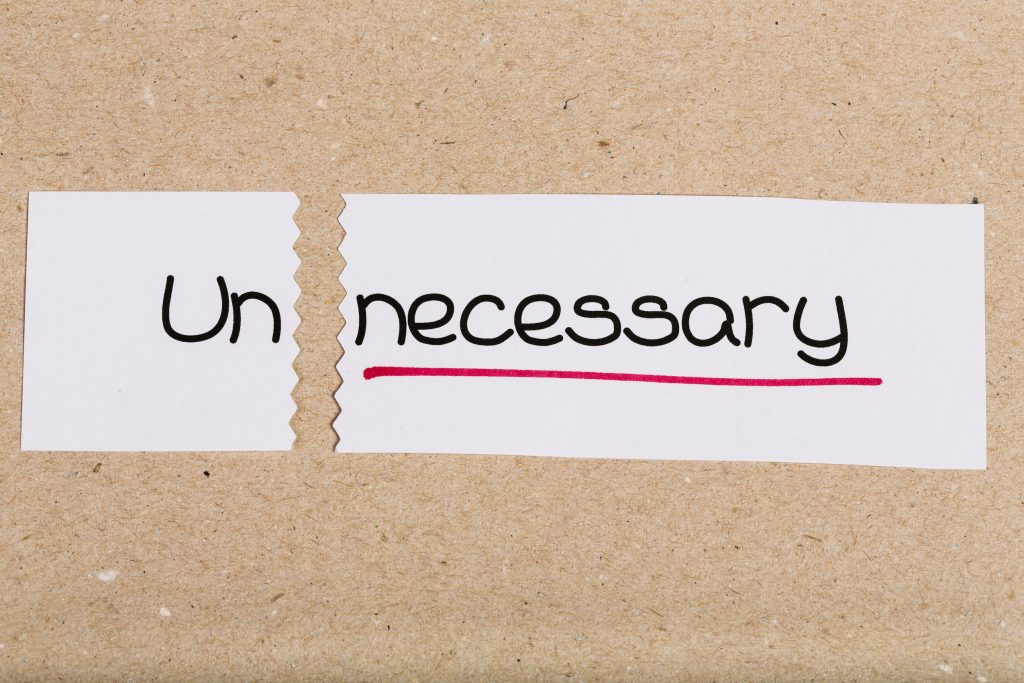
Unnecessary words can clutter your writing. Develop the habit of looking for these redundancies – and getting rid of them. Your writing will be better for it!

Sign with word unnecessary turned into necessary

Share

The Whistleblower

My friend Karen White just sent me a link to a wonderful New York Times article: “The Whistleblower Knows How to Write.” It’s a good refresher on some important points about writing.

The author, Jane Rosenzweig, directs the Harvard Writing Center. She analyzed the “whistleblower complaint” – a letter from a CIA officer claiming that President Trump put pressure on the Ukrainian government to interfere in next year’s Presidential election.

Somewhere there’s an English teacher who should be feeling very proud! Too bad that unsung person will never know that all those late-night grading sessions really paid off.

Share

Let’s Edit a Sentence

I love to think – and talk – about sentences. Writers quite naturally want to talk about big concepts: unity, coherence, emphasis, and the like. I prefer to get up-close-and-personal with a sentence. I think that’s where great writing happens.

Let’s edit a sentence today:

Protein, as well as vitamins A and C, abounds.

It’s correct. But I don’t like it. I think readers are going to stumble when they come to abounds. Shouldn’t it be abound?

Nope. The sentence is saying that protein…abounds.

“As well as vitamins A and C” is extra. You drop your voice. Those vitamins don’t really count. (Read the sentence aloud – you’ll hear that it’s really about protein.)

I have a rule (okay, I made it up) that if a sentence sounds odd, you should change it. So here’s my version:

Protein and vitamins A and C abound.  CORRECT

Elegant and easy! (Isn’t that what we’re aiming for when we write?)

It’s always a good idea to take an extra minute or two to edit a sentence. Those small changes add up!

Share