Category Archives: Writing Process

Starting a Writing Task

If you have trouble starting a writing task (and who doesn’t?), a kick-off task can help you get you warmed up and moving. Here’s a good one: Grab this “starting” idea and apply it to each part of the task by asking yourself questions like these: How will I begin my first sentence? How will I start each paragraph?

There’s another benefit to thinking about “beginnings” as you tackle a writing task: You can avoid many grammatical errors if you pay particular attention to how you start your sentences.

Here are a couple of tips:

-If you’re nervous about punctuation, try starting each sentence with a person, place, or thing. Because your sentences don’t have introductions, you don’t have to use commas. Just make sure there’s a period at the end.
Here’s another useful bit of advice about starting sentences: Avoid using an -ing word there. Yes, it’s perfectly correct to start a sentence that way–but long experience has shown me that many people tend to write dangling modifiers or fragments.
One more tip: “It” starts a new sentence. Wrong: The sky was dark, it looked like rain. Right: The sky was dark. It looked like rain.

-Stories are great starters for many writing tasks. If it’s a personal essay, think of a brief story from your own experience. If you’re writing a research paper or a report, find a story to put into your opening paragraph. News magazines like Time and Newsweek are great places to look for relevant stories.
So…suppose you were writing a research paper about the importance of educational programs in prisons. Your opening paragraph might be a story about an ex-con who was able to stay out of trouble after her release because she’d earned high-school equivalency diploma in prison.

-Paragraphs should begin with a sentence that does two jobs: Making a connection to your main idea and introducing what’s special about the paragraph.
In that paper about education in prison, you might start a paragraph with a sentence pointing out that ex-cons have greater earning power if they leave prison with an equivalency diploma. That sentence will set up your paragraph, which might include statistics and anecdotes to support your point.
Use the same strategy for each paragraph, and you’ll end up with a well-organized and well-developed paper.

 

Share

Writing Your Introduction Paragraph

Many writers (perhaps you’re one of them!) struggle with an introduction paragraph for an essay, research paper, or report. Today I’ll offer some suggestions for tackling the beginning of a writing task.

Why are introductions difficult? One reason is the “blank-piece-of-paper” syndrome: Your brain freezes because the writing task seems overwhelming.

If you’re caught up in this syndrome, a good strategy is to skip the introduction altogether and work on the rest of the paper. Use a warm-up activity to get yourself going: freewriting, listing, making a mind map. (Click here for more suggestions about writer’s block.) You can always write the introduction later, when you have some momentum going and have a clear idea of what you’re saying in your paper.

Another reason introductions are difficult: You don’t know what you want to say. As an English professor, I’ve read countless student essays that say…nothing significant about a topic. The best solution here is to do some writing preparation. If you’re writing about a personal experience, look at photographs from the event or talk to someone who was there with you. Draw a sketch about the experience. In other words, have something to say before you formally tackle the writing project.

Some writers struggle with the introduction to a paper because they’re unsure how to organize it. Help is on the way! Here’s a list of what should be included:

  • An attention-getter. A short story (a sentence or two) is a great way to kick off your paper. Leaf through magazines, and you’ll see that almost every article starts this way. It’s a strategy you can (and should) use in your own writing.
  • The 5 W’s: who, what, when, where, and why. Don’t try cramming all of this in the first sentence of your paper. But do get it into your first paragraph (or second paragraph, if it’s a lengthy writing task). Make sure your reader knows the basics about what’s going on before you start exploring your topic in depth.
  • The thesis. Your paper should have an attitude or make a point, and readers should know what it is by the end of the first or second paragraph.

And there you have it!

Share

Jane Austen Shows Us How It’s Done

Lately I’ve been noticing a recurring problem in the story manuscripts I’ve been reading: The authors are so busy moving the story forward that they forget to show how other characters are reacting to what’s going on.

For example, I just read a story about an ex-con who’s back in society and working full-time. He talks to a co-worker very sincerely about the ways that he’s matured over the years. When he finishes, she dismisses him with a cynical comment.

The story would make more sense if we had a couple of glimpses of the co-worker while the ex-con is talking. The writer could describe her facial expressions to let us know that she’s not buying what he’s saying. Then the rejection at the end would make more sense.

Here are three reasons why you should strive to include reactions when you write a story:

  • You’re helping readers keep track of your characters
  • You can use the reactions to develop characters
  • The story will make more sense

To show how this works, I’ve copied some dialogue from Jane Austen’s Pride and Prejudice. In the excerpt below, I’ve omitted the reactions from the other characters. Then I’ve copied the dialogue again, this time with the reactions included (they’re in blue so that you can identify them). Notice how much better the incident reads the second time.

Here’s the situation: The younger Bennett girls have been getting to know some soldiers who have been posted to their neighborhood. The girls are full of giggles, to their father’s dismay.

They could talk of nothing but officers; and Mr. Bingley’s large fortune, the mention of which gave animation to their mother, was worthless in their eyes when opposed to the regimentals of an ensign.

After listening one morning to their effusions on this subject, Mr. Bennet coolly observed,—

‘From all that I can collect by your manner of talking, you must be two of the silliest girls in the country. I have suspected it some time, but I am now convinced.’

‘I am astonished, my dear,’ said Mrs. Bennet, ‘that you should be so ready to think your own children silly. If I wished to think slightingly of anybody’s children, it should not be of my own, however.’

‘If my children are silly, I must hope to be always sensible of it.’

‘Yes; but as it happens, they are all of them very clever.’

Here’s the dialogue again, with the girls’ reactions included:

They could talk of nothing but officers; and Mr. Bingley’s large fortune, the mention of which gave animation to their mother, was worthless in their eyes when opposed to the regimentals of an ensign.

After listening one morning to their effusions on this subject, Mr. Bennet coolly observed,—

‘From all that I can collect by your manner of talking, you must be two of the silliest girls in the country. I have suspected it some time, but I am now convinced.’

Catherine was disconcerted, and made no answer; but Lydia, with perfect indifference, continued to express her admiration of Captain Carter, and her hope of seeing him in the course of the day, as he was going the next morning to London.

‘I am astonished, my dear,’ said Mrs. Bennet, ‘that you should be so ready to think your own children silly. If I wished to think slightingly of anybody’s children, it should not be of my own, however.’

‘If my children are silly, I must hope to be always sensible of it.’

‘Yes; but as it happens, they are all of them very clever.’

Notice: You got to know the daughters (Lydia and Catherine) a little better, the dialogue flowed better, and – most important – you could see for yourself what Mr. Bennett was talking about. Jane Austen was on to something here – try it yourself in your next short story.

Share

Should We Still Admire Jane Austen?

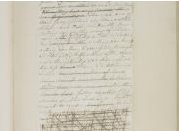
Breaking news from Oxford University: It turns out that Jane Austen did not deserve her reputation as a perfect writer, never-crossed-out-a-word writer. Those elegant sentences were often smoothed out by an editor who cleaned up her novels for publication.

She wasn’t even a very good speller, and – most startling of all – she was messy. Here, for example, is a much-scratched-out page from her novel Persuasion:

(You can read or listen to an NPR feature about the manuscripts by clicking here.)

The release of Austen’s manuscripts by Oxford University this week brought with it a storm of controversy. Some Austen lovers are bemoaning the edits, complaining that Austen’s experimental style and feminine voice were lost when the changes were made. Others say that literary critics and historians need to reappraise Austen’s reputation.

And some people (I’m one) are shrugging our shoulders and saying that we knew it all along.

Well, not really.

But it’s generally true that when you encounter a great writer, there’s a great editor nearby. Or at least lots and lots of revising. For years I’ve been saying the first thing any would-be writer needs is a substantial wastebasket.

When I teach my own writing classes, I always bring in a letter I received from an editor about a book review I submitted for publication. Before my book review was accepted, I had to make 18 (count ’em) changes.

My students are always shocked. Some are outraged. Their writing teacher produced a manuscript that – gasp – wasn’t perfect?

That’s right. All professional writers make revisions. Lots of them.

Let’s turn the tables a bit. Why was Jane Austen (as I still think) such a great writer?

She had two things going for her: A huge wastebasket and a terrific editor.

Let’s make that three things. Most important of all was her willingness to stick with it until she got it right. Good for her – and good for us, who are much richer for the literary legacy she left behind.

(To learn more about what Jane Austen did right, click here.)

Share

Parenting

Today is Wednesday, the day our local newspaper publishes John Rosemond’s Parenting column. Rosemond is a family psychologist who preaches what he calls “traditional parenting” – a common-sense approach to childrearing that emphasizes discipline and responsibility. Rosemond is upbeat and encouraging (to his credit, he doesn’t advocate hitting kids), and I enjoy the little anecdotes he sprinkles through his columns.

But it’s also true that he’s been writing the same column every week for as long as I’ve been reading him. No matter what’s going on in the world, you’re going to read a little treatise about how Grandma knew best.

This morning, for example, the rescue of the Chilean miners is very much on the minds of people everywhere. Last night I saw a small boy waiting with his mother for his father to make the terrifying ride through the rescue shaft and emerge at last into daylight. I heard a psychologist on TV talk about possible post-traumatic syndrome problems for the rescued miners. What about their children – and children with no personal connection to the miners who, nevertheless, may be subjected to nightmares about being trapped underground?

You won’t read about it Rosemond’s column. He rarely ventures beyond a few familiar topics – homework, chores, potty training, and everyday misbehavior.

Now for some writing advice. Forget the “Write What You Know” advice beloved of editors and writing teachers. Expand your experience. If you have a blog, read over your last five or six entries. Are you circling around a few familiar and safe topics? Or has the larger world found its way into your writing space? Here’s hoping it has.


Share

Arrive Late, Leave Early

Arrive late, leave early. There’s an intriguing bit of writing advice! What does it mean, and does it work?

Answers: Get to the interesting stuff quickly, don’t take longer than necessary, and yes, it works.

You should note, though, that “arrive late, leave early” overturns conventional writing advice, which suggests starting with a generalization and gradually arriving at your point. Here, for example, is how one first-year English textbook suggests that you begin an essay:

For a typical college freshman, entering college is fun and an exciting time of life.

The paragraph in this textbook example wanders around a bit (soda, pizza, music, playing cards) before it gets to the point: the writer is a twenty-nine-year-old freshman, and his experience has been different.

Hooey.

My advice: Arrive late, leave early. Here’s how I would start the same paper:

Typical? Hardly. Although I’ve been on the campus for almost three months now, I have yet to join the groups of students relaxing over cards and Cokes in the cafeteria. As a twenty-nine year old freshman, I’m having a very different college experience. For me, “relaxing” means bouncing my infant son on my knee while I struggle to read an English or psychology textbook. “Free time” means working the night shift at a discount store. Because I’m a husband and a father, college is serious business, leaving little time for recreation or making new friends.

Arrive late, leave early. Avoid preliminaries and introductions. See if you can combine action with atmosphere. If your character is closing a wet umbrella, you don’t need to write a sentence about the weather. Effective details – a pair of tickets to a Broadway show, snowflakes on your eyelashes, sand squishing between your toes – can set a scene in just a few words.

Good writing moves. Tell stories instead of philosophizing. Show rather than tell.

It’s fun to see how much you can pack into a sentence or a paragraph. Try it!

Share

Memoirs

Yesterday I came across an announcement about a memoir-writing workshop conducted by Natalie Goldberg, author of the bestselling Writing Down the Bones. Memoirs have become extremely popular. That’s a trend that’s going to enrich innumerable lives. Applause, applause.

How I wish my grandmother had written down her life story – leaving Finland as a young girl to work in New York City, falling in love and marrying an Austrian despite the language barriers, rearing four children during the Depression….I’d rather read that story than any bestseller you could throw at me.

Last month I facilitated an editing class for a group of memoir writers. More applause. They want to pass on not only their memories, but a grammatical account of their life’s adventures.

Our class discussions circled around a host of topics, foremost among them what might be called the Mr. Dick problem. Mr. Dick, you will remember, was a character in Charles Dickens’ David Copperfield who was writing a book. Any time you come across a literary character who’s dealing with writing in some way, there’s a strong possibility that postmodernism is making an entrance. (Think of Hamlet revising The Murder of Gonzago for the performance in court.)

The unfortunate Mr. Dick had to keep abandoning his book because the beheading of Charles the First kept finding its way back into the manuscript. And there, my friends, is one of the biggest problems in writing: Keeping the unwanted out.

Simply put, art is not life. Life – even at our best moments – is messy, confusing, and tedious. Good writing can never be any of those things (unless you’re a postmodernist trying to replicate life in the piece you’re creating, as some contemporary geniuses do).

Somewhere in Anne Frank’s amazing diary she tells her imaginary readers that they really know very little about life in the Amsterdam hiding place. This after pages and pages of entries, including a marvelous section where she describes, minute-by-minute, a typical day and night there. Anne, who looked forward to revising and publishing her diary, instinctively knew that good writing is a digestive process. Things are worked over and compressed before the audience is allowed to see them.

Not easy to do. I applaud Natalie Goldberg and all the memoirists, hard at work creating one of the greatest gifts they could give to future generations.

P.S. Did anyone notice my indefinite pronoun reference? I wrote: Somewhere in Anne Frank’s amazing diary she…. Because “Anne Frank’s diary” isn’t the same as “Anne Frank,” my sentence isn’t correct, strictly speaking. You could also say that it’s a dangling modifier.

I say that construction seemed to be the simplest way to say it, and I’m sticking with it.

Share

Editor at Work

I’m reading Bravura, the new biography of Lucia Chase, one of the founders of the American Ballet Theatre. The ABT has long been my favorite ballet company, and I’m having a wonderful time reading about its beginnings and ups and downs over the years. My sister Lois and I often saw Lucia Chase in the audience at performances, and I’m wishing now that I’d found the courage to go over and talk with her. (She died in 1986.)

The book is especially poignant because the author is Lucia’s younger son, Alex C. Ewing. His eyewitness descriptions of the many formidable people who shaped the ABT make this a truly remarkable book.

But I couldn’t turn off my internal editor while I was reading. Alas, problems crept into the book. Lucia’s early adulthood is given minimal coverage in the book. She did not marry until she was 29, but there is only a scant page describing those years. And the wedding is never mentioned. Suddenly you read that Tom Ewing and Lucia are living together in New York City, and then two children arrive. The date and place of the wedding are mentioned only in a photo caption (it was December 29, 1926, in St. John’s Episcopal Church in Waterbury, in case you’re wondering).

Another error: minuscule is misspelled not once but three times. (Here’s an easy way to remember the correct spelling: Think of the word “minus.”)

The book was done by the University Press of Florida, a fine publisher that (ahem!) brought out my own Pygmalion’s Wordplay in 1999. But any writer can make an error (or lots of them, as I do myself). That’s why there are editors.

If you’re trying to sharpen your writing skills (and who isn’t?), get into the habit of reading with an editor’s eye. You’ll be developing the editing software in your brain and, ultimately, you’ll become more skilled at revising your own work.


Share