The Dangling Modifier

What’s a dangling modifier? “Dangling” means hanging, and a “modifier” is a description. So a “dangling modifier” is a “hanging description,” or a description in the wrong place.

A dangling modifier is usually easy to spot because it sounds ridiculous. Take a look at these examples:

Spattered around the room, Jones photographed the blood.  DANGLING MODIFIER

I spotted broken glass searching for evidence.  DANGLING MODIFIER

I saw a bloody knife walking through the bedroom.  DANGLING MODIFIER

Here are the corrected sentences:

Jones photographed the blood that was spattered around the room. CORRECT

While searching for evidence, I spotted broken glass. CORRECT

Walking through the bedroom, I saw a bloody knife. CORRECT

Sometimes it’s harder to spot a dangling modifier. To most people, this sentence probably looks correct on first reading – but it isn’t:

Questioning inmate Kelly, he said his sister had bought the watch for him.  DANGLING MODIFIER

There are two problems with the sentence. First, Kelly didn’t do the questioning. Second, the sentence doesn’t specify who did. The omission might create a problem in a disciplinary hearing, when it’s important to identify all the parties involved.

Here’s the corrected sentence:

When I questioned inmate Kelly, he said his sister had bought the watch for him. CORRECT

Be careful when you start a sentence with an -ing word: Often it will contain a dangling modifier. If you do start a sentence with an -ing word, reword it to make sure it’s clear who did what.

Share

That Annoying Hyphen is Gone!

A celebration is in order: The Associated Press Stylebook has officially banished that annoying hyphen from the word e-mail: It’s now email. And the good news isn’t over: website is now one word with no capital letter. Bring out the champagne!

Everyone who’s serious about writing should know how these decisions are made.

You should know, for example, that the Associated Press Stylebook is a usage reference book widely used by journalists, so this decision will have far-reaching effects and will probably spread beyond newspapers and magazines.

This is probably a good opportunity to review a few basic facts about hyphens.

Hyphens tend to disappear over time, so often you’re going to have to make a judgment call about including or excluding them. (I stopped using that hyphen in email years ago.)

  • Use a hyphen when a) two describing words go together and b) a noun immediately follows.

The lawn-mower shop will be closed next week.  (Shop is a noun: Use a hyphen)

I need to get my lawn mower serviced.  (No hyphen)

  • Don’t use a hyphen with –ly words.

That’s a poorly written story.  (No hyphen)

To learn more about hyphens, click here.

Share

Check the Beginning of a Sentence

Hints of possible sentence problems often show up at the beginning of a sentence. Here are four tips you’ll use again and again:

1.  Anything that begins with a person, place, or thing is probably a real sentence and should end with a period.

My trip to Hawaii did not begin well.  SENTENCE

If what you’ve written doesn’t begin with a person, place, or thing, it’s probably an extra idea. That’s ok – but remember that it can’t stand alone. It should a) end with a comma and b) be attached to a real sentence.

Although my trip to Hawaii did not begin well,  EXTRA IDEA

Although my trip to Hawaii did not begin well, I had a wonderful time there.  SENTENCE

(Click here to read about Comma Rule 1.)

2.  Remember that it is a thing. Here’s a handy rule of thumb: If it starts with it, it’s a sentence. (This tip can save you from many run-on sentences.)

I pushed on the door, it wouldn’t open.  INCORRECT

I pushed on the door. It wouldn’t open. CORRECT

3.  The beginning of a sentence usually tells you who or what the sentence is about. Use that information to solve problems with subject-verb agreement.

Changes in top management (has, have) caused cancellations and delays.

Focus on the word changes, and you’ll know immediately that the verb should be has. [Use…has]

Changes in top management have caused cancellations and delays.  CORRECT

(Click here to read about Subject-Verb Agreement Rule 4.)

4.  Be especially careful about starting sentences with -ing words. Of course it’s correct to start a sentence with a word ending in –ing: Just remember that you risk writing a sentence fragment or a dangling modifier.

Loving her the way he does.  FRAGMENT

Loving her the way he does, he can’t bear to see her in so much pain. 
CORRECT

Loving her the way he does, the cost of the ring didn’t matter.  DANGLING MODIFIER

Loving her the way he does, he didn’t worry for an instant about cost of the ring. CORRECT

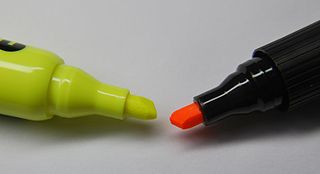
If you’re interested in improving your writing, one practice that will pay off again and again is to check the beginning of each sentence. A highlighter makes it easy. Try it!

320px-Two_highlighters,_closeup

Photo © Justin Smith / Wikimedia Commons, CC-By-SA-3.0

Share

Examples of Misnomers

Today’s topic is examples of misnomers.

On Wednesday Michele Bachmann challenged widespread fears that failure to raise the debt limit could lead to economic catastrophe. “This is a misnomer that the president and the Treasury secretary have been trying to pass off on the American people,” she said.

No, Michele. It’s a misconception. When David Letterman jokingly talks about “Michele Obachmann,” that’s a misnomer.

Misnomers are incorrect or inappropriate names. Want some examples of misnomers? Columbus called Native Americans “Indians” because he thought he had landed in India. His name for the people he found here is a misnomer. Theodore Roosevelt’s “Charge up San Juan Hill” is another misnomer: The actual name was Kettle Hill.

My husband, a horticulturist with a passion for palms, is constantly correcting people who talk about their “traveler’s palms”and “ponytail palms.” Both those common names are misnomers: traveler’s plants (the correct name) are related to bananas, and ponytail plants (again, the correct name) are members of the lily family.

If you think you can grow tulips in Central Florida (where we live), that’s a misconception.

We once owned a short-haired cat with a bad temper that somehow acquired the name “Fluff.” That was a misnomer (and for a long time we had the scratches to prove it).

Tulips Wiki Commons


Share

Oxford Comma

Sound the alarm: The Oxford Comma has met its demise.

Except that’s not really true. Turns out the Public Relations department at Oxford (not the entire University) is advising against the Oxford comma in its latest style sheet – a sensible decision, as it turns out (even though I, for one, love that comma).

First, let’s explain that the Oxford Comma is the last comma before and in a series of three or more. Here’s an example:

We served coffee, tea, and lemonade to our guests.  CORRECT

Oxford University has its own publishing company, and editors are instructed to use that comma.

Journalists, on the other hand, generally don’t use that comma. A newspaper reporter would write the sentence this way:

We served coffee, tea and lemonade to our guests.  CORRECT

Since the Public Relations department issues press releases to newspapers and magazines, it makes sense for them to omit that comma. But some commentators thought the whole University was dropping the comma, and…well, it’s been a long time since I’ve seen so much anguish about a punctuation mark.

Why do I like that comma? I think it clarifies sentences and makes the reader’s job easier. For example, take a look at this partial sentence, and see if you can decide where it might be going:

Suddenly the car, passengers and all

I think you’d expect the sentence to turn out something like this:

Suddenly the car, passengers and all, rolled into a ditch.

But if you put that comma in, you can tell that the sentence is going somewhere else:

Suddenly the car, passengers, and all

Here’s the completed sentence:

Suddenly the car, passengers, and all their luggage rolled into a ditch.

I vote for the Oxford comma.

Share

Is it Lay or Laid?

Here’s a vexing grammar problem: Is it lay or laid? Forms of lie/lay cause a great deal of confusion, and it seems that journalists struggle as much as the rest of us do.

A lay/laid problem caught my eye in a news story about the Casey Anthony murder trial yesterday. First, some background: Casey Anthony is accused of murdering her two-year-old daughter Caylee. (We’re getting a live TV broadcast of the trial, which is taking place in Orlando, less than an hour away from where my husband and I live.)

On Monday a canine handler, Jason Forgey, testified that his dog, trained to respond to decomposing human remains, had lain down in Anthony’s back yard. Here’s how our local paper, the Ledger, reported his testimony:

When deputies opened the car’s trunk, the dog jumped forward and placed his paws on the car. He then laid down, indicating an alert, Forgey testified.  INCORRECT

Oops! The writer slipped up. It should have been “He then lay down….” The past of lie is lay.

Laid is always used with an object:

I laid the paper on his desk. CORRECT

The Christian Science Monitor apparently has a better copyeditor: They got it right. Here’s how they reported the canine incident:

Jason Forgey, a K-9 officer with the Orange County Sheriff’s Office, said his dog stood on his hind legs and put his head and paws into the open trunk of Casey Anthony’s 1998 Pontiac Sunfire. The dog then lay down on the ground near the car’s right tail light and made eye contact with Deputy Forgey. CORRECT

Very few people use the various forms of lie and lay correctly. Knowing lie/lay/laid/lain sets you apart from the pack – highly recommended!


Share

Prepositions

Many writers are wary of prepositions and prepositional phrases. They’ve got to be hard, right? After all, “prepositional” is a five-syllable mouthful of a word.

Well, there’s good news and bad news. Bad news first: Many writers make mistakes with prepositional phrases.

The good news? There’s an easy rule that will keep you out of trouble. And here’s even better news: There’s also an easier rule that works maybe 99.5% of the time.

Let’s get started.

Prepositions are small, everyday words that indicate direction or purpose. The English language has dozens of them. For now, let’s stick to six: in by for with to of.

Prepositions are rarely used by themselves. You wouldn’t say “I went skiing with.” Expressions like “with Mary,” “to the store,” “for a wedding gift, “by myself” and so on are prepositional phrases.

There are a couple of general rules of thumb that work really well with prepositional phrases. Take your pick! Either one will help you get your sentences right.

  • Skip the prepositional phrases to get the grammar right
  • Go to the beginning of the sentence.

Maybe once or twice a year you’ll come across a sentence that works differently. That means most of the time you can use one of these rules, and you’ll be fine. (If you’re curious about the exception, click here and read Rule 6.)

Let’s try a couple of examples.

The bookcase with the glass doors (need, needs) to be emptied and moved.

What will you be emptying and moving – the glass doors or the bookcase? You can either go to the beginning of the sentence (“bookcase”) or cross out “with the glass doors.”

If you go with crossing out “with the glass doors,” here’s what your sentence will look like:

The bookcase with the glass doors (need, needs) to be emptied and moved.

Answer: The bookcase NEEDS. So here’s your sentence:

The bookcase with the glass shelves needs to be emptied and moved. CORRECT

Let’s try another one:

Misunderstanding of department policies (have, has) caused many problems recently.

What caused the problems – department policies or misunderstanding? Again, you can either go to the beginning of the sentence (misunderstanding) or cross out “of departmental policies.”

Let’s try crossing out “of departmental policies”:

Misunderstanding of department policies (have, has) caused many problems recently.

Answer: Misunderstanding HAS. So here’s your sentence:

Misunderstanding of department policies has caused many problems recently. CORRECT

To learn more about prepositional phrases, click here and read Rule 4.

One more thought: There’s a reason why writers often have difficulty with prepositional phrases. Most people aren’t used to thinking about parts of sentences. It’s not a normal activity. (When was the last time you found yourself thinking, “Hey! That was a prepositional phrase!” during a conversation?)

You’re learning a new skill. Be patient with yourself, and keep reviewing and practicing. After a while it will become second nature. That’s a promise!
 

Share

Understanding Interrupters

Here’s a sentence from a literary newsletter article about environmentalist Rachel Carson. Can you figure out what’s wrong with it?

Though too poor to have indoor plumbing, her mother subscribed to the children’s magazine, St. Nicholas, whose mission included the “protection of the oppressed, whether human or dumb creatures.”  INCORRECT

The problem is the comma after “children’s magazine.” That comma doesn’t belong there. Here’s the sentence again, with the correction:

Though too poor to have indoor plumbing, her mother subscribed to the children’s magazine St. Nicholas, whose mission included the “protection of the oppressed, whether human or dumb creatures.” CORRECT

Technically we’re talking about “interrupters” – words that cause a sentence to stop and then start again. Countless teachers (including me) have wrung their hands trying to explain to students how to do these commas correctly. Conventional rules and explanations usually complicate things and just confuse students more.

Luckily there’s a simple way to punctuate an interrupter correctly: Just read the sentence aloud, listen for a voice drop, and insert commas.

When you try that with today’s sentence, you’ll notice that your voice doesn’t change when you read “the children’s magazine St. Nicholas.” So – no comma!

Your voice will change, however, when you start reading “whose mission included…” Aha! Comma needed.

Here’s the sentence again, correctly punctuated. PLEASE read it aloud. You’ll hear your voice change. Automatically. In the right place.

Though too poor to have indoor plumbing, her mother subscribed to the children’s magazine St. Nicholas, whose mission included the “protection of the oppressed, whether human or dumb creatures.” CORRECT

To learn more, click here and read about Comma Rule 3. You can also watch a short video about Comma Rule 3 by clicking here.

Share

Snuck and Drug

Yesterday I heard a motivational speaker give an excellent talk about ways to achieve our potential. She was a polished professional – but she said drug instead of dragged.

I drug the boxes into the closet.  NONSTANDARD

I dragged the boxes into the closet. STANDARD

I may have been the only person in the room who knew that the past tense of drag is dragged. And that raises a provocative question: Does it really matter whether you say drug or dragged? Snuck or sneaked, which most writers consider more correct?

It’s the nature of language to change, and within 20 or 50 or 100 years both drug and snuck may be accepted in formal writing.

My personal choice is not to use either one. Like it or not, your word choices reveal a lot about you. I’m always impressed by people who get the subtle points of usage right – tricky pronoun cases, complicated subject-verb agreement, possessives with gerundives.

I’ll keep saying dragged and sneaked, and I recommend that you do the same.


Share

A New Word

It’s time to replace my Scrabble Players Official Dictionary: The 4th edition has just been published (The third edition was released in 1995.)

This new edition is raising eyebrows because it includes some slang, including a word that’s new to me: innit.

In case you’re wondering (I was!), innit can roughly be translated as “isn’t it?” It’s classified as an “invariant tag” – an unchanging phrase that can be added to the end of a sentence. Popular invariant tags in English include “you know?” and “okay?” They’re generally considered nonstandard, meaning they shouldn’t be used in formal writing.

Here’s an example of how you might use innit: We should make reservations soon, innit?

Iit’s not an expression I plan to start using.

But the BBC, no less, is warning sticklers like me not to be so hoity-toity. Here’s what one of their language experts said about innit:

Although its use varies between different groups of speakers, each individual will have their own grammatical rules on when ‘innit’ can and can’t be used.

Several things caught my eye when I read their statement. “Different groups of speakers” is, to my mind, a copout. If you’re the kind of person who visits the BBC website, you want to fit in with educated people who speak a certain kind of English with prescribed rules and practices. Innit is not going to show up in your conversation unless you’re joking around.

Another point the BBC made later on was, however, useful: “Invariant tags are common in other languages: Spanish has ¿verdad? and ¿no?, German has nicht war? and the non-standard oder? and French has n’est-ce pas?”

It’s a good reminder for people who insist, against all evidence, that language is supposed to be logical. Name a grammatical rule, and you’ll probably find that at least one language routinely breaks it, even in formal writing. (The double negative is a good example: It’s perfectly acceptable in educated Spanish.)

One more detail in the BBC statement caught my eye: The pronoun agreement error: “each individual…their”. (It’s supposed to be “each individual…his or her.”)

Frankly, I’m relieved. I hate “his or her,” and I often curse Lindley Murray, the man who saddled us with this rule, or at least got the ball rolling. Feminists made a bad situation worse by adding “or her” to that irritating “each individual…his.”

An annoying situation, innit?

Share