American Bloomsbury

One of the most profound observations about writing I’ve ever read came from Ann Berthoff. She’s the author of a number of intriguing books about composition theory, including The Making of Meaning.

I love that title. Astonishing, isn’t it: Just two words sum up the most important principle behind effective writing.

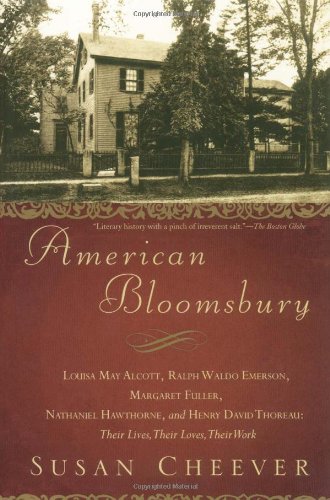
“Making meaning” came to mind this week while I was reading a book I absolutely adore – Susan Cheever’s American Bloomsbury. It’s a book I did not expect to enjoy. It’s about the Transcendentalists (doesn’t that sound dull already?). A point in the book’s favor is that Louisa May Alcott (who’s long fascinated me) is prominently featured – but I’ve read all her major biographies, so there didn’t seem to be much point in reading this book.

Despite my wariness, I was hooked before I got to page 1. Here are two sentences from the Preface:

“I remembered F. O. Matthiessen’s bold statement that all of American literature had been written between 1850 and 1855. What I hadn’t realized is that most of it was written in the same cluster of three houses.”

I’ve been to Concord, Massachusetts (the setting for the book), and I already knew that Hawthorne, Emerson, Thoreau, and Alcott had moved around in that neighborhood. But I’d never thought about American literature in terms of those three houses.

And that’s what “making meaning” is all about: tying things together and making them significant. It doesn’t even matter that I disagree with Matthiessen about “all of American literature” (what about Huckleberry Finn and The Great Gatsby?).

What’s wonderful is that Susan Cheever gave me something interesting to think about. Even better, she fulfilled her purpose in a wonderfully readable book. I finished it today, and I’m feeling kind of lonely. I began to see some familiar writers in a new way, and I find that I’m missing them.

You can’t ask for much more from a book, in my opinion.

American Bloomsbury

Share

The Cheeseburger Caper

Cheeseburger Stabbing 2

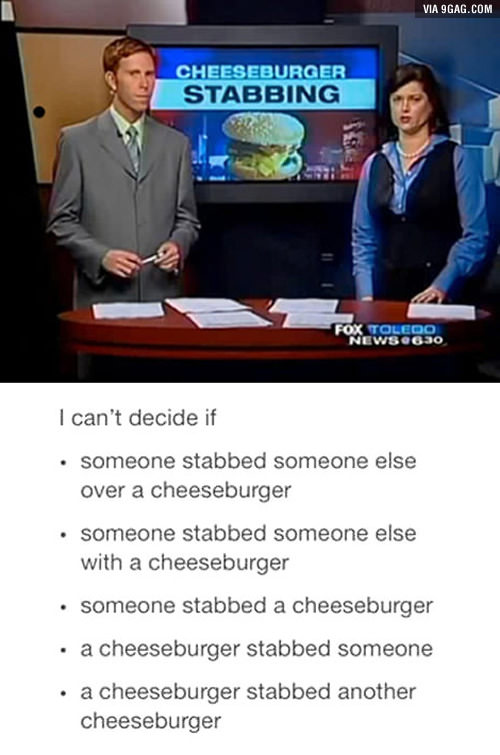
My friend Gustavo A. Rodriguez Martin just posted this picture on Facebook, along with a note that I might want to  comment about it. He’s right.

“Cheeseburger stabbing” has to mean, of course, that someone was stabbed in a dispute over a cheeseburger. Nobody is seriously going to suggest that a cheeseburger wielded a weapon against a person or another cheeseburger. 

But when you stop to think about it, some interesting questions arise. How do we know that the cheeseburger didn’t wreak any bodily harm? We have only two words to work with, and yet we’re able to construct a highly probable explanation about what happened:

Hamburger stabbing = someone stabbed another person in a dispute about a cheeseburger

That’s an amazing testimony to the power of language. Our brains contain such sophisticated linguistic wiring that we can extrapolate a large amount of information from just a couple of words.

Here’s an example I use often in my workshops. A guy named Frank calls his friend Bob and suggests they go bowling. Bob responds with “I’d love to but…” and his phone goes dead – he forgot to charge it.

Are they going bowling tonight? Probably not. When Frank hears that word “but,” his brain will instantly construct the rest of the message: “I can’t go tonight.” There’s no 100% guarantee that he’s right, of course. Maybe Bob was going to say that he’d be a little later than usual. But there’s a high probability that Frank’s brain will process that fragment of information correctly.

The power embedded in language also has a potential downside – a huge one, in fact: Ambiguity. Our two-word cheeseburger message can be interpreted in multiple ways, forcing us to rely on the context to ensure that we understood it.

And there, as Shakespeare would say, is the rub.

Does it ever happen that the context is just as ambiguous as the message?

Yes. It happens over and over again. A poorly worded remark causes offense – or a casual comment is misinterpreted as a promise for something that’s never going to happen.

And now we’re talking about postmodernism. Language – useful as it is – can’t possibly accomplish everything we task it with.

When I was writing my doctoral dissertation, and spending a lot of time thinking about language issues, a friend took me to task. Jacques Derrida and his ilk were part of a passing trend, she warned me. What would I do when deconstruction is no longer in style?

She was on target if you misunderstand deconstruction as a silly game where you load ambiguous readings into a literary work. But if you really study what Derrida was saying, and you start paying attention to everyday discourse, you begin to suspect that the postmodernists are right: Language issues are all around us.

Item: My husband and I once ordered a pizza with peppers – and were served a pepperoni pizza.

So many problems are attributed to inattention, carelessness, incompetence…when part of the blame needs to be laid at the door of our slippery language. And English is no worse (or better, for that matter) than any other language.

For example:

  • A man notices that a woman in his office has lost a great deal of weight. Should he compliment her? Or is he risking a summons from the Human Resources director for a sexually inappropriate message?
  • A deeply religious woman hears that a colleague has a very sick infant. Does she say “I’m praying for your family” – or is that intrusive?
  • A police officer approaches a group of women leaving a shopping mall. The officer points in the direction of one woman and says, “I need to talk to you.” Her response is “Are you talking to me?” Is that a defiant statement – or is she just looking for clarification?

And consider this statement:

Time flies like an eagle.

And this one:

Fruit flies like a banana.

Sometimes I think it’s a miracle that we’re able to communicate as well as we do.

Seen any violent cheeseburgers lately?

218px-Cheeseburger 2

Share

Steve Harvey and Miss Universe

The story has been all over the news: Emcee Steve Harvey misread his cue card at the recent Miss Universe beauty pageant and announced the wrong winner. Everyone watched in shock as the Miss Universe crown and sash were transferred from the Colombian contestant who thought she’d won to the real winner, a contestant from the Philippines.

I just read an online article that argued – convincingly –  that the mistake was due not to Harvey’s carelessness, but to a badly designed cue card. What does this have to do with writing? A LOT. I’ll make that connection in a moment.

You can see the card in the picture below. The top of the card identifies the second runner-up – USA. Then comes the first runner-up, Colombia. Finally, in small letters at the bottom, under “Miss Universe,” we see the winner: Philippines.

Steve-Harvey-Apologizes-For-Miss-Universe-Mix-Up

Bottom line (no pun intended!): The card failed to showcase the information that Harvey needed.

To avoid confusion, the card could have highlighted the winner’s country – Philippines – by placing it near the top, using a larger typeface, or highlighting it in color (or doing all three). Even an arrow drawn with a ballpoint pen would have helped.

If you think of that cue card as a written document – which, in a sense, it is – you’ll quickly see the connection to workplace writing. It’s human nature to  start from the beginning and work our way to the end. But that causes the most important point to be delayed until the end, where it loses impact. How many letters, emails, and reports are written in the same linear way? And how many mistakes are the result?

Let’s look at a  typical situation: Joanna Caffrey, Human Resources Director, is about to send a request to the department heads. Here’s her thinking process: Paul Oates is going on vacation. That means he’ll be away during the regular payroll deadline on the 15th. So…I’d better ask the department heads to send in their payroll reports early.

Here’s Joanna’s email:

To: Department Heads
From: Joanna Caffrey, Human Resources Director

As you know, every employee is entitled to two weeks of paid vacation each year. Paul Oates, our payroll director, will begin his vacation on July 15. That means he will be out of the office on July 20, the normal date for department heads to submit their payroll forms. Accordingly, we’re asking you to submit them by Monday, July 10. Thank you for your cooperation in this matter.

But those busy department heads don’t care when Paul takes his vacation. Some might not even bother to read the entire email. What part of the message concerns them? The early date for payroll reports. That information should come first. Often you can even omit some of the other information:

To: Department Heads
From: Joanna Caffrey, Human Resources Director

Please submit your payroll reports on July 10 this month so that Paul Oates, our payroll director, can process them before his vacation beginning July 15.

Thanks to computers, we can spotlight important information through color, a larger typeface, and features like boldface, italics, and centering. (Underlining is a bad choice – it’s ugly.)

The Miss Universe example would make a good activity for writing classes. The instructor could display the card and ask: How could the pageant have helped prevent Harvey’s mistake? And what principles can you apply to your own writing tasks?

Share

Making an Index

I just created an index for a soon-to-be-published book called What Your English Teacher Didn’t Tell You. It’s been fun working on the book, but it’s also taken up huge amounts of time. So I’m looking forward to holding the finished book in my hands…except that there will be tons more to do: getting endorsements and setting up the Kindle edition, for starters.

But my topic today is the index. I did not use index cards this time. I relied on the indexing function in Word, which did an excellent job except that it required more clicking than I thought necessary, and some of the page numbers are wrong.

And there was one big problem that I’d forgotten. The index function uses Section Breaks to create columns (necessary because I’m trying to keep the book a manageable size). When I finished marking all the entries and clicked “OK,” my entire manuscript turned into three columns. All the work I’d done on formatting and page numbers was destroyed.

Well, not really. I have dealt with Section Breaks (the nastiest and most stubborn feature in Microsoft Word, and that’s saying a lot) many times. I just used the Find and Replace feature to remove all of them, fixed the index, and then put the rest of them back. I fixed the page numbers, and everything was fine (except for the time I wasted having to redo everything).

But I wonder what an inexperienced writer would have done. Sob? Give up on the book? Hire someone to fix the file?

Self-publishing is not for the faint of heart. The bad news is that you need some highly sophisticated technology skills, and it takes time to learn enough so that you can solve the problems that inevitably appear. The good news is that the options available to writers are better than they’ve ever been if you have the grit to stick with a project and teach yourself what you need to know.

Still ahead: Fixing the page number errors in the index. Sigh. How did that happen?

index card ok

Share

McDonald’s Is Winning!

Here’s a headline I saw in a newspaper last week: McDonald’s Winning Fast-Food Fight with Chipotle. In recent years McDonald’s has been struggling to keep up with Chipotle (a company that sells burritos) and other food chains.

Well, good for McDonald’s!

But read that headline again: McDonald’s Winning Fast-Food Fight with Chipotle.

If you know that chipotle can also refer to a jalapeño pepper, your brain might do the same thing mine did: Flash a picture of  a McDonald’s throwing a can of chili at an opponent.

Better wording would be “McDonald’s Winning Fast-Food Fight against Chipotle.”

506b054cfb04d60a47001292._w.1500_s.fit_

Share

The Spider Spins Again

Stieg Larsson, author of The Girl with the Dragon Tattoo and two subsequent best-selling books, died in 2004. But those three books were so popular that another author,  David Lagercrantz, has stepped up to give us another exciting tale about Lisbeth Salander: The Girl in the Spider’s Web. Several of my friends have already read it.

Lois Smith, a writer friend, recently made a good point about the wording of the title: Spider’s Web, she says, is a better choice than Spider Web.

Technically it’s the difference between a possessive noun (spider’s) and an attributive noun (spider). Here are two more examples:

dog’s collar (possessive)

dog collar (attributive)

Linguistic experts who keep track of language trends are noticing that attributive nouns are replacing possessives more and more often. It’s not hard to see why: Speech is easier when we skip that apostrophe + s.

But sometimes that apostrophe + s is useful. Lois pointed out that spider’s web makes the spider “much more ‘possessive,’ more dangerous to the poor girl entangled within its steely filaments, than the plain spider web.” She added that spider web “just doesn’t have the same creepy feel. Funny, the big difference in my mind when the possessive is added.”

She’s right – and her comments point to an important principle: Our brains are hyper-sensitive to language. Small changes can make a big difference.

Here’s an example from Naked, Drunk, and Writing by Lara Adair:

“The airport’s over there,” he said, pointing out the window. WEAK

It’s a perfectly grammatical sentence – but it’s much improved if you break it into two sentences so that we can see him pointing:

He pointed out the window. “The airport’s over there.” STRONGER

I find this example especially intriguing because it defies conventional wisdom that writers need long, sophisticated sentences. (How many of us had essays returned to us with “choppy” written in red ink in the margins?) The truth is that sometimes a short, punchy sentence works better.

How to tell? The best route is to do a lot of experimenting and revising.

spider 2

Share

Hyphens Would Have Helped!

When I was on Facebook a couple of minutes ago, I saw a picture that stopped me in my tracks, for two reasons. It was an picture of an ugly spider, but the caption said that it was a bird.

I looked more closely to see if it was a bird that had developed some really amazing camouflage. Nope – definitely a spider.

And then I figured it out. It’s a picture of an Australian bird-eating spider (more precisely, an Eastern tarantula). But the caption said bird eating spider, leading me to believe that I was looking at a bird that was eating a spider.

Bottom line: Hyphens would have helped: bird-eating spider.

Just in case you’re a person who’s intimidated by hyphens (as I was for years), here’s another example:

man eating shark (a man with a knife, a fork, and a very large fish on a plate)

man-eating shark (keep your distance!)

Not that difficult after all!

Queensland 2


Share

Be a Pro

In one of my favorite Andy Griffith Show episodes, Gomer Pyle is looking for a job and decides to answer an ad for a butcher. Andy asks, “Do you know anything about cutting meat?” Gomer, startled, says, “Do you think they’ll ask me that?”

It’s funny when Gomer Pyle says it. But that kind of attitude is NOT funny coming from a would-be writer. I regularly get asked to evaluate manuscripts from hopeful writers who haven’t taken the time to acquire the skills needed for a writing career.

Here’s a typical snatch of dialogue:

Me: “What word-processing system do you use?”

Writer: “What’s that?”

Other questions: Are you familiar with Amazon.com? (You’d better be – they’re going to be selling your books.) Have you studied books similar to yours to see how they’re put together? Are you thinking about self-publishing? (The odds are strongly against persuading a commercial publisher to take on your book.) How much time and energy are you willing to commit to marketing your book?

Writers who take themselves seriously can produce outstanding work. My husband, a garden writer, just came across a beautiful self-published book about ornamental tobacco plants: Illustrated Guide to Flowering Tobacco for Gardens by Richard Pocker. I’m writing a review of another impressive book, The Baby Mama Syndrome by Judge Robert Doyel.

Another self-published book didn’t impress me as much – and it underlines the point about knowing the writing business. I just finished reading The Art of Compassion by Yola Miller Sigerson. It’s a biography of Sigrid Undset, one of my favorite writers, and it’s beautifully researched and a joy to read. All the scholarly apparatus is there, including pages of endnotes.

But…there are no endorsements on the back cover. Sigerson spoke to Undset’s relatives and friends. Why not ask them to make some comments about her book to enhance her credibility? And there’s no acknowledgments page. Another problem is that the word didn’t was misspelled numerous times (with an extra apostrophe).

Yes, Gomer, butchers need to know how to cut meat. And yes, dear would-be writer, you need to go to the library, pull some competing books off the shelves, and learn how to punt your book into the same league.

It’s all about a commitment to professionalism.

Jim Nabors as Gomer Pyle

                   Jim Nabors as Gomer Pyle


Share

New Yorkese

Whenever I visit New York, I stay at a lovely little hotel on West 46 Street. It’s right next door to St. Mary the Virgin, a beautiful and historic Episcopal church. Often I can hear the Sunday morning church bells from my room.

Once, on a whim, I signed up for a weekly e-newsletter from St. Mary’s. The articles are interesting and well written, and I have been reading them ever since.

The big news this week is that St. Mary’s has hired a new organist, imported from England. According to the newsletter, this new organist is settling in well: He has already applied for a Social Security number, and he has learned to say schlep.

If you’re not a New Yorker, you might be wondering about schlep. It’s a Yiddish word (derived from Middle High German) that means “walk” or “carry,” but with a distinctive New York feel – a sense of moving along, but having a hard time at it. When New Yorkers schlep something (it’s also a transitive verb), they drag or pull or wrestle with it.

New Yorkers use Yiddish without even thinking about it, to the consternation of other Americans who may not know what we’re talking about. (Finagle? kvetch? mentsch?)

I just looked up schlep on Google and was reminded again why it’s the only search engine I ever use. Google delights me by its apparent ability to read my mind (think of all the possible meanings of “St. Mary the Virgin,” but the New York church came up at the top of the hits). And today there was a bonus – a timeline showing the history of schlep in English. Turns out it started to become popular in the 1950s.

Schlep and its Yiddish kin illustrate a writing problem I wrestle with all the time – or, more accurately, several problems: How much information should I provide for my readers?

Let’s say I’m trying to think of an example for a point I’m making. Do I choose one that my readers will instantly recognize – or one I like better which, however, is somewhat obscure? How much explanation should I give my readers? Should I risk insulting them by explaining something obvious – or is it better to just hope they know what I’m talking about?

That newsletter from St. Mary’s didn’t bother defining schlep, but I did. It’s just one example of the decisions that we writers grapple with every time we sit down at our keyboards.

Did that rector at St. Mary’s have a debate with himself before he inserted schlep into his newsletter? We’ll never know – but what a delight for readers to find it there!

Church_of_St._Mary_the_Virgin_145_West_46th_Street ok

Share

Does Usage Matter?

I subscribe to a website that offers writing tips. A recent post contained two usage errors: A hyphen with an -ly adverb (overly-similar), and two sentences joined with however.

An inner debate began: Should I be charitable, or should I write something in the Comments section?

If you’ve been reading my blog for a while, you already know the answer: I posted a comment (a polite one) with corrections. I don’t do this kind of thing often – honest. But geez. If you’re offering advice to writers, shouldn’t you follow the rules of Standard English?

I got a courteous response that included, however, this astonishing statement: We don’t write formally. We just aim to be understood.

I wrote another comment back (a calm, professional one.) I didn’t say, “Why the hell are you telling writers to use correct punctuation and word choices (I get lots of instructional emails from them) if you don’t think those things matter?”

I did, however, point out that “formally” doesn’t apply here. “Formally” means academic writing (lots of semicolons, no “I,” strict adherence to even obscure usage points).

What we’re really dealing with is the distinction is between colloquial and professional writing.

Here’s what I think:

If you’re a professional writer, you need to know your craft and (a more subtle point) SHOW that you know your craft. Make it clear that you spend a lot of time thinking about words, sentences, and everything that goes with them. You’re always learning something new. And you display (in subtle ways) what you know.

It’s like being a member of a secret club. When I spot, say, a gerundive with a possessive, I mentally reach across the miles to shake hands with the person who wrote that sentence. Ah, I say. You are one of us.

The Club doesn’t require perfection. Lately I’ve been allowing my husband to use an occasional dangling modifier in his gardening columns. (I know how arrogant that sounds. But I’m the one who types the columns, so I get to have the last word about usage.)

I was starting to worry that I was gradually losing my mind – and then I read, in Mary Norris’s Comma Queen, that the New Yorker (the New Yorker! The last holdout for the dieresis and other sticky usage points!) allows an occasional dangling modifier when the sentence would read better that way.

I’ve also decided to go back to pre-Lindley Murray days and allow they with singular pronouns (but not when I’m writing formally).

Who knows what will be next?

But I know what I’m doing. I care. If you’re a professional writer, and you spend time thinking about usage, good for you. Nice to have you in The Club!


Confused ok

Share