Category Archives: Writing Skills

Jean Cleans out a Folder

I have a folder where I jot down ideas, tips, likes, and dislikes related to writing. The folder is starting to fill up! So here’s a random sampling:

  • The word sank is disappearing. I hear many people using sunk as the past tense of sink: “In the last minute of the game, Greg sunk the ball.” (Dictionaries accept sunk as the past tense, but sank is preferred.)
  • My friend Margaret Swanson commented that many people use “would have” where “had” would be preferable: “I wish he would have told me the tickets were so expensive before I agreed to go.” (I’m wondering if that usage sometimes finds its way into my own speech! It’s common in New York. Margaret is right: it’s not a good choice for professionals.)
  • Margaret asked me what I thought of using any more to mean nowadays or lately, as in “Everyone is doing that any more.” Good question! I suspect that it’s a regionalism. A high school friend who grew up in Pennsylvania often used it. I’m wondering if it appears in other regions as well.
  • In a recent post I mentioned that I always check Fowler’s Modern English Usage for answers to my usage questions.
  • Speaking of Fowler – last month I used his Modern English Usage to settle an argument about “the number” (which takes a singular verb) and “a number” (which takes a plural verb). Guess what – variety works the same way! I came across this sentence in a New Yorker article called The Secrets of Sleep“Once we’ve finally nodded off, a variety of things occur.” I looked it up, and the New Yorker is right (as usual): “a variety” takes a plural verb; “the variety” takes a singular verb.
  • Lists can be confusing. In the following sentence, someone might think you’re talking about spinach dressing, broccoli dressing, and cornbread dressing: Side dishes include spinach, broccoli, and cornbread dressing. To avoid confusion, I’d put “cornbread dressing” first, like this: Side dishes include cornbread dressing, spinach, and broccoli.


Share

When an English Usage Rule Doesn’t Work

Here’s a problematic sentence that my friend Gustavo A. Rodríguez sent me:

This year performances have been intermittent because of the weather.

It’s an interesting sentence because it obeys the rules of English usage – but it doesn’t work! Our brains want to change “this year” to “this year’s.”

Gustavo’s solution (which was right on!) was to put a comma after “this year”:

This year, performances have been intermittent because of the weather.

Gustavo’s sentence triggered some thoughts of my own:

1. Many English teachers wrongly believe that writing problems could be eliminated if everybody would just buckle down and learn the rules of English usage. The reality is that many perfectly grammatical sentences just don’t work.

2.  My own rule of thumb for introductory phrases (like “this year”) is to count the syllables. Five or more syllables: use a comma. Fewer than five: no comma. But in this sentence I’d insert the comma even though “this year” is only two syllables. The sentence is easier to read that way.

3.  Our brains know more about language than we think they do. Our brains form expectations while we’re reading or listening.  It’s like there’s a hidden language-processing machine inside our heads.

4.  In my writing classes, I used to type sentences from student essays (with no names, of course) onto a handout and put students into groups to evaluate them – and revise them when necessary. When we came together as a large group to talk about the sentences, I tried to stay out of the discussion as much as possible. Learning by talking – and grappling with real-world writing – are great ways to improve writing skills.

5.  Often there are several solutions to a problem. Many editors counsel writers to consider replacing forms of the verb to be (is, are, was, were, will be, have been, etc.) with active verbs. I think that’s good advice (though you shouldn’t follow it slavishly!). So here’s another way to revise today’s sentence:

This year the festival canceled many performances because of bad weather.

6.  And I have another suggestion. Some writers have an almost superstitious fear of passive-voice constructions, but I think passive voice would work well in today’s sentence.

This year many performances were canceled because of bad weather.

Share

Editing Software

How strong are your writing skills? Are you a good speller? Do you feel confident about spotting and correcting usage errors? Do you have a knack for finding and fixing awkward sentences and tangled syntax?

If the answer to any of those questions is “no,” you might want to think about signing up for editing software. Some services are free, while others charge a subscription fee.

My friend Chuck Warren sent me an article that lists 11 editing tools and describes how they work: Instantly Improve Your Writing with These 11 Editing Tools.” I recommend reading the article and thinking about using one of these editing tools to look for errors in your written work.

Computer software tools can’t think like humans, of course! For example, most editing tools can’t spot a word that’s spelled correctly but used incorrectly (your/you’re, its/it’s). And sometimes they’re not as smart as we are! The grammar checker on my computer sometimes nags me to fix a sentence that I know is perfectly ok.

Still – spellcheckers, grammar checkers, and other editing tools are a great boon to writers. (The tools on my home computer have saved me from many embarrassing errors!)

editing


Share

Learn More about Publishing

For years I’ve been encouraging authors to explore the free resources at www.Smashwords.com. I learned how to format an ebook, and I’ve picked up many useful tips about marketing. Most important, I sell books there. (I’m not a paid endorser, by the way.)

Smashwords is offering a new service (free, of course) that’s a real boon to writers: podcasts you can listen to just about anywhere. There are also transcripts for people like me who prefer reading over listening.

Mark Coker (the host) is a pro, and the podcasts include research that will help you succeed as a published writer. (I was surprised when I read his research about pricing a book, for example.)

Go to https://www.smashwords.com/podcast, or click on the image below.

Share

Happy Halloween!

Or should it be Happy Hallowe’en?

Here comes a confession: I spell it both ways. (Spooky!) Of course I know that professional writers are supposed to be consistent. I don’t care.

I also know that my hero Bernard Shaw hated apostrophes and dropped them whenever he could get away with it. I can confidently state that he would never have written our October 31 holiday as Hallowe’en. I still don’t care.

Clearly an explanation is in order. (Trick or treat!) I use the apostrophe in my personal writing – this blog, for example. Letters. Emails. But I omit the apostrophe whenever I’m writing for publication. For example, my husband writes a Hallowe’en column for the newspaper every October. I’m the one who types that column – sans the apostrophe.

So what’s the difference? Publishers have style sheets that dictate writing practices. As a professional writer, I respect those rules.

In fact I think dropping the apostrophe in Hallowe’en is generally a good idea. Let’s make spelling as easy as possible!

But I also love the way that English tries to hold onto its history as long as possible. Our language is full of silent letters and other quirks that remind us of a word’s origin or point to a long-forgotten pronunciation.

Knight used to be pronounced in all of its consonant glory (plus there used to be an “e” at the end – and that was pronounced too). Debt has a silent “b” that was added during a time in British history when people believed that Latin was the perfect language. “Debt” in Latin had a “b” (debitum), so it was added to the English spelling as a silent letter.

And then there’s Hallowe’en, one of my favorite holidays. (I always wore a costume when I was teaching, even when I worked in the prison system.)

For many years the Christian church observed November 1 as the feast of All Hallows. (Today it’s called “All Saints Day.”) You’ll recognize hallow as the word for “holy” in the Lord’s Prayer: “Hallowed be thy name.” So “All Hallows” was a day to honor all the holy people who had gone to their eternal reward.

But wait – there’s more! The Christian church often observes the day before a holy day in some special way. It’s called the “eve,” or “evening,” or “even” (giving us New Year’s Eve and Christmas Eve).

The Eve of All Hallows – Hallow even, or Hallowe’en – was a night when all the spirits of the dead were thought to walk the earth – evil ones as well as the good. If you were a teenager who loved mischief, Hallowe’en was an opportunity to knock over your neighbor’s outhouse or throw paint at someone’s front door. Nobody was going to blame you for what happened: it was the evil spirits!

Have a wicked Hallowe’en. (Or Halloween.)

Halloween pumpkin

Share

Latin – For or Against?

I like to talk about language issues with my friend Janis Koike, who has an enviable background in Spanish, French, and linguistics.

In a recent email, Janis made some comments about the study of Latin. She told me that she knows someone “who took Latin throughout junior high, high school and college. He was a finance major, but his academic hobbies were journalism and Latin. He insists that Latin was a great aid for understanding English grammar.  I, of course, disagree. I think the study of any foreign language enhances the command of the native language…so why not study a language that people speak?”

Guess what: I took four years of Latin in high school, plus another semester in college (we studied St. Augustine’s Confessions). So I’m going to weigh in here…and agree with Janis. (If you’re not interested in Latin, there’s a larger question here about a theory called “transfer of learning” – so I hope you’ll read on.)

I signed up for Latin because the teacher stopped by my eighth-grade English class and begged us to take her class (enrollment was low). (A contributing factor was that Latin was the official language of the Catholic Church back then, so I had some contact with the language every Sunday.)

I had exactly the same experience that Janis’s friend did: I learned grammar. If it weren’t for those Latin classes, I don’t think I’d ever have been exposed to terms like “nominative,” “indirect object,” and “past perfect.” Whatever grammar I know was drummed into me by Miss Walsh.

But wait…there’s more! Latin also helped with my vocabulary, and I learned some ancient history and had some exposure to Virgil.

So you might be surprised that I agree 100% with Janis: Don’t study Latin. You’re better off studying a language that people speak. (I did take Spanish in college, and several years later I got along pretty well chatting with some very patient Mexicans on a trip South of the Border.)

The veneration of Latin goes back to an old idea that it’s the best language and will make you smarter. But – as Janis says – exposure to any foreign language will improve your language skills. And if you choose a living language, you can talk to people!

Latin (despite a lot of wishful thinking in some academic quarters) isn’t better, or purer, or more sophisticated than any other language.

Most important (and faithful visitors to my blog already know what I’m going to say): you learned almost all the grammar you need before you were five years old. Most errors are diction problems, not grammar mistakes. If you grew up speaking English, working your way through a grammar workbook will not make you a better writer.

So what should you do to get better at writing? Write. Often. A lot. You also need to read, read, and read some more. And you need to get feedback from someone who cares about you and about language. If you can enhance your program with some curiosity about the English language – and language in general – that’s even better.

Have at it!

                                           Ancient Roman Forum

Share

Spread Thin or Thinly?

Early this month, Charlie and I spent several blissful days at Mohonk Mountain House near New Paltz, New York. One night we noticed that the restaurant (which is wonderful, by the way!) was exceptionally busy. “The servers are spread thin,” I said.

And then I had doubts. Charlie saw me struggling and offered “spread thinly” as a better option. We spent a few minutes discussing peanut butter and other things you spread (blankets, fertilizer, and gossip). I talked vaguely about copulative verbs that take adjectives rather than adverbs (“He looks happy today” versus “He looks happily today”). And then we gave up.

Back in our room, I Googled “spread thin or spread thinly” and quickly found the answer. When a verb leads to a result, use an adjective. (In plain English, ditch the -ly ending.)

Here’s an example:

Soon the program grew too large for its headquarters.

The program didn’t grow anything! Nobody’s thinking about soil and a watering can. What you’re really saying is that the program became too large. (A grammarian would say that grew in this sentence is a copulative verb that takes a predicate adjective.) So you would say that the program grew too large (not largely).

Here’s another verb that can take an adjective instead of an adverb (an -ly word):

He went crazy.

The sentence means he became crazy. It’s very different from “He went crazily out the door.”

So let’s go back to that restaurant. Nobody spread the servers. They became thin (sparse) because the dining room was so busy that night.

Relief!

This image has an empty alt attribute; its file name is Charlie-Mohonk-May-2016-ok-1024x682.jpg

Charlie and a rainbow trout at Mohonk (we threw it back, of course!)

 
Share

“A Number” or “The Number”?

I hope you’re up for another round of challenging the rules of English!

LinkedIn (a social media platform for professionals) hosts many discussion groups about a variety of topics. Recently someone raised a provocative grammar question:  should we say “a large number of researchers is active” or “a large number of researchers are active”?

How would you answer that question?

More than 50 writing professionals embarked on a lively discussion. Some argued for “is,” on the grounds that “a large number” is singular. Others argued for “are,” reasoning that “researchers” is plural.

Everybody was wrong.

I – ahem – answered the question correctly. A few people agreed with  me – but most ignored my comments and went back to arguing about prepositional phrases and singular and plural verbs.

So…I ask you…how would you answer today’s question? And (to add to the fun) would your answer be the same if you changed “a number of researchers” to “the number of researchers”?

And while we’re at it…how can I be so sure I’m right and almost everyone else was wrong?

*  *  *  *  * 

 Here are two principles for writers to live by:

  1. Usage – not grammar – is the key to writing correct English. Language is a social tool. People (not grammarians) make the rules.
  2. If you’re a native English speaker, you’ve been unconsciously absorbing English usage since you were a tot. Whenever you’re up against a rule, run it past your language experience and common sense.

Let’s look at some sentence pairs. Choose the one that sounds best to you.

1:

A large number of people is going to the show.

The large number of people is going to surprise the planners.

2.

A large number of people are going to the show.

The large number of people is going to surprise the planners.

3.

A large number of people are going to the show.

The large number of people are going to surprise the planners.

 *  *  *  *  *  *  *  *  *  

Which sentence pair did you choose – #1, #2, or #3?

 *  *  *  *  *  *  *  *  

I’m delaying my answer to make it harder for you to cheat by looking for the answer before you’ve thought about it. OK – here it comes: #2 is correct!

The usual rules of grammar don’t apply to “a number” and “the number.” The rule is that “a number” is plural and “the number” is singular.

Chances are #2 sounded best to you when you read the sentences – but then you started to doubt yourself. What about that prepositional phrase – “of people” – aren’t you supposed to skip over that? (Yes.) And “a number” and “the number” are both singular. You couldn’t possibly make one singular and one plural, could you? (Right again.)

Except that the rules don’t apply in those case. Common sense and experience will point you to the right answer.

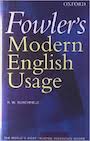
But how can I be so sure? By playing my trump card. I went to my bookcase and pulled down Fowler’s Modern English Usage – the absolute authority on correct English. (If you don’t have a copy, your library has one. You can even call the reference librarian and save yourself a trip.)

According to Fowler, “a number” is plural, and “the number” is singular. Case closed!

When I posted my answer (the correct answer) on LinkedIn, I added a comment about the silliness of trying to reason your way to an answer about a sticky usage question. Check an authority!

Forty-seven people ignored that sensible (and professional) advice. Sigh. 

Fowler's Modern English Usage

Share

When Wrong Is Right

Scott Joplin is my favorite composer. A line from his opera Treemonisha has been running through my head lately: “Wrong is never right.”

Joplin is correct, of course – unless you’re talking about language. Wrong is right when it’s more clear or more natural – or when you simply like it better. 

Here’s an example from the introduction to a personal essay by my friend Jane Brumbaugh:

Mary Ann, a music teacher, was a friend of mine. She invited me and a few other women to her living room to discuss forming a group to work toward passing the Equal Rights Amendment.

Someone in our writing group suggested that it would be better to put “me” second, like this:

“She invited a few other women and me…”

Check! Most of the time you’re supposed to put “me” after “women.” (Similarly, “Paul and I” sounds much better than “I and Paul.”) 

But I voted for putting me first in Jane’s piece. Doing it that way builds an oh-so-subtle bridge between the first sentence and the second one. Another advantage is that writing the sentence this way helps personalize Jane’s piece.

Mary Ann, a music teacher, was a friend of mine. She invited me and a few other women to her living room….

Ready for another one? Here’s a sentence I wrote myself based on a nono in Theodore Bernstein’s wonderful book Watch Your Language. Bernstein would give this sentence a thumbs-down. Even though I’m a great admirer of his, I would leave the sentence the way it is. (And to make things more interesting, I sneaked in another problem! Can you find it?)

The trio was honored for the performance they had given in March.

Give up? Trio is singular, and they is plural, so there’s an agreement error. (The sentence should be worded this way: “The trio was honored for the performance it had given in March.”)

I like my version better (sorry, Mr. Bernstein!) because it humanizes the singers. They is a better choice than it, even though a strict grammarian might slap my wrist with a ruler.

It’s true you could avoid the problem altogether by writing the sentence this way:

The trio was honored for the performance in March.

But I like “they had given” because now I can see – for just a moment – that trio performing on stage.

Let’s go on to the second problem – passive voice. I’ve known some self-proclaimed experts who say that passive voice (“the trio was honored”) is always wrong. Here’s how they’d want me to write the sentence:

The Arts Council honored the trio for the performance it had given in March.

Word processors tend to agree, and they always put an angry red line under passive-voice constructions.

So why did I decide to stick with passive voice? Because my version puts the trio in the position of importance, right at the beginning of the sentence. I don’t even want to mention the Arts Council. I want all the focus to go on the trio – and passive voice does the job for me very nicely.

Let’s challenge one more rule. Last month I did a post about Strunk and White’s admonition to “Omit needless words” in their classic book The Elements of Style. I suggested that sometimes those apparently needless words can enhance a sentence. Along the way I quoted an excerpt from Margaret Mitchell’s novel Gone with the Wind.

Enter Darrell Turner, a regular visitor to my blog who often leaves thoughtful and intelligent comments for me. He noticed something I had missed in that excerpt from Gone with the Wind: Mitchell’s unnecessary words. Here’s Darrell’s list:

“expectantly” in “expectantly upon him”

“long” in “long harangue”

“always” in “country funerals were always long”

“loved” in “loved friend”

What a great comment! I hadn’t noticed the redundancies. What’s even better is that Darrell’s comment got me thinking. If I had been Mitchell’s editor, would I have omitted those unnecessary words?

Umm…maybe. Editors need to be wary of making changes for a writer as strong as Mitchell was. And there’s always the question of whether those seemingly unnecessary words add something to the book. On the other hand, Gone with the Wind is a huge novel. Surely some cuts would be helpful, especially for readers who might not want to tackle such a weighty book.

So – here goes. I would have cut “expectantly” and “always” on the grounds that they don’t evoke any of the five senses. I would have kept “long” and “loved,” which are more tangible words.

What would you have done?

That last question is more important than anything else I’ve told you today. If you find yourself scratching your head when you’re working on a piece – wondering if there’s a better way to word a sentence, or trying to decide if the word you’ve chosen is the right one for the job – congratulations! You have entered the realm of real-world writers.

Share

Subjunctives

You rarely hear complaints about people who overdo grammar. It’s much more common for people to be careless with subject-verb agreement, diction, pronoun case, and similar issues.

But I occasionally hear people using the subjunctive mood (that’s the grammatical term) when it’s not necessary. The word to watch for is if, and the question is whether to use was or were. (I’ve known people who use were all the time, just as I’ve known people who always use whom. Not a good solution!)

If your radio were tuned to NPR this morning at about 7:15, you heard an excellent report about Brexit.  INCORRECT

If I were a British citizen, I’d already be feeling the effects of Brexit.  CORRECT

Here’s what you need to know. The subjunctive (if I were) is only for situations that don’t exist. If something is (or was) possible, use was with if.

So…your radio really could have been tuned to NPR this morning. Use was:

If your radio was tuned to NPR this morning at about 7:15, you heard an excellent report about Brexit.  CORRECT

Here are two more examples. In the first sentence, Joan really could have been in Florida during the hurricane: use was. In the second sentence, Joan isn’t going to stop being busy, so you should use were.

If Joan was in Florida last month, she experienced the full force of Hurricane Irma. CORRECT

If Joan weren’t so busy, I’d ask her to chair the committee.  CORRECT

Share