Category Archives: Writing Skills

Strain on My Brain!

Many ambitious writers believe that if you can just get the @##$%! grammar right, you’re going to be an effective writer. Sadly, that’s not true. Here’s a perfectly grammatical sentence from the Business Daily Review that – nevertheless – has a problem:

Abortion clinics and a doctor have launched a challenge at the Florida Supreme Court after an appeals court Wednesday rejected a temporary injunction that would have blocked a new law preventing abortions after 15 weeks of pregnancy.

First, it’s too long. More seriously, readers (at least the ones with a brain like mine) have to struggle to figure out what the sentence means.

I’m going to be folksy here and call this sentence a triple negative. A preventive measure was blocked, rejected, and challenged. Each step reversed the previous step. It’s like a shell game.

Be kind to your readers! Tell the story one step at a time.

Abortion clinics and a doctor have launched a Florida Supreme Court challenge. Florida has a new law preventing abortions after 15 weeks of pregnancy. That law started a chain reaction: a temporary injunction blocked the law and reinstated the right to abortion. But then an appeals court reimposed the 15-week limit. On Wednesday the Supreme Court accepted a challenge from an abortion clinic and a doctor who want to make no-limits abortions legal again.

Whew. (Incidentally, the Florida Supreme Court did reinstate the 15-week limit.)

Writing isn’t a contest to see who can cram the most information into a sentence. The goal is to communicate with your readers. The best writers are the ones who work hard to make things easy for their readers.

Share

The Meanings of Words

If you’re looking for ways to improve your language skills, you might enjoy this article: https://www.mentalfloss.com/article/505154/25-words-don%E2%80%99t-mean-what-you-think-they-do.

It’s a clear and engaging discussion of some words that have tricky meanings: luxurious/luxuriant and loath/loathe, for example. 

But be warned! There are some traps here. Right off the bat, the author notes that literally is often used to mean figuratively: “I literally laughed my head off.” Umm…no, you didn’t. Your head is still nicely attached to your neck and shoulders.

That literally/figuratively confusion is often used as a sad example of the deterioration of English nowadays. I’ve also heard people from the UK complain that it’s yet another example of American disrespect for English.

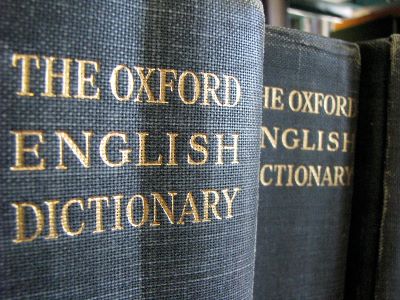
To settle the issue, I headed for the Oxford English Dictionary, which traces the history of English words over the centuries. And what I discovered is that literally was first used to mean figuratively back in 1769 – in an English novel, not an American one.

Words change over time. I’ve stopped yapping about the widespread misuse of disinterested, for example. It’s supposed to mean “impartial”: you don’t have an interest, or an investment, in a proposal or program.

But today it’s often used to mean “bored,” and I’ve stopped worrying about it. We haven’t really lost anything: you can always use impartial, as I just did.

I recommend a healthy dose of common sense as you go through this Mental Floss word list. Some words have always been so confusing that they should never be used.

Nonplussed is a prime example: “I was surprised” (or “taken aback”) will do nicely. (That confusion is nothing new, by the way – I remember struggling with nonplussed back in the 1970s.)

The reverse principle is also true. If you know the difference between – say – luxuriant and luxurious, you’ll impress people like me who still care about those words.

I’m one of those dinosaurs who still reserve enormous for negative sentences (“enormous damage”). Enormity continues to have a negative meaning, but the expiration date on that definition is looming.

Have fun with these words!
Oxford English Dictionary

                                       Photo courtesy of Emdot

Share

The Oxford Comma

What’s an Oxford comma? It’s the comma before and in a list. In the sentence below, there’s an Oxford comma after tea:

We served coffee, tea, and cake to our guests.

Students are sometimes told that God (or Moses, or someone) made a rule that the Oxford comma is wrong. (That happens to journalism students all the time.)

No, it isn’t. The Oxford comma is a choice.

That comma is wrong if you’re writing for a newspaper or magazine. (If omitting that comma messes up the sentence, you put it back in.)

Here are some rules:

  • If you’re a journalist, you omit it.
  • If you’re an academic, you use it.
  • If someone’s paying you to write, you ask them their policy about that comma, and you follow it.
  • If that comma (or the lack of it) causes a problem with a sentence, you fix it.
  • If you’re writing on your own, you make your own decision.
  • What you never (ever!) do is argue about it.

Share

The Man with the Broken Jaw

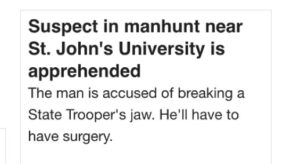
Here – courtesy of my friend Jenna – is an example of an indefinite pronoun reference.

The good news is that you don’t have to bother with the grammar gobbledygook. All you need to know is that he, she, and it are some of the trickiest words in the English language. (Strange but true!)

In today’s example, there are two men. Which one is having the surgery?

Here’s how I would fix the problem: The man is accused of breaking a State Trooper’s jaw, which will require surgery.

Take extra care with he, she, and it. Make sure your sentence is clear about who’s who. (And if you want to show off by talking about an “indefinite pronoun reference,” I’m not going to stop you!)

A fist that's hitting

Share

What’s an “Indefinite Pronoun Reference”?

Here’s a excerpt from the New York Times that caught my eye recently. It’s from an article about what to wear to a wedding:

No matter what, “avoid predictability,” said Donnell Baldwin, a stylist in New York City. This may mean gowns with funky patterns, art-printed dinner jackets and eye-catching accessories like velvet purses or patterned pocket squares. 

It’s a confusing sentence because “predictability” could have two meanings. Baldwin could be saying that funky patterns and the rest are the answer to predictability – or that they’re examples of predictability.

The problem is the word this. This is one of the trickiest words in the English language. (Who knew?)

When you were reading “This may mean,” your eyes automatically started backtracking to find out what “this” meant. Aha! Predictability. So Donnell Baldwin was telling you that funky patterns are too predictable.

But wait a minute! Funky patterns aren’t predictable. So your brain had to make an adjustment. Oh – Baldwin was saying that funky patterns are a remedy for predictability.

I am not making this up. Your brain (and eyes) automatically start backtracking every time you see the words this or that by themselves. Grammarians call this usage an indefinite pronoun reference.

Happily, they also have a cure for it: never use this or that by itself. Always put a noun after those words: this advice, that idea, and so on. (Did you notice what I wrote in the previous paragraph? “Grammarians call this usage….” I was careful to put a noun after this.)

Here’s my fix for that sentence about “predictability”: 

This problem can be solved by gowns with funky patterns, art-printed dinner jackets and eye-catching accessories like velvet purses or patterned pocket squares.

Professional writers care about our readers. We want you to enjoy reading! So we avoid  sentences that require backtracking.

the word grammar

Share

Quotation Marks Part II

Last week I talked about a common problem with quotation marks – the bad habit of using them to apologize for a word choice.

Today I have another lesson about quotation marks. I’m going to give you a simple rule about using quotation marks correctly.

Here it is: In the US, periods and commas always go inside. (Did you notice the word always?)

Here are a few examples:

When Janie came through the door, we all started singing “Happy Birthday.”  CORRECT

Although Mark liked the movie, he said he would have “drastically cut it.”  CORRECT

“The time has come,” the Walrus said, “to talk of many things.”  CORRECT

During my long teaching career, I discovered that many people routinely ignore the word always. After I explained that commas and periods always go inside quotation marks in the US, I would ask my class for the exceptions.

Hands would immediately go up, and I’d get answers like “Put the period outside if it’s an incomplete sentence.” “Periods go inside, and commas go outside.”

And I would say, “Does anyone know what always means?” The hands would go down, and there would be some sheepish looks.

Other countries have different rules. In 2015 I published an article about Shaw in a book published in England. I followed British rules for quotation marks and put some of the punctuation outside. But in the US, there are NO exceptions.

Man propping up quotation marks

Share

Quotation Marks Part I

Today’s topic is scare quotes – quotation marks used to call attention to an unusual way to use a word. Here’s an example:

While I was reading about Charles Dickens yesterday, I “stumbled” onto something interesting.

The person who wrote this didn’t really stumble, of course. They were sitting down and reading. To show that it wasn’t a real stumble, they used scare quotes: I “stumbled” onto something interesting.

 The pros don’t use scare quotes, and you shouldn’t either. It’s like wearing a t-shirt that says, “I’m an amateur!”

The sentence about Charles Dickens is stronger if you omit the quotation marks:

While I was reading about Charles Dickens yesterday, I stumbled onto something interesting.  BETTER

I’ve always told my students not to apologize if they use an unusual word – or if they use a word in an unusual way. The pros do it all the time, and so can you.

Stand by your word choices! If it’s the word you want, go ahead and use it. If it’s not the word you want, find a better word.

Take a look at this sentence: “Jenny and Tom were wrapped up in each other.”

I doubt that Jenny and Tom were Scotch-taped together in shiny Christmas paper! Anyone can figure out what the sentence means: Jenny and Tom were deeply involved with each other. No quotation marks are needed.

Next week I’ll have more to say about quotation marks.

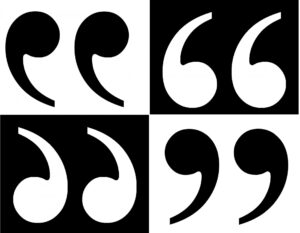
Four sets of quotation marks

Share

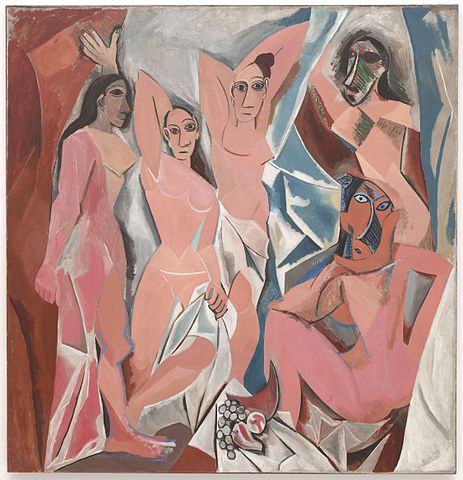
Pablo Picasso

Today I’m going to talk about a paragraph from the SAT prep website. The subject is Pablo Picasso, a famous twentieth-century artist. The paragraph is an interesting one because the writing is both good and bad.

The world in which Picasso lived was particularly supportive of his developing celebrity. His family cultivated his creative passion, he had clusters of peers who inspired him, and he had the good fortune to be born at a time when new ideas in science, literature, and music energized his work. Moreover, the advent of mass media allowed him to achieve widespread fame.

Here’s what’s good: the paragraph uses moreover to build towards a climax. That’s what professional writers do – and what student writers should practice doing.

Here’s what’s not so good: too much information is crammed into the second sentence. It talks about family, peers, science, literature, and music. Whew!

This is typical textbook writing. Because there’s so much to cover in a semester, information comes at you at lightning speed.

I’m not blaming the College Board for posting this paragraph. But there’s a danger if students imitate these examples. The ideas rush by too quickly.

Instructors can help by spending more time talking about emphasis. Students should work on emphasis too. One suggestion is to simply spend more time thinking about it.

An easy first step when you’re writing is giving each idea its own sentence. An effective second step is developing each idea with something interesting – an anecdote or an intriguing fact.

Try it!

                                             Les Demoiselles_d’Avignon

Share

Semicolons: Easy or Difficult?

I usually enjoy Mary Norris’s articles about language. She’s a former copyeditor for The New Yorker and a terrific writer – funny, readable, and informative.

But…yikes! Sometimes she goes overboard. Here are her thoughts about semicolons:

That is, commas, semicolons, and colons were plugged into a sentence in order to highlight, subordinate, or otherwise conduct its elements, connecting them syntactically. One of the rules is that, unless you are composing a list, a semicolon is supposed to be followed by a complete clause, capable of standing on its own….Sentence length has something to do with it—a long, complex sentence may benefit from a clarifying semicolon—but if a sentence scans without a semicolon it’s best to leave it alone.

Anyone reading that would decide that it’s best not to attempt  to use a semicolon at all – ever.

There’s an easier way. Just write two sentences. Change the first period to a semicolon. Lower-case the next word (unless it needs a capital letter). You’re done!

Tuesday is my birthday. I’m throwing a party.  CORRECT

Tuesday is my birthday; I’m throwing a party.  CORRECT

Some of my writer friends blanch when they hear this. They insist that you have to make semicolons difficult!

No, you don’t. So there!

Share