Category Archives: Writing Skills

Prescriptive or Descriptive?

Last week a disgruntled college student (let’s call her “Linda”) logged on to Quora.com with a language problem. She had used dude in an academic paper. Her instructor said that dude is an inappropriate word for academic writing and crossed it out.

Linda wanted some ammunition to justify putting dude back into her paper. She felt that her instructor was being prescriptive rather than descriptive, and that was wrong…wasn’t it?

I told Linda that she was asking the wrong question. The terms “prescriptive” (laying down the law about language practices) and “descriptive” (suspending judgment about them) aren’t much help when you’re actually using the English language.

Language rules are slippery things. Here’s the best way to settle them: Think about the group you aspire to join – and adopt their language habits.

If your friends at college use dude in their conversations, go ahead and use it. But if your aim is to publish in an academic journal (or earn a good grade in Freshman Composition), you’re going to have to forsake dude. I’m sorry.

In my next post I’m going to dig deeper into Linda’s “Do I have to obey the rules?” question. It’s not as simple as you might think!

old strict teacher with glasses

Share

The President Is Missing

I often read books and articles about better writing practices, and I’m usually disappointed. Although they’re fun to read, they rarely get specific enough to teach anything useful. But last week my friend Karen White showed me a magazine article that has some wonderful real-life examples of bad sentences that make important (and practical) points about writing.

The article is “High Crimes by Anthony Lane. It appeared in the June 18, 2018 issue of The New Yorker. Lane is reviewing The President Is Missing, a bestselling thriller written by former President Bill Clinton and bestselling novelist James Patterson.

Here are some examples from Clinton and Patterson’s novel (quoted by Lane), along with comments from me:

“She had to bite her tongue and accept her place as second fiddle.”

The first problem is the two overused images – biting your tongue and playing second fiddle. But what’s really wrong here is that you’re not seeing the woman in this scene. Of course she didn’t really bite her tongue. So what did she do? Purse her lips? Scowl? Frown? If you picture what she was doing, you could come up with a decent sentence.
Ann Whitford Paul says you should act out every scene when you’re writing a book. She’s even known writers who took acting classes – and found them helpful. So – act out the scene. What gestures, actions, and words did you use? Now you have something to write down.

“The sorrowful, deer-in-the-headlights look is long gone. The gloves have come off.”

Same problem, same advice.

“I terminate the connection and walk out of the room.”

Why “terminate”? Couldn’t you just say “stopped” or “ended” it? And who or what were you connected to? Again, we’re not really seeing what’s going on. “Walk out of the room” doesn’t convey anything useful. Did you leave abruptly? Suddenly? Quickly? Quietly? Would the sentence convey more information if you said that you marched or stomped out of the room – or fled it?

“Vokov’s eyebrows flare a bit.”

I hate a bit. It minimizes the point you’re making. If you’re “a bit” hungry, why do anything about it? Great writers don’t waste time with small, unimportant feelings.
And how can an eyebrow “flare”? If it flared “a bit,” would anyone even notice it?

“Augie lets out a noise that sounds like laughter.”

Apparently Augie wasn’t really laughing. So what was he doing? Telling your reader what isn’t going on doesn’t help at all.

A character “hiccups a bitter chuckle”

This sounds self-consciously clever to me. I’m trying to imagine how a hiccup could sound like a chuckle – and how a chuckle could sound bitter. Nope – I’m not coming up with anything.

“a  focused squint”
“a sweeping nod”

How can you focus a squint? When someone is squinting, you can barely see their eyes. And how can a nod be sweeping? Isn’t a nod a small, subtle movement?

* * * * * * *

Surprisingly, Anthony Lane liked the book. It’s an intriguing story, despite the clumsy writing. Maybe Lane shouldn’t even be criticizing a successful writer. But here’s my philosophy: just about every writer comes up with tons of awful stuff. Why not take pride in your work – and fix everything that doesn’t work? 

weakness warning

Share

Is Wikipedia Reliable?

Should we trust Wikipedia? My answer is a strong yes. One study I saw found that Wikipedia is more reliable than the Encyclopedia Britannica. My husband and I have submitted edits to Wikipedia, and we’ve been impressed by the quality control process they use. We had to provide reliable sources for the changes we suggested.

It’s true that teachers are always telling students not to use Wikipedia as a source. But that’s not because there’s anything wrong with Wikipedia’s information. I’m a longtime college professor, and I never allowed students to use the Encyclopedia Britannica as a source. But we often used it in class for a quick fact-check.

What you need to remember is that encyclopedias publish only straight facts, and those don’t need documentation. You wouldn’t give a source for the date when Thomas Edison was born, or the length of the Thames river, or the number of rooms in Buckingham Palace, or the name of Queen Elizabeth II’s great-great-grandmother. Nobody is going to argue with you about those facts.

What you have to document are controversies – and those are beyond the mission of an encyclopedia. That’s where you start reading articles and books by experts. You want quotes, opinions, viewpoints, and statistics. Encyclopedias don’t deal with those. Just the facts, ma’am.

I use Wikipedia all the time, and I donate whenever they have a fundraiser.

Share

The Thumb Rule

Pronouns (I, me, he, him) confuse many people. Read the following sentence. Is it right or wrong?

My father taught my brothers and me many important lessons about life.

If you said that the sentence is right, you’re probably a college graduate – maybe even an English major. Yes, the sentence is correct, even though many people would insist (mistakenly) that it should be “my brothers and I.” (To many people, “I” sounds more elegant than “me,” and they overuse it.)

A grammarian would say that taught is a transitive verb, taking the objective case. So you need “me,” not “I,” in this sentence.

But let’s be Writing Revolutionaries and skip the jargon. There’s an easy way to get sentences like this one right every time. Just use your thumb to make the sentence shorter.

Here’s how: Go back to the original sentence and cover up “my brothers and” with your thumb. This is what you end up with:

My father taught me many important lessons about life.

You can hear that “me” is right. So here’s the corrected sentence:

My father taught my brothers and me many important lessons about life.  CORRECT

Just for fun, let’s do the same thing with “I.” Cover up “my brothers and.” This is what you get:

My father taught I many important lessons about life.  WRONG

Doesn’t sound right, does it? You need “me” in this sentence, not “I.”

Let’s try one more:

In July my best friend and I will be going to Mexico for two weeks.

Cover “my best friend and.” Here’s what’s left:

I will be going to Mexico for two weeks.

Sounds right! So your sentence is correct:

In July my best friend and I will be going to Mexico for two weeks.  CORRECT

Take your thumb with you wherever you go. It’s a great language tool!

Just kidding. But this “Thumb Rule” trick works every time. You can download a free handout that explains pronoun rules at .

a thumb

Share

Diagramming Sentences

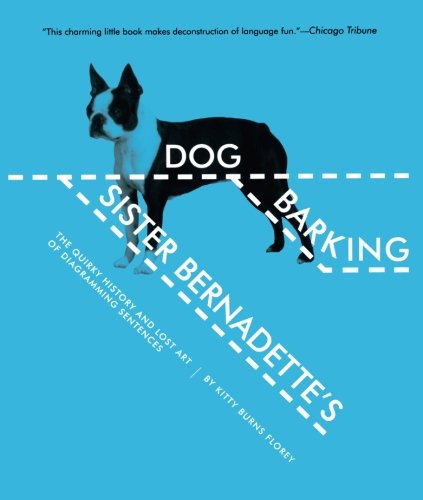
I own (and cherish) a copy of Sister Bernadette’s Barking Dog: The Quirky History and Lost Art of Diagramming Sentences, written by Kitty Burns Florey.

You’re shrugging your shoulders. Why wouldn’t an English teacher own a book about diagramming sentences?

Because I don’t know how to do it, that’s why, and (my voice gets loud here) I DON’T WANT TO LEARN HOW.

It’s a great book anyway.

I heard the author interviewed on NPR and was delighted by her offhanded attitude towards sentence diagramming. It is not, she declared, the answer to America’s writing problems. Imagine: Writing a whole book about a topic and then telling the world your subject isn’t important or necessary! You have to love a writer like that.

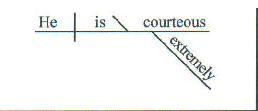
Before I go any further, I need to show you an example of a sentence diagram. I had to crib this one because, as I confessed earlier, it’s a skill I never learned.

Sentence Diagram

You can see many more examples by Googling “sentence diagram.” Some of the more elaborate ones look like subway maps.

(The barking dog, incidentally, was the subject of a diagramming exercise invented by Sister Bernadette, who was Florey’s sixth-grade teacher.)

Back to our central question: Why would I read (and shell out good money for) a book about a skill that doesn’t interest me?

Answer: Florey is a great writer about a subject I’m passionate about – writing. Here, from page 47, are two sentences I particularly like:

Trying to stuff the complexities of the English language into flat visual structures is a bit like trying to force a cat into the carrier for a trip to the vet. And coming up with the idea in the first place seems comparable to the boldness and daring of cracking open the first oyster and deciding it looked like lunch.

Why is that a great sentence? One reason is the vivid images: forcing a cat into a carrier (been there, done that), and cracking open an oyster. Still another is Florey’s gift for words: You can hear her cracking open that oyster, and “looked like lunch” is…well…lovely.

And now, at last, I’m going to make today’s point. If you want to be a terrific writer, you need to think about words and ideas. You need to read good writers and get inspired by them. What isn’t going to help you (despite the fond wishes of leagues of English teachers) is diagramming sentences.

As Florey points out in her book, ungrammatical sentences can be diagrammed just as prettily as elegantly correct ones.

It’s true that diagramming will show you how to think about the parts of a sentence – a vital habit for good writers. Most of the students who walked into my college classroom for the first time had never thought about the way that words are grouped together to form a thought. Getting students over that hump was a big challenge. A background in sentence diagramming might have helped (though I wouldn’t spend more than 25 or 30 minutes on it – just enough to convince students that sentences have parts you can play with).

But if you’re reading this blog, surely you’ve already taken that first step! Please…don’t get bogged down in the parts of speech (another topic I’m shaky about). Find something enjoyable to read, figure out why it’s so good, and apply what you’ve learned. Soon you’ll be on your way!

Share

Is It a Word?

I often see questions about whether something is a word. My response is always the same. If you type, write, or say it – it’s a word. A better question would be whether it’s a standard word.

Last week I was surprised to come across this common misunderstanding in – of all places – the prestigious New York Times. I read an excellent article about Benjamin Dreyer, author of a new book called Dreyer’s English: An Utterly Correct Guide to Clarity and Style.

I’m looking forward to reading Dreyer’s book, and I also enjoyed the Times article:  “Meet the Guardian of Grammar Who Wants to Help You Be a Better Writer. “

But sheesh – there it was, right in the Times: Meanwhile, the president of the United States thinks ‘seperation’ is a word.”

According to the dictionary, a word is “a sound or a combination of sounds, or its representation in writing or printing, that symbolizes and communicates a meaning.”

You don’t have to like the word. Maybe it’s vulgar, or misspelled, or silly. But irregardless is a word, and so are ain’t and binky. They’re not standard, and you won’t even find binky in any dictionaries. But they’re all words.

If you think about this “what’s a word?” question, you can see why we have to give word status to every neologism that comes along. Revising a dictionary is a long and expensive project. Does it really make sense to forbid people to talk about – say – “software” and “malware” until lexicographers get around to revising the dictionary?

Here’s something I wrote just a minute ago:But sheesh – there it was, right in the Times.” Wait a minute! Is sheesh even a word?

No need to ask.

Dictionary with an magnifying glass on top

Share

The Great Vowel Shift

Few things in my life have brought me more joy than…the Beatles. The soundtrack to Hard Day’s Night is my favorite album, and I’ve watched the movie at least a dozen times.

Today I’m going to talk about something that has always puzzled me about Hard Day’s Night: the way the Fab Four pronounce the word book. It rhymes with look and cook, right? But in Hard Day’s Night, book sounds a lot like boot.

The reason seems to be the Great Vowel Shift that started in the 14th century. All our English vowels changed. I like this explanation from Richard Watson Todd’s book Much Ado about English:

Prior to the GVS, which took place over around 200 years, Chaucer rhymed food, good and blood (sounding similar to goad). With Shakespeare, after the GVS, the three words still rhymed, although by that time all of them rhymed with food. More recently, good and blood have independently shifted their pronunciations again.

But somehow the GVS skipped Liverpool, home of the Beatles. I think the GVS deserves some attention, for three reasons. First, it helps explain why English spelling and pronunciation are so weird.

Last week my friend William Vietinghoff asked why bone and done are pronounced differently. Very likely the Great Vowel Shift was responsible. And what about done and dun? Pronunciations of many English words changed, but spelling didn’t – and that opened the door to all kinds of inconsistencies.

The Great Vowel Shift also challenges some common assumptions we make about good and bad English. Many people think that a) British English is better than American English and b) the English of bygone years was better than the version we use today.

The GVS puts the lie to those notions. First, “British English” is a vast oversimplification. The English spoken in Liverpool is different from what you’ll hear in Yorkshire, Newcastle, Edinburgh, Cardiff, Cornwall, and London. (American English is just as diverse: you’ll hear different versions in Boston, New York City, Chicago, and Birmingham.)

Things get even more complicated if you’re a member of the “older is better” school. The Four Lads from Liverpool are clearly using a more authentic version of English than what you’d hear in Buckingham Palace. Does anyone really want to chastise the Queen about her pronunciations?

An understanding of the GVS can also help us understand and accept changes in English today. Take the word flourish, for example. I make the first syllable sound a little like “flood.” But just this morning I heard a friend pronounce it like “floorish” – and he’s not the only one.

I know several women named Dawn – but everybody calls them Don. (I still pronounce the aw sound like “broad,” but I’m in the minority.)

We’re having our own Great Vowel Shift, right now. Three hundred years from now, linguistics scholars may be analyzing pronunciations in Roma and A Star Is Born to track changes in English during the twenty-first century. Fascinating, isn’t it?

Hands holding the vowel letters of the English alphabet


Share

If Only Everyone Used “Only” Correctly!

Are you careful when you use only in a sentence? Most people aren’t – and hardly anybody notices. Today I’m going to try to make a case for positioning only carefully. It’s a small detail that will impress careful readers.

The rule is that you should place only right next to the word it modifies. Here’s a mini-lesson I’ve often used with my students. Notice how the meaning changes every time only is moved to a different position:

Only I kissed her.

I only kissed her.

I kissed only her.

All three sentences are correct, and they all mean something different. Start listening to how only is used in conversations, and make an effort to spot it when you’re reading. It’s worth the extra effort to use only correctly – even though it will only be noticed by a few perceptive readers.

Oops! I meant to write it this way: even though it will be noticed by only a few perceptive readers.

a man and a woman kiss

Share

Writing a Strong Opening

A friend kept urging me to read Writing Picture Books by Ann Whitford Paul. I was skeptical. I love picture books (Danny and the Dinosaur, anyone? Little Bear?). But I don’t write for children.

My friend was so insistent that I finally gave in and ordered it from the library. She was right: This concise book offers priceless advice. (Yikes: concise, priceless, advice – I’m starting to think in rhymes. I guess the book really got to me!)

Today I’m going to share a suggestion from the book and one of my own. Then I’m going to give you an example to think about.

Ann Whitford Paul wants you to ask yourself a series of questions about the opening paragraph of your book: Who is the main character? What does your main character want? When and where is the story taking place? What’s the tone? What’s the WOW factor?

I’m going to add one more: What’s the first interesting word? If you’re having trouble answering the questions, that’s a sure sign that you need to revise.

For example, often there are two people in the opening of a story – two friends, or a husband and wife, or a boss and an employee. That’s fine if it’s it clear right away which one is going to be the central character. If not, it’s time to revise.

The same principle applies to other kinds of writing. If you’re working on a nonfiction piece, you might have three or four ideas in your opening. Is it clear which one will carry the book?  And you’d better get to an interesting word quickly! There’s a whole world out there competing for your reader’s attention.

I leave it to you to figure out how Paul’s other questions work, with this observation: if the answers aren’t clear right away, you need to revise. 

Let’s go on to an example. I’ve often taught Ernest Hemingway’s classic novel The Sun Also Rises. It’s a great book, but I also think there’s a serious flaw in the opening. Jake Barnes, the narrator, writes at length about Robert Cohn, his tennis friend in Spain. But as the book progresses, Robert Cohn fades away from the story.

There’s no rule that the first two characters have to be there on every page of your novel. But I always get the feeling that Hemingway had a different plan in mind for his novel. He finally changed the plan – but he didn’t go back to make sure the opening matched his new version.

Hemingway was such a great writer that the novel works anyway. But you and I can learn something important here. The beginning of any book generates the energy that will carry the story to the end. Make it powerful. Whatever goes into that opening should stay with the book all the way to the end. It’s good advice even if Hemingway decided not to follow it!

Front cover of Ernest Hemingway's Novel

Share

Commas with And

It’s a question I hear all the time: when do you use a comma with and? If you’d like to learn about the Oxford comma, click here. What I’m going to focus on today is joining sentences with and.

Here’s the rule. If there are two sentences, use the comma. If not, omit the comma. Here are two examples:

We loved Hawaii, and we want to go back.  TWO SENTENCES: COMMA

We loved Hawaii and want to go back.  ONE SENTENCE: NO COMMA

But why? Many people just insert the comma (or leave it out) willy-nilly, without using a rule for guidance. What difference does it make? Answer: A huge difference. And I can prove it.

Take a look at this sentence:

We roasted marshmallows and a squirrel

Pretty nasty picnic! But now read this:

We roasted marshmallows and a squirrel grabbed one.

Much nicer picnic! So how do we make the sentence clear enough so that it can be understood on the first reading?

The answer is to insert a comma after marshmallows. That punctuation mark – a mere wiggly line – tells your brain that the roasting is over. We know that the squirrel introduces something else that happened.

We roasted marshmallows, and a squirrel grabbed one.  CORRECT

Let’s try another example. Here’s the beginning of a sentence about a party:

I invited Joe and Alice

Poor Alice – she wasn’t included! But maybe she came to the party after all:

I invited Joe and Alice asked if she could come too.

It’s another confusing sentence that can, luckily, be fixed with a single comma. Try this:

I invited Joe, and Alice asked if she could come too.  CORRECT

So here’s the rule: Use a comma when you join two sentences with and. (Sentences with but work the same way.)

And here’s the underlying principle: Your brain uses that comma to figure out that the first sentence is finished and a new one is beginning.

Let’s try one more example – an and sentence that doesn’t need a comma:

I invited Joe and Alice to the party this weekend.  CORRECT

There’s no need to separate “Joe and Alice” – they’re both invited. So I didn’t insert a comma.

Are you surprised how easy this rule is? I am too. Isn’t English wonderful?

a squirrel on a branch

Share