Category Archives: Sense and Nonsense

Top Ten Grammar Peeves

I saw this list on Facebook this morning. Uh-oh!

Top 10 grammar peeves 2

There’s a mixture of good and bad information here. Let’s take a look:

 1, 3, 4, 5, 6, 7, and 9 are accurate and make good points – though I’ve heard “nonplussed” in a conversation only once, so I don’t think #7 is a useful piece of information. And BTW, I do know what it means (perplexed). One more thing: I can’t ever recall seeing “nonplus” (without the -ed ending) anywhere. So I was nonplussed (hah!) when I saw it on this list.

Enough about that. What about 2, 8, and 10?

#2:  Apostrophes are used to form plurals of symbols and letters used alone:  Dot your i’s and cross your t’s. They’re sometimes used with plurals of numerals: Her 1’s look like 7’s. (You should know that some style manuals limit this kind of apostrophe usage to even decades – the 60’s but not 70s – and some don’t use it at all.)

#8:  Psychologists often use “affect” as a noun meaning feeling or emotion (this usage is standard and appears in all the dictionaries). And “effect” is sometimes a verb meaning accomplish or make happen: We effected the changes after only a short delay.

#10:  Of course “irregardless” is a word. Any unit of sound with a meaning is a word. If your child loves his “binky” (pacifier), then “binky” is a word in your house. It’s more helpful to label “irregardless” (and “binky”) nonstandard.

I’m also going to argue for a minute about the title: Top Ten Grammar Peeves. Grammar is the underlying structure of language. Here’s an example of a grammatical problem: I gave the receipt to she and her brother (instead of her and her brother). (I actually hear that kind of thing once in a while. Sigh.)

These Top Ten Grammar Peeves are usage problems – choosing the wrong word or the wrong punctuation.

Despite the issues with 2, 8, and 10, I’m pleased that this list is circulating. Maybe we’ll see fewer unnecessary apostrophes and less confusion between your and you’re (an error I see daily on Facebook). If this list encourages writers to take a little more time to check their usage, it will have accomplished a lot (which should have been Pet Peeve #11: PLEASE write a lot as two words, not one!).


Share

Blowout!

Yesterday’s football shocker, when the New England Patriots held Tim Tebow to only 10 points, started me thinking about the word “blowout” – a favorite word in our household.

If you’re a fervent Honeymooners fan, you know that the Kramdens and the Nortons used to celebrate special occasions with a blowout at a favorite Chinese restaurant. To this day, if my husband unexpectedly finds a ten-dollar bill in a pants pocket, he’ll wave it at me and shout “Blowout! Blowout!”

I started thinking about the word blowout when I logged on to Facebook early this morning. Friends had already lined up to comment on the demise of Tebowmania (another great word).

I’m not taking sides on this (although I have a sister who lives in Massachusetts – you can draw your own conclusions).

What I want to talk about for a moment is the word blowout itself. Yes, it’s in the dictionary – but (at least until recently) referring just to blown tires and mining. Only recently did the American Heritage Dictionary add the definitions referring to a feast or a sports fiasco.

The ultimate authority, of course, is the Oxford English Dictionary. Thanks to the Internet, we can now see words under consideration for future editions. The definitions of blowout that we’re talking about are on that draft list. Blowout in the sense of a feast goes back to 1823. The failure usage first appeared in print in 1923.

No one knows when blowout was first used for a pizza outing, but I can confidently predict that you’ll hear it in our house tomorrow: Plans for our weekly trip to Pizza Town are already in place. Knowing the quality of the food there, I can tell you that our trip will definitely not be a fiasco.

As for Tim Tebow and the Broncos, there’s always next year.


Share

Pre- is Often an Unnecessary Prefix

Please understand me. I think a prefix is a fine and useful thing – in its place. Unfortunately pre– is often not fine and not useful.

Here’s a sentence from today’s New York Times that caused my blood pressure to go up. Erin McKean, founder of Wordnik, an alternative online dictionary, was explaining how her team prepares citations to go online. “We don’t pre-select and pre-prune,” she said.

Under Erin’s leadership, Wordnik is doing a fine thing: Everyone can benefit from unmediated access to the way words are being used today. But what’s the difference between “selecting” and “pre-selecting”? “Pruning” and “pre-pruning”?

The pre– prefix shows up (usually unnecessarily) all the time. I prepaid for my vacation. I preregistered for a conference. I prearranged for a ride to the airport.

During political discussions about insurance, we keep hearing about coverage of pre-existing conditions. Really? What’s the difference between an existing condition and a pre-existing condition?

Does pre– add anything useful in those three sentences? No.

Down with it. I’m pre-deciding not to use pre– this way in 2012.


Share

Offensive or OK?

Language – more specifically, the question of what constitutes offensive language – has made the news recently, not once but twice.

On December 9, the New York Times reported that the American Heritage Dictionary decided to label “anchor baby” an offensive term. 

(An anchor baby is a child born to an undocumented immigrant who hopes to use the baby to obtain citizenship. )

The second story came out of the 11th Circuit Court of Alabama. On December 16 its Court of Appeals reversed its own ruling from September 2010 that “boy” was not an offensive term. This time the judges awarded about $365,000 in damages to black employee John Hithon, who complained that his white supervisor used the term “boy” to refer to black employees.

How much attention should we pay to political correctness? Answers to that question vary. What about the term “class warfare,” for example? Some advocacy groups find “class warfare” a useful way to describe attacks on legislation that favors one group over another. Others oppose the term, asking why it’s ok to show political favoritism but not to talk about it.

Bottom line: Language is not something to be taken for granted – and (as the Alabama court demonstrated) language issues are not to be taken lightly. We all need to keep updating both our speech habits and our views about our fascinating and evolving language.

Share

Christmas Quiz

Here’s a different kind of Christmas quiz: Usage questions with a holiday theme. Correct the errors in the sentences below. (Some items don’t have errors.) Scroll down for the answers, and have fun!

Part I  Usage Errors

1.  Last night I ran out of scotch tape while I was wrapping some gifts.

2.  Two Christmas’ ago, each of the children received a new bicycle.

3.  We’re invited to the Smith’s annual Christmas Eve party.

4.  Aunt Carol gave us a beautiful pointsetta again this year.

5. Because some of our friends don’t celebrate Christmas, I always choose cards with a “Seasons Greetings” message.

Part II  Excerpts from Christmas Songs

6.  “God rest ye, merry gentlemen, let nothing you dismay”

7.  “Rudolph the red nosed reindeer had a very shiny nose”

8.  “Hark, the herald angles sing, glory to the new-born King”

9.  “The stars in the heavens looked down where he lay”

10.  “It’s beginning to look alot like Christmas, everywhere you go”

ANSWERS

1.  Last night I ran out of Scotch tape while I was wrapping some gifts.  (Brand names are always capitalized)

2.  Two Christmases ago, each of the children received a new bicycle.  (To form the plural of a word ending in “s,” add “es”)

3.  We’re invited to the Smiths’ annual Christmas Eve party.  (“Party of the Smiths”: Put the apostrophe after the final “s”)

4.  Aunt Carol gave us a beautiful poinsettia again this year.  (Be careful not to misspell poinsettia)

5. Because some of our friends don’t celebrate Christmas, I always choose cards with a “Season’s Greetings” message.  (“Greetings of the Season”: Put the apostrophe after the “n.”)

Part II  Excerpts from Christmas Songs

6.  “God rest ye merry, gentlemen, let nothing you dismay”  (It’s not a song about “merry gentlemen”: In this old song, the lyrics hope the men will “rest merry.”)

7.  “Rudolph the red-nosed reindeer had a very shiny nose”  (Use a hyphen. He’s not a red reindeer or a nosed reindeer.)

8.  “Hark, the herald angels sing, glory to the new-born King”  (Angels, not angles.)

9.  “The stars in the heavens looked down where he lay”  (Correct! The past tense of lie is lay.)

10.  “It’s beginning to look a lot like Christmas, everywhere you go”  (A lot is always two words: No exceptions.)

How did you do?

Share

Is It OK to Repeat a Word?

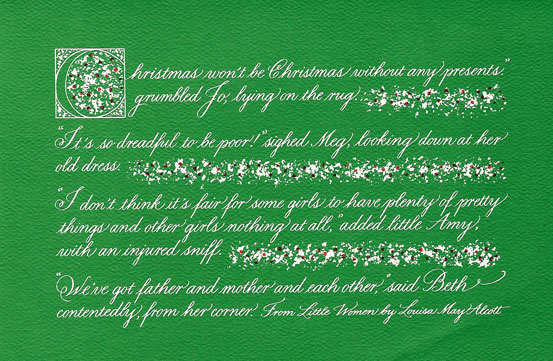
 It’s December, and I’m again displaying a beloved Christmas card my younger sister sent me back in 1986. It features the opening lines from Louisa May Alcott’s classic Little Women:

"Christmas won't be Christmas without any presents," grumbled Jo, lying on the rug.

“Christmas won’t be Christmas without any presents,” grumbled Jo, lying on the rug.

And I noticed something odd: The word “Christmas” appears twice in the first sentence: “Christmas won’t be Christmas without any presents….” (The same thing happens in the third sentence, when Amy says “girls” twice.)

Wait a minute! Is it ok to repeat a word?

Yes.

Despite what you may have heard in an English class, it’s perfectly ok to repeat words. Good writers do it all the time. If the repetition works, go for it.

How do you know whether it’s working? Set aside what you’ve written for a while and then read it again. If it sounds good, you’re ok. Better yet, ask a friend or family member to read it. Don’t ask whether the repeated word is ok. Just ask for a general reaction.

I hope you’ll be getting lots of presents this year!


Share

Does the English Language Really Have a System of Rules?

How much do you know about English grammar and English rules? Try this little test. Are these statements always true?

1. “Everybody” is a singular pronoun.

2. Use “who” for people, “that” for things.

3. Double negatives (“don’t have none”) are wrong because two negatives make a positive.

4. “One” is singular, and “five” is plural.

5. It’s wrong to use “good” to modify a verb.

6. Good writers don’t start sentences with “but.”

All the statements are false. Surprised? Let’s take a look.

1. Of course “everybody” is usually singular. But take a look at these two sentences:

Everybody finished early. How did they answer all those questions so quickly?

No one would replace “they” in the second sentence with “he or she.”

The “everybody…he or she” rule goes back to 1795, when a self-proclaimed grammarian named Lindley Murray invented it for a book that went on to become a bestseller.

Before Murray wrote his book (and, some say, messed up a perfectly workable grammatical structure), “they” was a free-floating pronoun that could be either singular or plural. (English, remember, has lost the useful gender-free singular pronouns that many other languages still have.)

“He” became “he or she” in the twentieth century to make English more inclusive. Feminists everywhere (I’m one!) heartily approve that change…but it added a clumsy, unnatural construction to many sentences. Some language experts are encouraging writers to go back to the original “everybody…they” construction that everyone used before Murray came along.

2. Yes, “that” should be reserved for things. For example, The nurse that took care of my sister should be changed to who took care of my sister.

But like many grammar rules, this one doesn’t work every time. Take a look at this sentence:

He’s the only man that I know of who has visited all 50 states.

3. The “two negatives make a positive” argument against double negatives seems to make sense – until you realize that many other languages (Spanish is one) routinely use double negatives, even in formal writing. And if you study Old English, you’ll discover that our language used to have double negatives too.

Why are double negatives ok in Spanish and in Old English, but not in modern English? The answer is that educated people don’t use them. That simple principle is the basis for every rule.

4. Of course “one” is singular and “five” is plural – most of the time. But what about this sentence?

Five dollars is too much to pay for a gallon of gas.

“Five dollars” is a unit, not five separate things, as in this sentence:

Five stores are closing because business has been so slow.

5. Yes, verbs require adverbs (well, -ly words), and nouns require adjectives (good). But not always. Forms of the verb to be and its cousins, the copulative verbs (seem, look, sound, smell, taste, feel) also use adjectives.

Consider feel, which has two meanings. It can be an action (as when you feel for a light switch in a darkened room). But it can also be a form of is (I feel good about my chances for the job).

Note these examples:

The soup smells good.

Your idea sounds good to me.

That color looks good on you.

6. The “you can’t start a sentence with but” rule does not exist and never has. It doesn’t appear in any grammar books – in fact the grammar books themselves feature sentences that start with but. (Did you notice that three sentences in this article start with but?)

Great writers, both old and new, routinely start sentences with but. Check the King James Bible, the Declaration of Independence, the novels of Jane Austen and Charles Dickens, today’s newspaper…any professional writing you have handy. Look at The Elements of Style by Strunk and White and Fowler’s Modern English Usage. Turn the pages of Lynn Truss’s Eats, Shoots and Leaves. You’ll have a hard time finding an author who doesn’t start sentences with but (I haven’t found any yet).

Bottom line: Don’t try to force a sentence to fit into a logical system. Read, read, read. Figure out what good writers do, and use them as models. You’ll soon be on your way to expertise.

Share

Happy National Writing Day!

In honor of National Writing Day, here’s a quiz to challenge you – along with some thoughts about the rules that govern correct English. Warning: You may encounter some surprises as you read on!

How much do you know about English grammar? Try this little test. Are these statements always true?

1. “Everybody” is a singular pronoun.

2. Use “who” for people, “that” for things.

3. Double negatives (“don’t have none”) are wrong because two negatives make a positive.

4. “One” is singular, and “five” is plural.

5. It’s wrong to use “good” to modify a verb.

6. Good writers don’t start sentences with “but.”

All the statements are false. Surprised? Let’s take a look.

1. Of course “everybody” is usually singular. But take a look at these two sentences:

Everybody finished early. How did they answer all those questions so quickly?

No one would replace “they” in the second sentence with “he or she.”

The “everybody…he or she” rule goes back to 1795, when a self-proclaimed grammarian named Lindley Murray invented it for a book that went on to become a bestseller.

Before Murray wrote his book (and, some say, messed up a perfectly workable grammatical structure), “they” was a free-floating pronoun that could be either singular or plural. (English, remember, has lost the useful gender-free singular pronouns that many other languages still have.)

“He” became “he or she” in the twentieth century to make English more inclusive. Feminists everywhere (I’m one!) heartily approve that change…but it added a clumsy, unnatural construction to many sentences. Some language experts are encouraging writers to go back to the original “everybody…they” construction that everyone used before Murray came along.

2. Yes, “that” should be reserved for things. For example, The nurse that took care of my sister should be changed to “who took care of my sister.”

But like many grammar rules, this one doesn’t work every time. Take a look at this sentence:

He’s the only man that I know of who has visited all 50 states.

3. The “two negatives make a positive” argument against double negatives seems to make sense – until you realize that many other languages (Spanish is one) routinely use double negatives, even in formal writing. And if you study Old English, you’ll discover that our language used to have double negatives too.

Why are double negatives ok in Spanish and in Old English, but not in modern English? The answer is that educated people don’t use them. That simple principle is the basis for every rule.

4. Of course “one” is singular and “five” is plural – most of the time. But what about this sentence?

Five dollars is too much to pay for a gallon of gas.

“Five dollars” is a unit, not five separate things, as in this sentence:

Five stores are closing because business has been so slow.

5. Yes, verbs require adverbs (well, -ly words), and nouns require adjectives (good). But not always. Forms of the verb to be and its cousins, the copulative verbs (seem, look, sound, smell, taste, feel) also use adjectives.

Consider feel, which has two meanings. It can be an action (as when you feel for a light switch in a darkened room). But it can also be a form of is (I feel good about my chances for the job).

Note these examples:

The soup smells good.

Your idea sounds good to me.

That color looks good on you.

6. The “you can’t start a sentence with but” rule does not exist and never has. It doesn’t appear in any grammar books – in fact the grammar books themselves feature sentences that start with but. (Did you notice that three sentences in this article start with but?)

Great writers, both old and new, routinely start sentences with but. Check the King James Bible, the Declaration of Independence, the novels of Jane Austen and Charles Dickens, today’s newspaper…any professional writing you have handy. Look at The Elements of Style by Strunk and White and Fowler’s Modern English Usage. Turn the pages of Lynn Truss’s Eats, Shoots and Leaves. You’ll have a hard time finding an author who doesn’t start sentences with but. (I haven’t found any yet.)

Bottom line: Don’t try to force a sentence to fit into a logical system. Read, read, read. Figure out what good writers do, and use them as models. You’ll soon be on your way to expertise.

Share

Can You End a Sentence with a Preposition?

Can you end a sentence with a preposition? I love Winston Churchill’s answer: “That is something up with which I will not put.”

Despite Winston Churchill’s dismissal of this grammatical nonsense, most of us have had an English teacher or two warn us about putting a preposition at the end of a sentence:

I haven’t decided whom I’m going to the prom with.  AWKWARD

I haven’t decided with whom I’m going to the prom.  AWKWARD

You can see the difficulty: Both versions are clumsy. If you’re aiming for a sentence that sounds natural, you might have to start over:

I haven’t decided who’s going to the prom with me.  BETTER

Instead of worrying about that preposition at the end, we might all be better off if we tried for the smoothest, most natural wording.

Another difficulty is that many common prepositions can also act as adverbs: off, up, out, on. Even the strictest grammarian would say you’re allowed to end a sentence with an adverb. So it’s perfectly ok to end a sentence with, say, the word out if it’s used as an adverb – but woe betide you if out (the same word) is acting as a preposition.

As soon as it stops raining, I’m going to take the dog out.  BAD: out is a preposition.

Janice is in the hospital, so I’m going over to her house to help out.  GOOD: out is an adverb.

Do we really need to spend our precious time making judgments about these hairsplitting distinctions?

Here are some phrases that seem to contain prepositions but actually end in adverbs and are acceptable at the end of a sentence:

sign uplog oncheer upcarry on, step downback up

Bottom line: Use your ear to decide whether a sentence is awkward and needs rewriting. And – if you live in the Deep South – remember that ending a sentence with an unnecessary at (“Where’s Jimmy at?”) isn’t appropriate for formal writing. Stick to “Where’s Jimmy?”


Share

That Annoying Hyphen is Gone!

A celebration is in order: The Associated Press Stylebook has officially banished that annoying hyphen from the word e-mail: It’s now email. And the good news isn’t over: website is now one word with no capital letter. Bring out the champagne!

Everyone who’s serious about writing should know how these decisions are made.

You should know, for example, that the Associated Press Stylebook is a usage reference book widely used by journalists, so this decision will have far-reaching effects and will probably spread beyond newspapers and magazines.

This is probably a good opportunity to review a few basic facts about hyphens.

Hyphens tend to disappear over time, so often you’re going to have to make a judgment call about including or excluding them. (I stopped using that hyphen in email years ago.)

  • Use a hyphen when a) two describing words go together and b) a noun immediately follows.

The lawn-mower shop will be closed next week.  (Shop is a noun: Use a hyphen)

I need to get my lawn mower serviced.  (No hyphen)

  • Don’t use a hyphen with –ly words.

That’s a poorly written story.  (No hyphen)

To learn more about hyphens, click here.

Share