Category Archives: Sense and Nonsense

Steve Harvey and Miss Universe

The story has been all over the news: Emcee Steve Harvey misread his cue card at the recent Miss Universe beauty pageant and announced the wrong winner. Everyone watched in shock as the Miss Universe crown and sash were transferred from the Colombian contestant who thought she’d won to the real winner, a contestant from the Philippines.

I just read an online article that argued – convincingly –  that the mistake was due not to Harvey’s carelessness, but to a badly designed cue card. What does this have to do with writing? A LOT. I’ll make that connection in a moment.

You can see the card in the picture below. The top of the card identifies the second runner-up – USA. Then comes the first runner-up, Colombia. Finally, in small letters at the bottom, under “Miss Universe,” we see the winner: Philippines.

Steve-Harvey-Apologizes-For-Miss-Universe-Mix-Up

Bottom line (no pun intended!): The card failed to showcase the information that Harvey needed.

To avoid confusion, the card could have highlighted the winner’s country – Philippines – by placing it near the top, using a larger typeface, or highlighting it in color (or doing all three). Even an arrow drawn with a ballpoint pen would have helped.

If you think of that cue card as a written document – which, in a sense, it is – you’ll quickly see the connection to workplace writing. It’s human nature to  start from the beginning and work our way to the end. But that causes the most important point to be delayed until the end, where it loses impact. How many letters, emails, and reports are written in the same linear way? And how many mistakes are the result?

Let’s look at a  typical situation: Joanna Caffrey, Human Resources Director, is about to send a request to the department heads. Here’s her thinking process: Paul Oates is going on vacation. That means he’ll be away during the regular payroll deadline on the 15th. So…I’d better ask the department heads to send in their payroll reports early.

Here’s Joanna’s email:

To: Department Heads
From: Joanna Caffrey, Human Resources Director

As you know, every employee is entitled to two weeks of paid vacation each year. Paul Oates, our payroll director, will begin his vacation on July 15. That means he will be out of the office on July 20, the normal date for department heads to submit their payroll forms. Accordingly, we’re asking you to submit them by Monday, July 10. Thank you for your cooperation in this matter.

But those busy department heads don’t care when Paul takes his vacation. Some might not even bother to read the entire email. What part of the message concerns them? The early date for payroll reports. That information should come first. Often you can even omit some of the other information:

To: Department Heads
From: Joanna Caffrey, Human Resources Director

Please submit your payroll reports on July 10 this month so that Paul Oates, our payroll director, can process them before his vacation beginning July 15.

Thanks to computers, we can spotlight important information through color, a larger typeface, and features like boldface, italics, and centering. (Underlining is a bad choice – it’s ugly.)

The Miss Universe example would make a good activity for writing classes. The instructor could display the card and ask: How could the pageant have helped prevent Harvey’s mistake? And what principles can you apply to your own writing tasks?

Share

New Yorkese

Whenever I visit New York, I stay at a lovely little hotel on West 46 Street. It’s right next door to St. Mary the Virgin, a beautiful and historic Episcopal church. Often I can hear the Sunday morning church bells from my room.

Once, on a whim, I signed up for a weekly e-newsletter from St. Mary’s. The articles are interesting and well written, and I have been reading them ever since.

The big news this week is that St. Mary’s has hired a new organist, imported from England. According to the newsletter, this new organist is settling in well: He has already applied for a Social Security number, and he has learned to say schlep.

If you’re not a New Yorker, you might be wondering about schlep. It’s a Yiddish word (derived from Middle High German) that means “walk” or “carry,” but with a distinctive New York feel – a sense of moving along, but having a hard time at it. When New Yorkers schlep something (it’s also a transitive verb), they drag or pull or wrestle with it.

New Yorkers use Yiddish without even thinking about it, to the consternation of other Americans who may not know what we’re talking about. (Finagle? kvetch? mentsch?)

I just looked up schlep on Google and was reminded again why it’s the only search engine I ever use. Google delights me by its apparent ability to read my mind (think of all the possible meanings of “St. Mary the Virgin,” but the New York church came up at the top of the hits). And today there was a bonus – a timeline showing the history of schlep in English. Turns out it started to become popular in the 1950s.

Schlep and its Yiddish kin illustrate a writing problem I wrestle with all the time – or, more accurately, several problems: How much information should I provide for my readers?

Let’s say I’m trying to think of an example for a point I’m making. Do I choose one that my readers will instantly recognize – or one I like better which, however, is somewhat obscure? How much explanation should I give my readers? Should I risk insulting them by explaining something obvious – or is it better to just hope they know what I’m talking about?

That newsletter from St. Mary’s didn’t bother defining schlep, but I did. It’s just one example of the decisions that we writers grapple with every time we sit down at our keyboards.

Did that rector at St. Mary’s have a debate with himself before he inserted schlep into his newsletter? We’ll never know – but what a delight for readers to find it there!

Church_of_St._Mary_the_Virgin_145_West_46th_Street ok

Share

Does Usage Matter?

I subscribe to a website that offers writing tips. A recent post contained two usage errors: A hyphen with an -ly adverb (overly-similar), and two sentences joined with however.

An inner debate began: Should I be charitable, or should I write something in the Comments section?

If you’ve been reading my blog for a while, you already know the answer: I posted a comment (a polite one) with corrections. I don’t do this kind of thing often – honest. But geez. If you’re offering advice to writers, shouldn’t you follow the rules of Standard English?

I got a courteous response that included, however, this astonishing statement: We don’t write formally. We just aim to be understood.

I wrote another comment back (a calm, professional one.) I didn’t say, “Why the hell are you telling writers to use correct punctuation and word choices (I get lots of instructional emails from them) if you don’t think those things matter?”

I did, however, point out that “formally” doesn’t apply here. “Formally” means academic writing (lots of semicolons, no “I,” strict adherence to even obscure usage points).

What we’re really dealing with is the distinction is between colloquial and professional writing.

Here’s what I think:

If you’re a professional writer, you need to know your craft and (a more subtle point) SHOW that you know your craft. Make it clear that you spend a lot of time thinking about words, sentences, and everything that goes with them. You’re always learning something new. And you display (in subtle ways) what you know.

It’s like being a member of a secret club. When I spot, say, a gerundive with a possessive, I mentally reach across the miles to shake hands with the person who wrote that sentence. Ah, I say. You are one of us.

The Club doesn’t require perfection. Lately I’ve been allowing my husband to use an occasional dangling modifier in his gardening columns. (I know how arrogant that sounds. But I’m the one who types the columns, so I get to have the last word about usage.)

I was starting to worry that I was gradually losing my mind – and then I read, in Mary Norris’s Comma Queen, that the New Yorker (the New Yorker! The last holdout for the dieresis and other sticky usage points!) allows an occasional dangling modifier when the sentence would read better that way.

I’ve also decided to go back to pre-Lindley Murray days and allow they with singular pronouns (but not when I’m writing formally).

Who knows what will be next?

But I know what I’m doing. I care. If you’re a professional writer, and you spend time thinking about usage, good for you. Nice to have you in The Club!


Confused ok

Share

Down with Serenity

There are words I’d like to outlaw, at least temporarily. Respective is one. You could show me a hundred sentences containing the word respective, and in most of them it would be a meaningless and unnecessary word. I think we’d all be better off if we stopped using the word respective.

OK – maybe you agree with me about respective. But I want to write about another word I worry about, and so far I’ve never met anyone who sees it the way I do: Serenity. The Serenity Prayer is a wonderful bit of wisdom that has benefited many people, including me. The idea that there are things I can’t change, and I just need to let them go, is a lesson I’m still trying to learn: God, grant me the serenity to accept the things I cannot change, the courage to change the things I can, and the wisdom to know the difference.

So what’s wrong with the word serenity, and what does it have to do with writing? The answer to both questions is a lot. First, attaining serenity is an unrealistic goal much of the time. Humans just aren’t wired for serenity. We’re agitated, uneasy, frustrated, obsessed…anything but serene. What happens next is that we start beating ourselves over the head because we’re feeling lousy (even if there’s a perfectly good reason for the way we’re feeling).

On to writing. If you happen to be feeling serene today, and you decide to write about it, your piece is probably going to be…dull.

Good writing is edgy, provocative, and unpredictable. It’s personal. Serenity, by contrast, strips away all the callouses and rawness that make us human. You lose your voice and your individuality – the very qualities I look for when I read. I want your piece to sound as if only you could have written it.

So if you’re sitting on a cloud and dispensing wisdom, congratulations! You’ve attained a rare level of spiritual development. But you’re not going to be very interesting until something (or someone) bumps you off that cloud and makes you struggle to refind your balance.

That’s what I want to read about.

equilibrium


Share

Homophones? Really?

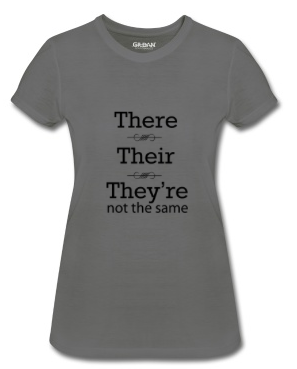
I wear t-shirts all the time, and one of my favorites displays this message:

There. Their. They’re not the same.

When I’m wearing that t-shirt, I’m a walking billboard about an important piece of usage advice: Always go back and check when you write the word there. Or their. Or they’re. (I’ve made plenty of slip-ups myself with these words.)

It’s a concise reminder for writers, and I always enjoy wearing that shirt.

But many English teachers (sigh) don’t want to take the simple-and-direct route to better writing, as an article in today’s Salt Lake Tribune demonstrates.

It’s a ridiculous story. A social-media specialist for the Nomen Global Language Center was fired for posting a blog about homophones (sound-alike words like there, their, they’re). Tim Torkildson, who posted the blog, said that his boss was upset because homophone sounds like homophobia.

Good grief. Homo means “same” in Greek. It shows up in familiar words like homogeneous and homogenize. Phone means “sound” (telephone, phonograph).

Clarke Woodger, who did the firing, should be ashamed of himself.

But I’m also angry at Torkildson. I have (ahem!) a Ph.D. in English, along with 40 years of experience teaching in English. I’ve published two books with a university press. I’m an editor for a scholarly journal.

And I’ve never used the word homophone in my life. (Well, actually I did – I wrote an indignant post about the Salt Lake Tribune article for Facebook this morning.)

There is no need to use homophone – or any of the other jargon so beloved by English teachers. “Easily confused words” does the job very nicely. Or “sound-alikes.”

What infuriates me is that all this unnecessary complexity scares off people who would like to learn more about writing. They get the unfortunate impression that a huge body of technical knowledge must be mastered before they can get to the good stuff – strategies for better writing.

You, reading this post, please believe me: You don’t need a Ph.D. in grammar to be a good writer (just as you don’t have to know how to dismantle a car in order to drive safely). Focus your energies on finding something to say, developing strategies for engaging your readers, and learning standard English usage.

Here’s a good way to start: Take another look at the message on my t-shirt.

t-shirt

Share

Double Negative?

Double Negative

It’s an article of faith for English majors: Two negatives make a positive. So, in the minds of these jurors, “didn’t do nothing” = “did something.”

If they had majored in linguistics, they wouldn’t make that mistake. (Sorry, English majors!) Many languages have double negatives; they’re a form of emphasis. Spanish and Welsh are examples, and – surprisingly – so is English. Old English and Middle English, that is. Yep, our Anglo-Saxon forefathers (and foremothers) routinely used double negatives.

Here’s an example: In the “Friar’s Tale” in the Canterbury Tales, Chaucer used a double negative: “Ther nas no man no wher so vertuous.”

English isn’t mathematical, and it isn’t logical. Languages evolve in their own way, often defying common sense…and English majors’ attempts to inject sense and structure.

Everyone who’s ever studied formal grammar knows that you can’t say “It’s me” because the copulative verb is requires a nominative case pronoun (I, in this case).

But wait a minute! French speakers say “It’s me” (“C’est moi“) all the time.

So that means I advocate throwing out all the rules, right?

No.

Language rules arise from the desire to fit in with the group of speakers you belong to (or the group you aspire to belong to). If you want to hang out with educated professionals, your speech and writing habits need to match theirs.

In the 21st century, educated professionals generally don’t use double negatives.

It’s that simple. It’s even logical. (But not mathematical.)

(To learn more about pronouns, click here.)

Share

The Sound of Music

A poster for a TV broadcast of "The Sound of Music"I am a Rodgers & Hammerstein fan, so of course I was interested in the live broadcast of The Sound of Music last month. (Bonus: It was performed in a former Grumman building in Bethpage, New York. I grew up in Bethpage, and my father retired from Grumman.)

A thought popped into my head as I was watching Carrie Underwood (playing Maria von Trapp) and the children singing “Do Re Mi”: She’s using the same reasoning that shapes much writing instruction today.

If you’re familiar with the Sound of Music, you know that Maria (Carrie) decides to teach the children how to sing. And she begins with music theory: Do, Re, Mi, Fa, So, La, Ti, Do. When the children are befuddled, she makes it fun.

Wouldn’t it be easier just to teach the children “Twinkle, Twinkle, Little Star”? or “Row, Row, Row Your Boat”?

English teachers do the same thing. (Sigh.) If you decide you really, really want to be a better writer, some eager-beaver English teacher is sure to load you up with Latin-based grammatical terms.

Good grief. You’ve been using language since infancy. Why not build on the skills you already have?

On to another thought triggered by The Sound of Music. A friend who’s also a Rodgers & Hammerstein fan sent me a beautiful book about The Sound of Music featuring information about the history of the show and the story of the von Trapp family.

“Climb Ev’ry Mountain” is one of the most important songs in the show: It ties together a spiritual message about courage with the story of the von Trapps’ escape from Nazi Germany.

Only there’s a catch. The book I read reported that the real von Trapps were very amused when they saw their Broadway counterparts with their climbing gear: There’s no mountain between Salzburg (their home city) and Switzerland.

But the song wouldn’t have worked if it had been rewritten as “Cross Ev’ry Highway.”

Call it poetic license. Sometimes you’re allowed to fudge details in order to enhance the story you’re telling. In fact you can get hopelessly mired in writer’s block if you try to get every picky detail right in something you’re writing.

Postmoderns say that words – any kind of art, really – inevitably distort reality. There’s always a selection process. The simple act of taking a step forward or back when you’re taking a picture shows how much we control what we think is objective reality.

Back to “Do Re Mi”: It’s a wonderful song. So what if I don’t like the educational philosophy behind it?

(One thing, though: If you’re planning to produce a Broadway musical show, please don’t write a song about adverbial conjunctions!)

Sound of Music


Share

Don’t Be Boring!

I enjoy reading rules about writing. Even when I disagree with them (something that happens often), reading and thinking about rules always awakens new ideas and unexpected possibilities.

I just came across a rule I really like: If it’s boring to you, it’s boring to your reader.

Amen, brother. Amen!

One of my personal Rules for Living – and one that spills over into my Rules for Writing – is “Never tell people something they’ve heard before.” Alas, it’s a rule that I violate frequently. But still it has saved me (and, more important, my friends and family) from many trips down the Highway of Boredom. Here’s a list of strategies I’ve found helpful:

1.  Check in with my stomach. I know that sounds strange, but it works great. If my stomach is humming, I can be confident that I haven’t lapsed into boredom. If my stomach feels dead, it’s time to  find a different topic or another approach – or simply shut up.

2.  Don’t try to impress people. Surefire pathway to boredom.

3.  Tell a story (preferably one with a surprise – or one that pokes fun at me).

4.  Go somewhere unexpected. I used to teach nontraditional college students who hadn’t acquired the habits needed for academic success. Lecturing them about responsibility/hard work/success and so on was both a waste of time and a serious violation of my sacred “Never tell them what they’ve heard before” rule.

What to do? I used to show my classes a clip from Mona Lisa Smile. Julia Roberts is an art history professor who’s teaching her first class in a topnotch college for women. She discovers that her students have already read the entire textbook and supplementary materials.

It’s wonderful to watch her try to cope gracefully with the situation – the students have outstripped her expectations, making her feel irrelevant and diminished. But the scene also makes a point that the movie producers probably didn’t intend: A real education requires preparation and effort.

That’s my list, and all that remains is a question (an honest one, because I have another rule about never asking a question if I already know the answer): Did I bore you?

Woman Yawning

Share

A Recovering Prescriptivist

A prescriptivist is someone who believes that language has absolute rules about what’s right and wrong.

I’m a recovering prescriptivist. And, since “recovering” is used nowadays only for addicts who can expect a forever fight against their addictions, it’s unlikely that I’ll ever really change into a descriptivist (a person content to describe language habits rather than pontificate about what’s right or wrong).

Nevertheless, I’m no longer the 100% prescriptivist I once was. The curtain has been pulled back, and I’ve seen the Wizard of Oz and his clanking machinery. Or (more accurately in my case) I learned about Lindley Murray and others of his ilk – the autocrats who lumbered our language with senseless rules like “each and every have to take singular pronouns” and “never split an infinitive.”

Last night I curled up with the latest issue of The New Yorker to read a marvelous article about the prescriptive vs. descriptive language debate. Joan Acocella (whose day job is writing great articles about dance for the magazine) reviewed The Language Wars: A History of Proper English by descriptivist Henry Hitchings.

The article is wonderful. For example, Acocella refutes Hitchings’ attack on H.W. Fowler, pointing out that Fowler is not “the starchy old schoolmaster” that Hitchings makes him out to be.

Here’s what really thrilled me (and started me thinking about “recovering prescriptivists”): Hitchings thinks that the who/whom distinction is on the way out. (So do I.) But, Acocella says, “we never see any confusion over these pronouns in his book, which is written in largely impeccable English.”

Do I have the guts to deliberately use “every” with a plural pronoun in something I’m writing for publication? No. Coward that I am, I always recast the sentence to avoid the hideous “his-or-her” construction that’s one of the banes of modern writing. My reasoning is that even though I’m a descriptivist (sort of), there are lots of prescriptivists out there just rubbing their hands together, waiting for me to make an error.

Well, I did split an infinitive in the first sentence in the previous paragraph.

As I tell my students, your language choices need to satisfy the group for whom you’re writing. And there, my friends, is a grammatically correct sentence that’s absolutely hideous. Maybe I’m further along the road to recovery than I thought I was (although I did just look up farther and further to make sure I got this sentence right). As I said, I’m recovering….


Share

National Grammar Day

Happy National Grammar Day!

You’re expecting a discourse about imperatives, interrogatives, absolute modifiers, and object complements, right?

You won’t be getting it here. Truth to tell, I struggle with some of that terminology. (Just now I had to look up “absolute modifiers” – it’s a term I’d never heard before. Turns out it refers to words like unique and pregnant that can’t be modified. You can’t be very unique, sort of pregnant, or kind of dead.)

Lots of people believe that what’s wrong with writers today is their lack of grammatical knowledge. If you share their views, you believe that everyone should spend a lot of time in school labeling parts of speech and underlining various kinds of words and phrases in workbooks (or, if you’re trendy, on a computer screen).

I’m not one of those people. I draw a sharp distinction between grammar (the rules and terminology that construct a language) and usage (the rules that people follow when they write and speak).

I vote for usage.

Here’s an example of what I’m talking about: Just yesterday in the newspaper someone wrote that he “felt badly” about something that had happened to him. Wrong: It should be “felt bad.”

If you’re a grammarian, you’d go into a discourse about the differences between copulative and transitive verbs, and you’d explain that a predicate adjective rather than an adverb was needed in that sentence.

Shucks. Wouldn’t it be much simpler to note that educated people tend to say “felt bad”? Is all that grammatical baggage really necessary?

When I press the brake pedal on my car, I don’t think about the stopping process involving pedal, brake pads, and tires. I think about good driving practices.

Going back to the prohibition against “very unique” and “sort of pregnant”: I knew that already. Why impose a clunky discourse about “absolute modifiers”? Why do we have to complicate something simple?

So…have a great time celebrating National Grammar Day today. But while you’re at it, please raise a glass in honor of usage too.

Fingers tapping on a keyboard


Share