Category Archives: Sense and Nonsense

Should You Use Correct Grammar When You’re Texting?

You might expect me to answer that question with an emphatic yes, but I’m not going to do that today. I’m not going to say no either. Instead I’m going to argue that it’s the wrong question.

Some background first. The Huffington Post recently published the results of a YouGuv poll showing that most people aren’t bothered at all by grammar mistakes in texts. (According to the poll, there was slightly more concern about grammar mistakes in emails.)

I’m a stickler about the rules of English. Shouldn’t I be concerned? The answer is no, for several reasons.

First, texts and emails are closer to conversation than formal writing, so looser rules apply. I suspect that if you could do a brain scan of someone typing on a laptop or a smartphone, you’d see neurological activity that’s quite different from – say – writing a business report.

Here’s why I think that’s true: I’ve noticed the difference in my own behavior. I’m endlessly chagrined by the mistakes that slip past me when I send an email. Egad! Who wrote that? Gulp – I did.

I’ve noticed too that I don’t pick up mistakes in emails sent to me. Someone apologizes later for a garbled email, and I realize that I didn’t see any of the mistakes. Mind you, I’m a maniac who can spot a typo in a book or student essay from 10 feet away.

I have another gripe about the poll. (If you visit this blog often, you aleady know what I’m going to say.) What we’re talking about are usage – not grammar – mistakes. Grammar is the structure of a language. I rarely hear anyone make a mistake with word order, which is where you find the fundamental grammar of our language.

Problems with capital letters, apostrophes, and the like are usage problems, and (as I said a moment ago), the rules aren’t as strict for informal situations. In fact many usage rules (such as the aforementioned capital letters and apostrophes) don’t come into play at all when we’re talking. Perhaps our brains transition to talking mode when we’re texting, and that’s why we’re more casual about punctuation and spelling.

I’m not losing any sleep about it. 

Mistake

Share

Updates

My friend Lois Smith had some interesting responses to two recent blog posts.

You may remember that I asked my husband to rescue a lizard that turned out to be a carpet stain in a hallway. I was impressed that Charlie made a connection to military camouflage, which often tries to make something flat look three dimensional.

Lois made another connection – to facial recognition, which she says “is why we see things in the dark, and in ink blots – see two women in hats, facing each other in that famous illustration, etc.  So I’m thinking our facial recognition slips over to other recognitions, like lizard stains.”

Intriguing! Thanks, Lois.

Lois also had some thoughts about a grammar issue I discussed in a recent post. I was comparing these two sentences:

The arena is big.

The arena is west of here.

In the first sentence, big is an adjective modifying a noun – arena. But in the second sentence, west is an adverb. Adverbs don’t modify nouns. What’s going on here?

Lois dug into her memory bank and came up with the term predicate adverb from grammar lessons in elementary school.

I looked it up, and Lois is right – but it seems to be a questionable term. Most grammar websites don’t mention it.

Here’s what I think happened: At some point a grammarian noticed this anomaly – an adverb with a copulative verb. Aughhh! Formal grammar doesn’t allow anomalies. And so the term “predicate adverb” was invented to cover this situation.

To put it another way: Language – not grammar – is primary. I suspect that many hallowed grammar rules were invented by grammarians trying to cover gaps in their theories.

There’s a lesson here for all of us: Language – not grammar categories – should always be our first priority.

And now I want to veer off to another topic: Feedback. Writing posts for this blog has show me again and again how important it is for writers to have a living, responsive audience (and not just a copyeditor or teacher who makes corrections).

Feedback for this blog shows up in the Comments section and in responses from friends in conversations and emails. Even though I have a plugin that gives me detailed statistics about activity on my blog, there’s nothing like a thoughtful response from a real, live reader.

You’re reading this post because you’re a writer. Who regularly gives you feedback? If the answer is “no one,” please find a support group!

compass-32477_640

Share

Red Flags

I often rail against nonsensical pronouncements about language and writing. Today I’m going to turn the tables and rail a bit against my own nonsense.

There are words and expressions I cannot abide. I just used one of them, and it is taking every bit of willpower I can muster not to go back and delete it.

Here it is: I can’t stand the expression “a bit.” It’s weak. If something is small and insignificant enough to warrant the term “a bit,” why are you even talking about it? (I don’t like “every bit” either – for the same reason.)

Here’s another one I can’t stand: “in today’s society.” Based on my experience with thousands of student essays, there’s roughly a 100% chance that any essay containing the phrase “in today’s society” is going to flounder and sputter without every getting to anything interesting.

I just stopped typing for a moment to try to figure out why “in today’s society” always points to a weak paper, and I think I’ve found the answer. No society is homogeneous. There are always conflicting forces and clashing ideas. When a student writes about “today’s society,” that’s a sure sign that she hasn’t done much research or analytical thinking.

But I said at the beginning of this post that I’m focusing on my own nonsense. Of course it’s possible to use the expressions “a bit” and “in today’s society” thoughtfully and intelligently. Here’s my real point: Words sometimes spew out of us at such a rapid rate that we fail to notice that we don’t have anything to say.

Don’t let that happen to you. Start looking for your own red flags. What verbal habits do you fall into when you don’t have something interesting to say? Learn to recognize them and – more important – start building habits that will help you uncover interesting ideas. Develop your curiosity. Read. Expose yourself to new experiences.

Here’s one practice that I wish I had stumbled on much earlier in my own life: Studying the thinking habits of other people. I read Carolyn Hax’s advice column in the Washington Post every day because – at least half the time – she has a completely different approach to a problem than I would have taken. I’m working on opening my brain up to new and different ways of thinking.

In today’s society we all need to do that a bit more often.

Red_flag_waving Wiki ok

Share

Time Machine

In a recent episode of The Big Bang Theory, Sheldon Cooper decided that life in the present was unbearable. His solution was to turn the calendar back to 2003, with hilarious results.

Everyone knows that you can’t turn back the hands of time – well, everyone except English teachers. Ignoring the principles of linguistics and common sense, we stubbornly cling to usages that were current when we were in high school.

That means my verbal preferences are frozen in the 1960s, when I went to high school and college. I will spell all right as two words until my dying day. I never put hopefully at the beginning of a sentence, I avoid using impact as a verb, and I hate the word enthuse.  Time has passed me by, and I don’t mind a bit. I’m one of a handful of people who still use the apostrophe in Hallowe’en.

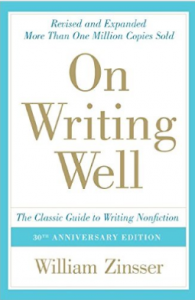
Turns out, though, that I haven’t been living in a time machine after all. I just read a chapter in William Zinsser’s On Writing Well that made me realize how much my verbal choices have changed over the years. I’ve been part of a language revolution without even knowing it!

Back in the 1960s, Zinsser was a member of the Usage Panel that votes on the acceptability of various words and constructions for The American Heritage Dictionary. I was amazed to find that many words I use all the time were considered controversial back then.

Questionable verbs included trigger, rile, escalate (which was born in the Vietnam era), contact (accepted by only about a third of the panel), outsource, and stonewall (which first became a verb in the Nixon era)

Problematic nouns included blog, laptop, geek, boomer, Google, multi-tasking, slam dunk, trek (rejected by more than half the Usage Panel), senior citizen (rejected by 97% of the Panel), dropout, funky, downer, vibes, rip-off, and bummer

Trendy jargon that earned a thumbs-down from the Usage Panel included TV personality, downsizing, and ongoing.

Most language changes have happened so gradually that nobody noticed them. Words and constructions that were once considered abhorrent seem perfectly normal just a generation later.

The most important principle for all of us to remember is that the process will continue, whether we like it or not. One-word spellings of all right and a lot will soon be widely accepted (sigh). I expect to see binky (colloquial for “pacifier”) in a dictionary any day now. And no one knows what other changes are coming.

It’s a downer and a bummer for many of us senior citizens – but it’s also a testimony to the health and vitality of our wonderful language.

Share

An English Teacher Falls to the Floor

I’ve been waiting to write about something that comes up frequently in my writing group. The problem was that I couldn’t come up with a good example. I finally found one in a gardening column I was typing for my husband.

Charlie was writing about resurrection plants that dry up and look dead – sometimes for years – until a rain shower revives them. One plant in this category – Selaginella lepidophylla, aka “spikemoss” – has an even more remarkable quality. Here’s what my husband wrote about it. Notice anything?

Interestingly, even wholly dead specimens uncurl when moistened because the cells responsible for rehydration continue to expand after death.

I had doubts about that “wholly dead” – but before I could say anything, Charlie raised the point himself. “Dead is an absolute term,” he said. “You can’t be wholly dead, can you?” (In fact I just raised that point in a recent post.)

My thoughts exactly. But after we talked about it for a couple of minutes, we agreed that “wholly” should say in. Why? Because he wanted to emphasize that he was talking about plants that really, really, really were dead.

It’s an issue that comes up all the time in my writing group. Rules are rules, aren’t they? Don’t good writers have to follow them 24/7?

Instead of giving a direct answer, I usually raise another question: Which came first, rules or language?

The answer – of course – is that language came first. Rules were an attempt to pass on what good writers were doing so that the rest of us could follow in their footsteps.

My standard advice is to write the problematic sentence both ways – following the rules and breaking them. Then set the sentence aside. After some time has passed, read both versions and decide which one feels better. Use it without apology. If someone raises an objection, say – loudly – I like it this way.

(I always picture an English teacher falling over dead when I say this. Sorry!)

I’m going to leave that unfortunate English teacher lying on the floor (in the spirit of this “resurrection” post, I’ll bring her back to life in a minute). I want to explain why I voted for “wholly dead.”

Every book of writing advice ever written urges writers to aim for brevity. “Omit needless words!” is the solemn advice from Strunk and White’s classic The Elements of Style. William Zinsser’s On Writing Well has a whole chapter about avoiding verbal clutter.

The problem with this sensible advice is that it sometimes clashes with other essential writing principles: Be emphatic. Be clear. Sometimes an apparently unnecessary word can be useful and should stay in. Our language is full of redundancies (the lofty term is “overdetermination”). They’re so much a part of our everyday lives that we never notice them.

Take a look at this sentence:

He takes his car to the dealership for an oil change twice a year.

How many times does this sentence tell you he’s male? Not once but twice: He/His.

And how many times does it tell you that we’re talking about just one person? Three times! He/takes/his.

Everyday communication usually takes place in less-than-perfect surroundings. The TV is on, an ambulance siren is blasting, other people are talking. But even if you miss big chunks of a conversation, you’re likely to know exactly what was said: The redundancy in our language ensures that you won’t miss anything important.

(Surprising fact: Much of this research was done by telephone companies. Their studies showed that static and interference don’t cause problems with most phone conversations. The redundancy built into our English language has saved phone companies from wasting a lot of money on unnecessary upgrades.)

Let’s bring that English teacher back to life and talk about Charlie’s column. He wanted to make sure his readers got the point: Even a dead-as-a-doornail spikemoss specimen can revive – slightly, for just a few moments – when it’s given some water. How do you show that you’re no longer talking about the specimens that lie dormant for years and dramatically spring back to life?

That two-syllable word does the job nicely: Wholly dead. Nobody is going to miss the point – even if the kids are squabbling in the background, the microwave is beeping, and the dog is barking.

Spikemoss is amazing. So is our language!

Selaginella lepidophylla - the common name is "spikemoss"

Selaginella lepidophylla – the common name is “spikemoss”


Share

National Grammar Day

Today is National Grammar Day – an appropriate time to think about the role that grammar plays in our lives.

I’ve been thinking – a lot – about an intriguing statement by James Harbeck in his Sesquiotica blog. Harbeck is a writer who specializes in language issues. Here’s what he said: “Not everything you do with language is a matter of grammar.”

Amen, amen.

Spelling mistakes, for example, aren’t grammar errors. I  have trouble spelling words with double letters. All the grammar instruction in the world isn’t going to help me spell Cincinnati correctly.

Clumsy sentences, poor word choices, and boring ideas aren’t grammar issues either.

Revising a weak article or essay takes multiple skills. (I know all about this, having done plenty of weak writing myself.) You need a strong thesis, powerful examples, and the ability to organize and develop ideas. You have to know how to grab your readers’ attention – and how to hold on to it.

Here are my favorite remedies for poor writing:

  • a friend who takes your writing seriously
  • a voracious reading habit
  • a sense of curiosity and wonder about language

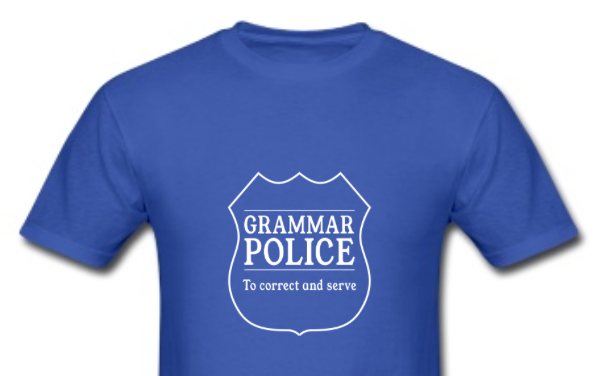
 I’ll be wearing my Grammar Police t-shirt today to honor National Grammar Day. But I’ll also be reminding anyone willing to listen that grammar should be only one of many tools in a writer’s toolbox.

Grammar Police ok


Share

A Question about “Whose”

Yesterday a friend raised an interesting issue about the word whose. She sent me a sentence similar to this one and asked what I thought of it:

Acme is the only local company whose ads are created by a New York agency.

She’d been told whose is appropriate only for sentences about people. If you follow that reasoning, you couldn’t use whose in a sentence about a company – or a dog, a building, or a town.

I wrote back that the sentence was fine and whose can be used in a wide variety of situations. But I want to raise an additional issue today: Who decides these things – and how?

I know people who panic and moan “There are no rules anymore!” any time someone challenges a usage practice they hold dear.

So I want to talk about the process I followed before I answered my friend’s question.

  1.  I checked my own experience. I have a doctorate in English and I’ve published with some prestigious organizations. I’m also a member of the editorial board for a scholarly journal.  So my opinion carries some weight. My verdict: The sentence is fine.
  2. I went to my bookshelf and looked up whose in my copy of Fowler’s Modern English Usage, a widely respected reference book. Fowler’s comment: The prohibition against using whose with non-human antecedents is a “folk belief.”
  3. Just for good measure, I looked up whose in the Oxford English Dictionary, which traces how  words have changed over the centuries and provides examples. The OED, as it’s affectionately called, is now available as a searchable database through many libraries. So instead of having to make a trip to the library, I looked up whose on my home computer. And I learned that both Shakespeare and Milton used whose in sentences with non-human antecedents:

    Shakespeare Hamlet i. v. 15,   I would a tale unfold, whose lightest word would harrow up thy soul.
    Milton L’Allegro in Poems 33   Mountains on whose barren brest The labouring clouds do often rest.

My conclusion: The sentence is fine.

Acme is the only local company whose ads are created by a New York agency.  CORRECT

Richard Burton in Hamlet

Richard Burton in Hamlet


Share

Showcase Yourself!

Chances are your English instructors in high school (and college, if you’ve taken freshman English) didn’t talk much about showcasing yourself.

That’s unfortunate, and here’s why: When writers want to make a good impression, they don’t know how to do it. And here’s a question you should ask yourself: When don’t you want to make a good impression?

Most people (and probably you as well) sit down to write because they want to solve a problem, promote an idea, or share what they know. How often did your English instructors talk about that kind of writing?

The likely answer is “rarely.” English curriculums and textbooks are so busy teaching you how to do workbook exercises and master jargon that there’s little time left for the real business of writing – showcasing yourself, your ideas, and your accomplishments.

But out there in the career world, people really do think about showcasing themselves every time they write. Hmmm, they think. What did my English instructors care about? Sophistication, big words, complicated sentences. And they had this thing about word counts.

So they sit down and write something like this (an actual example from a law-enforcement article I just read):

In the case of subjects presenting with agitated-chaotic behavior, it is extremely important that officers not compress distance in approaching the subject unless exigent circumstances exist.  Case histories have clearly shown that distance compression with delirious and/or paranoid subjects significantly increases agitation, which in turn can exacerbate psycho-medical condition.

Let’s translate that into normal English:

When you’re working with a person who’s agitated or confused, don’t get too close, too quickly unless there’s an emergency. People who are delirious, paranoid, or both are just going to get more agitated, making the situation worse.

But won’t people think less of you if you say “don’t get too close” instead of “avoid distance compression”?

You can answer that question yourself. How good are you at figuring out when someone really knows what they’re talking about – versus someone who’s just a pompous blowhard?

I suspect that you’re an expert.

Start paying attention to the people you like and respect. Notice how they talk and write. You’ll soon realize that you’re focusing on what they know and how they present themselves, not their inflated vocabularies and tangled sentences.

Here’s the #1 principle for effective writing: Think about showcasing yourself and what you know. You won’t have time for overblown writing. And you’ll be pleasantly surprised by the positive feedback you’ll start hearing. Try it!

Spotlight Dollar ok

Share

Thinking about Lists

Lately I’ve been thinking about what sets English apart from other languages (especially Latin, which I studied in both high school and college). For centuries Latin has been held up as a model for good writers. Recently I’ve begun to question that notion.

Mixed in with those doubts about Latin has been curiosity about how our brains process language. Schools and textbooks tend to present writing skills as if students had no experience with words and sentences – a huge mistake, in my opinion.

Last week while I was typing a gardening column for Charlie, both thoughts came together in a sentence he had written. While you’re reading this, pay attention to what your brain does with the sentence. Notice anything? (I did.)

Such plants include azalea, cape honeysuckle, camellia, tea olive, Carolina jessamine, and tabebuia trees.

It’s like a magic trick – every plant in the list turns into a tree!

Such plants include azalea trees, cape honeysuckle trees, camellia trees, tea olive trees, Carolina jessamine trees, and tabebuia trees.

But only the tabebuias are trees. So Charlie and I rearranged the sentence:

Such plants include azalea, cape honeysuckle, camellia, tea olive, tabebuia trees, and Carolina jessamine.

Now you have a sentence that a horticulturist could love.

Charlie’s original sentence is a wonderful example of the amazing things our brains can do. We get to the last word in the sentence – trees – and our brains go back and add it to every item in the list. (Does Latin do this to lists? I don’t know. If you know the answer, please leave a comment – I’m interested!)

Back to my original point. I’m not sure I really explained myself. Let’s try this sentence:

I need to buy salt, bacon, and sugar substitute.

Your brain will automatically change the sentence to “I need to buy salt substitute, bacon substitute, and sugar substitute.”

But if you reword the sentence, you’ll be buying real salt and real bacon:

I need to buy salt, sugar substitute, and bacon.

(I’m wondering if you could demonstrate this principle in a sentence diagram. Would you have little arrows jumping backwards?)

Amazing thing, this language of ours!

Here’s my big point: Our brains do this kind of processing constantly in the course of our everyday lives. Shouldn’t we incorporate those processes into the way we teach writing skills? Why approach a roomful of students as if they knew nothing about our wonderful language?

In Central Florida, tabebuia trees put on a spectacular display every January.

In Central Florida, tabebuia trees put on a spectacular display every January.


Share

The Singular They

It’s exciting when English usage makes news, and that’s what happened last week. The American Dialect Society voted overwhelmingly to make the singular they its Word of the Year.

So much information is packed into this story that it amounts to a mini-course in linguistics.

English is a quirky language. Unlike Spanish, German, French, Welsh, and many other languages, it doesn’t have genders for most nouns. (Actually English once did have genders – those were lost a thousand years ago.)

Nor do we have a gender-neutral singular pronoun. (Again, we once did – but we lost it.)

All we have left are gender-neutral plural pronouns (they, them, their). Our English-speaking ancestors were fine with this. They didn’t miss the singular pronoun at all. They happily used they, them, and their instead.

Here’s what I’m talking about: Suppose your boss asks about the status of a project your team is doing. She might say, “Let’s ask everyone to write up their views about the proposal before they come to the next meeting.”

We all write and talk that way. Great authors write and talk that way. (Click here for examples.) But grammarians want us to rework this sentence so it reads like this:

“Let’s ask everyone to write up his or her views about the proposal before he or she comes to the next meeting.”

Gack.

It’s clumsy. But that’s what you’re supposed to do.

Or is it?

And this is where it gets interesting. In the 18th century, when most people were happily using they and their as singular pronouns, some self-appointed grammarians decided that English should be more mathematical.

Example: Everyone is a singular word. (Evidence: It contains the word “one,” and it’s used with “is,” not “are,” as in “Everyone is here.”) So those 18th-century grammarians insisted that we use the singular “he,” not “they,” with anyone, someone, anybody, every, each, and similar words.

Under their well-meaning tutelage, our example above turned into this:

“Let’s ask everyone to write up his views about the proposal before he comes to the next meeting.”

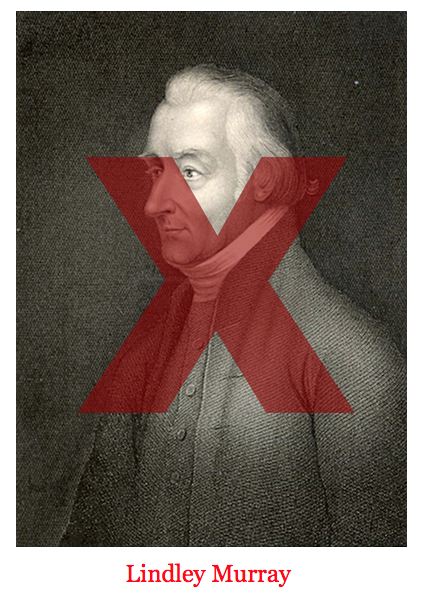
The men who argued this way had no background in linguistics. They weren’t even English teachers. The most famous of them – Lindley Murray – was an attorney. But that made-up rule found its way into some bestselling grammar books. English teachers picked it up, and soon English lost a perfectly workable practice – using “they” as a singular word.

Fast forward to the 20th century. Lindley Murray and his friends lived in a male-dominated world. But he clearly was inappropriate in modern workplaces that were welcoming more and more women. So our sentence became:

“Let’s ask everyone to write up his or her views about the proposal before he or she comes to the next meeting.”

As I said before, gack.

Here’s where our mini-course in linguistics comes in. Many people (I’m one) grew up believing that English usage is carved in stone, sort of like the Ten Commandments. But it’s not.

Languages are created by people. Languages don’t have to be logical or mathematical. A language has two requirements: It has to work, and we have to agree about how to use it. 

That means I can’t use ain’t when I write a scholarly paper or go for a job interview. But I can use ain’t at home. You get the idea.

What’s happening right now is that many people are getting fed up with good old Lindley Murray, and they want to put English back the way it was. The Washington Post has already revised its style guide to accept the singular they. As I said before, the American Dialectic Society also voted for the singular they. And of course many people never stopped using it, even though English teachers kept pleading with us to use “his or her” instead.

So…let’s see what we’ve learned from this story:

  • English has no official rules. Every group can choose the rules and practices it wants to follow
  • Rules come at us from many directions
  • We can’t trust everyone who claims to be a language expert
  • The English language has undergone drastic changes over its history
  • Languages are social tools. They’re not meant to be logical or mathematical
  • Most people switch back and forth from formal English (used in school and the workplace) and informal English (used with family and friends)
  • We tend to use formal English when we write (as I’m doing here) and informal English when we talk

If you look at English from this broad perspective, you can see that there’s no reason to panic when someone uses “they” as a singular pronoun. It’s an old and respected practice that became discredited through an accident of history.

I, for one, am celebrating the courageous people who are voting against “his or her.” For years now I’ve been revising sentences to avoid that @#$%! construction. For example:

To get the best deal on a car loan, everyone should check his or her credit history before he or she visits a car dealership to purchase his or her next car.  YUCK

To get the best deal on a car loan, consumers should check their credit history before they visit a car dealership to purchase their next car.  MY VERSION

(I love this comment from Geoff Nunberg on NPR’s Fresh Air: “if I could have back all the time I’ve wasted writing my way around a perfectly grammatical singular “they,” I could have added another book or two to my name.” My thanks to Lois Smith for pointing me to Nunberg’s essay.)

Looks like the day is coming when I won’t have to rewrite those “they” sentences anymore. Fist pump!
Share