Pronoun Agreement, Anyone?

No, I’m not going to teach you how to do pronoun agreement today. Instead I want to talk about a problem caused by one of those #${%&! people who want to fix our language.

(If you want a refresher about the rule I’m going to talk about, click here to read a short explanation of Pronoun Rule 1.)

I used to have a blog where I reflected on all kinds of things. In one entry I focused on Jungian author and analyst Marion Woodman. Here’s what I wrote:

Marion Woodman tells the story of a “shadow party” she held as part of a women’s retreat. Everyone at the retreat was invited to dress up as someone she secretly longed to be – in Jungian terms, a “shadow” figure.

Do you see the problem with the second sentence? It’s grammatically correct (“everyone” is singular, so I continued the sentence with “someone she secretly longed to be”).

But someone reading quickly (OK, I’ll confess – I’m a longtime member of that group) might think I meant that the partygoers dressed up as someone Marion Woodman wanted to be. After all, I wrote she rather than they.

So here are my choices: Be ungrammatical (“someone they secretly longed to be”) OR confusing (“someone she secretly longed to be”). I chose Door #2 grammatical but confusing. Readers will figure out what I meant – no big deal.

But I’m annoyed about being forced to make that choice. Why can’t English be readable and grammatical at the same time? The answer is that various people have messed with our language over the centuries, and sometimes they create problems instead of solving them.

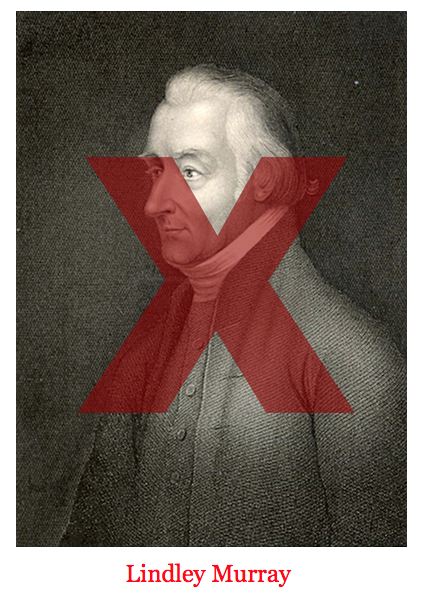
The ridiculous pronoun agreement rule (“everyone” = he or she) was invented by Lindley Murray, a self-proclaimed grammar expert back in the 18th century who took it upon himself to make English more logical. And so we are stuck with a clumsy “he or she” structure instead of using “they,” which was considered perfectly correct until Murray came along.

Time to calm down. I’m going to go back to the blog and revise the sentence to eliminate the problem. Here’s how:

Marion Woodman tells the story of a “shadow party” she held as part of a women’s retreat. Participants were invited to dress up as someone they secretly longed to be – in Jungian terms, a “shadow” figure.

Did you notice that a new problem has emerged? Participants is plural, but someone and a “shadow” figure are singular. Strangely, there’s no rule in the English language for this kind of thing. You just close your eyes and jump in, hoping it will be OK.

I wonder how much time I’ve wasted over the years trying to fix problems like these that shouldn’t have been problems in the first place. Anyone out there want to be a professional writer?

Share

Comma Rule 1: Commas with Introductory Ideas

I haven’t been able to confirm the story I’m about to tell. But it’s so useful when you’re learning commas that I’m going to tell it anyway.

Years ago a wealthy man is supposed to have won a lawsuit against Western Union because of a missing comma. Here’s what happened:

He was away on business when his wife telegraphed him for permission to buy an expensive piece of jewelry.

When she got his telegram – “No price too high” – she went ahead and bought the jewelry. He got home from the trip, found out she’d indeed made the purchase, and sued.

Here’s the message he’d intended to send: “No, price too high.” Big difference!

It’s a great story to illustrate the importance of punctuation, and a great excuse to remind you about Comma Rule 1: Use a comma when a sentence begins with an extra idea.

(Or: Use a comma when a sentence begins with an introduction. Take your pick: The two rules amount to the same thing.)

Here are some examples for you to mull over (suggestion: Read the sentences aloud). All these sentences are correct:

I picked up the dry cleaning this afternoon. CORRECT

Jane, I picked up the dry cleaning this afternoon. CORRECT  (“Jane” is extra)

Jane picked up the dry cleaning this afternoon. CORRECT

No dogs are permitted in the lobby. CORRECT

No, dogs are permitted in the lobby. CORRECT  (“No” is extra. Can you hear that this is probably the answer to a question about the rule about dogs?)

To learn more about Comma Rule 1, click here. And did you notice that the previous sentence is a perfect example of a Comma Rule 1 sentence?

Share

Memoirs

Yesterday I came across an announcement about a memoir-writing workshop conducted by Natalie Goldberg, author of the bestselling Writing Down the Bones. Memoirs have become extremely popular. That’s a trend that’s going to enrich innumerable lives. Applause, applause.

How I wish my grandmother had written down her life story – leaving Finland as a young girl to work in New York City, falling in love and marrying an Austrian despite the language barriers, rearing four children during the Depression….I’d rather read that story than any bestseller you could throw at me.

Last month I facilitated an editing class for a group of memoir writers. More applause. They want to pass on not only their memories, but a grammatical account of their life’s adventures.

Our class discussions circled around a host of topics, foremost among them what might be called the Mr. Dick problem. Mr. Dick, you will remember, was a character in Charles Dickens’ David Copperfield who was writing a book. Any time you come across a literary character who’s dealing with writing in some way, there’s a strong possibility that postmodernism is making an entrance. (Think of Hamlet revising The Murder of Gonzago for the performance in court.)

The unfortunate Mr. Dick had to keep abandoning his book because the beheading of Charles the First kept finding its way back into the manuscript. And there, my friends, is one of the biggest problems in writing: Keeping the unwanted out.

Simply put, art is not life. Life – even at our best moments – is messy, confusing, and tedious. Good writing can never be any of those things (unless you’re a postmodernist trying to replicate life in the piece you’re creating, as some contemporary geniuses do).

Somewhere in Anne Frank’s amazing diary she tells her imaginary readers that they really know very little about life in the Amsterdam hiding place. This after pages and pages of entries, including a marvelous section where she describes, minute-by-minute, a typical day and night there. Anne, who looked forward to revising and publishing her diary, instinctively knew that good writing is a digestive process. Things are worked over and compressed before the audience is allowed to see them.

Not easy to do. I applaud Natalie Goldberg and all the memoirists, hard at work creating one of the greatest gifts they could give to future generations.

P.S. Did anyone notice my indefinite pronoun reference? I wrote: Somewhere in Anne Frank’s amazing diary she…. Because “Anne Frank’s diary” isn’t the same as “Anne Frank,” my sentence isn’t correct, strictly speaking. You could also say that it’s a dangling modifier.

I say that construction seemed to be the simplest way to say it, and I’m sticking with it.

Share

Possessive with a Gerundive

When I wrote about the “use a possessive with a gerundive” rule on July 29, I assumed it would be quite a while before I came across the rule in a real-world sentence.

So I was pleasantly surprised to find this example (people’s using) in a recent New Yorker article : “Huckabee wouldn’t mind being characterized as a Christian intellectual, but he is vigilant against people’s using his background as a pastor to characterize him as a ‘redneck from southwest Arkansas,’ as Nelson put it.” (“Prodigal Son” by Ariel Levy, 6/28/10; click here to read the article.)

Let’s all give author Ariel Levy a round of applause!

But I also have a bone to pick with him. Who was the “Nelson” who made that statement? I couldn’t remember and had to backtrack through the article to find the answer. It turns out that two pages (or 2,976 words) earlier, Rex Nelson was identified as Governor Mike Huckabee’s policy and communications director.

Bad writing. Your job as an author is to provide everything the reader needs to move smoothly through whatever you’ve written. There should be no backtracking and no interruptions to look up a word at www.Dictionary.com or to Google confusing information.

Postmodern theorists are correct when they say that reading is a collaborative effort between author and audience. But that doesn’t give authors permission to slack off. What it does mean is that authors constantly need to consider their readers’ experience, knowledge, and thinking processes. You can’t insult your readers (identifying Shakespeare as “a great Elizabethan playwright,” for example), but you also have to avoid obscurity and confusion (referring to “Bertie,” say, without explaining that his formal name was King George VI).

I began this column by harking back to one I’d previously written about the possessive-with-a-gerundive construction. Now I’m going to hark back to July 31, when I wrote about indefinite pronoun references. Did you find one in the previous paragraph? No? Here it is: But that doesn’t give authors permission to slack off.

“That” is indefinite because it doesn’t refer to anything specific in the previous sentence. If someone pinned me against a wall and insisted on knowing what “that” stood for, my answer would be “The fact that reading is a collaborative effort between author and audience.” But those exact words don’t appear anywhere, for a good reason: I intensely dislike “the fact that” and don’t use that phrase unless it’s absolutely necessary.

So let’s summarize what’s passed between you (the reader) and me (the writer) in today’s entry:

  • People in the real world use the possessive-with-a-gerundive construction. At least Ariel Levy does. Or his editor at the New Yorker.
  • Writing should flow with no backtracking and no side trips to www.Dictionary.com or Google.
  • Real-world writers sometimes run red lights, so to speak, to avoid clumsy constructions, as I did when I deliberately chose an indefinite pronoun reference.

And that’s enough for one day!

red light ok

Share

Double-Check It, Please

In my July 28 post I mentioned Tinker Bell, the fairy in Sir James M. Barrie’s wonderful Peter Pan. I typed it as one word, with an “e” at the end. Because I’m an editor and trained to be accurate, a couple of minutes later I started to wonder about that final “e.” After a quick Google search I discovered two things: That “e” had to go, and the fairy’s name is two words, not one.

Good editors are doubters, and good editing is very different from good reading. A good reader takes in the message and information in big chunks. Editors creep along slowly and stop to ask many questions along the way. Is that really how he spells his name? Is New York City really the capital of New York (no, it’s Albany). Should capital be spelled with an “o”? (Only when it’s a government building or a business that spells its name that way, such as Capitol Records).

I edit college documents for the institution where I worked as a professor for almost 30 years. Knowing the faculty and staff can be a huge advantage. I often notice factual errors (she goes by her middle name, he lives in another city) that an outsider might miss.

Because checking and double-checking are so important to me, I’m endlessly astonished at the “So what?” attitude of so many writers. Last week I was flabbergasted when I read the title of this new movie in our newspaper: The Kids Are Alright. The movie was listed that way in two places – the review and, a few pages later, in the local schedule of showings.

The name of the movie (I checked it!) is The Kids Are All Right. But somebody who works for our local newspaper apparently decided that the movie producers didn’t know the correct title of their own movie – or figured that it didn’t make any difference.

If you don’t care about accuracy, you shouldn’t be working for a newspaper. (And if you don’t know that all right is always two words, you shouldn’t be holding any kind of writing job.)

Years ago, when I was a prison teacher, I submitted an article to The Journal of Correctional Education. The editor called to tell me that my article was going to be published after she corrected the spelling errors.

“I don’t make spelling errors,” I told her. There was silence at the other end of the phone.

Six months later, when my article was published, she’d changed my correctly spelled argument to the incorrect arguement.

She didn’t own a dictionary?

I talk to many people who wish they were better writers, and I’ll be the first to admit that good writing is a challenge. But there’s a simple principle that will instantly make any piece of writing better: Double-check what you’ve written.

 Today’s Quiz ANSWER

You can improve this sentence by removing the unnecessary word “currently.”

She currently lives in a beautiful apartment high over the city of Toronto. ORIGINAL SENTENCE

She lives in a beautiful apartment high over the city of Toronto. BETTER

Incidentally, you could argue that “the city of Toronto” can be shortened to simply “Toronto.” It’s also possible, however, that “the city of” helps you see Toronto in your mind’s eye. I’d call this one a judgment call.

Share

Research Papers

In the past couple of weeks I’ve been editing research papers. Not a happy experience. I’m realizing I need to add some research-paper resources to this website. I’ve done enough research myself to do that there are many pitfalls to watch for, and an experienced guide can be a big help.

But I also know that there are some obvious mistakes that nobody should be making. Here are some tips for student researchers:

1.  Find out what documentation system you should be using. If you’re a high school or college student, your institution has adopted a handbook that lays out the approved system. Buy the handbook (or camp out in the library, which surely owns a copy) and follow it slavishly.

2.  In general, English and humanities courses require MLA. Science courses use APA.

3.  End every Works Cited entry with a period. I know: Picky, picky, picky. But it’s the first thing many instructors (including me) look for.

4.  There are online aids for documentation. You can go to my college (www.Polk.edu/library), click on the How to Cite link, and scroll down for the Citation Machine.

5.  Check and double-check your work. The Citation Machine occasionally inserts extra periods, for example.

6.  Use capital letters. I shouldn’t even have to say this, but it’s a big problem with many papers.

7.  Your introductory paragraph should include the following: A catchy opening (an interesting quotation or a story), background about your topic, a statement by an expert about the importance of your topic, and your thesis statement. If there’s a lot of background, your introduction can be two paragraphs long.

8.  No matter what – even if you’re writing a book – get the thesis on the first page.

9.  Begin every paragraph with a topic sentence that a) relates to your thesis and b) predicts what the paragraph will be about. Stick to that topic through the whole paragraph.

10.  Wrap up your paper in the last paragraph. Don’t introduce anything new.

11.  Find out the big names in your field, and find a way to include them in your paper. Librarians can help you with this. You can also find top experts’ names in the Encyclopedia Britannica. Just find the entry about your topic and go to the end. The bibliography there will list the best books. If it’s a strictly American topic (Abraham Lincoln, Lizzie Borden), use the Encyclopedia Americana.

12.  Be strong and emphatic. Recently I read two research papers that started out with “not” statements, explaining what something or somebody wasn’t. Bad idea.

13.  Don’t stray from your topic. I read a paper about Shaw this week that included several paragraphs that didn’t mention Shaw or his writings at all. Nope.

14.  Librarians are research experts. You’d be surprised how often I go to librarians for help with my research projects. If I’m a professional writer, and I rely on librarians for help, shouldn’t you be doing the same?

15.  Ask a friend or family member to read your paper before you submit it.

 Today’s Quiz ANSWER

The sentence is correct, but it could be better.

Here’s the original (correct) sentence: I served coffee after my husband cleared the dinner dishes.

It would be better to insert “had” to show that clearing the dinner dishes happened before I served coffee. Here’s the improved sentence:

I served coffee after my husband had cleared the dinner dishes. IMPROVED

Share

Indefinite Pronoun Reference

Here’s an obscure topic for you! Translated into everyday English, “indefinite pronoun reference” means a confusing pronoun (he, him, she, her, it, they, them, this, that, and similar words). Here’s an example:

Carl took his son to Home Depot to pick out a paint color for his room. INDEFINITE PRONOUN REFERENCE

Whose room, Carl’s or his son’s? Because there are two males, that “his” is unclear, or indefinite. Here’s a more clear sentence:

Carl took his son John to Home Depot to pick out a paint color for John’s room.  BETTER

Professional writers are always on the lookout for vague pronoun use. It’s a habit that makes good writers stand out from the rest of the pack.

And I just did it incorrectly. Did you notice? If not, here’s a chance to make your writing a little sharper – and to make your own writing stand out.

The problem word is “it.” (I’ve often said that it’s the seemingly easy everyday words in our language that create the biggest problems for writers.)

I wrote “It’s a habit….” What exactly is the habit? Being on the lookout for vague pronoun use. But those exact words didn’t appear in the previous sentence.

Here’s a revision that eliminates the vague reference:

Professional writers are always on the lookout for vague pronoun use. The habit of using pronouns in a precise way makes good writers stand out from the rest of the pack. BETTER

That sentence might have struck you as a little too formal for everyday writing. I agree. In conversation and emails I don’t concern myself with indefinite pronoun references. If you’re writing something for work or for publication, though, it pays to check your pronouns and revise sentences when necessary. Your writing will be sharper, and that’s a good thing.

(Not really. Did you notice the indefinite pronoun reference? That is unclear. Here’s the revised sentence: Your writing will acquire greater precision, and that’s a good thing.)

UNCLEAR ok

Share

Possessive with a Gerund

We always read the Crankshaft comic strip in our daily paper. Today, though, I read it twice. I had to go back because I realized, to my surprise, that today’s strip included a possessive with a gerund – a grammatical construction known only to editors and English teachers. More accurately, some editors and English teachers.

Here’s the sentence that startled me:

I wouldn’t worry about Pickles being out all night, Dad.

Turns out I was wrong. The sentence looked like a possessive-with-a-gerund because Pickles, the cat (not to be confused with the Pickles comic strip, also a favorite), ends with an “s.” The apostrophe was missing, however. (If it had been there, I would probably have fainted. As I said, few people know about this grammatical construction.)

What on earth am I talking about?

A gerund is a verb that’s been turned into a noun by adding an -ing ending. “Walk” is a noun. “Walking” is a gerund.

Here’s the sentence again, correctly punctuated:

I wouldn’t worry about Pickles’ being out all night, Dad.  POSSESSIVE WITH A GERUND

In other words, the sentence is talking about the “being of Pickles.” Let’s try a few more of these:

We were excited about John’s being chosen for the All-Star Team. (the “being chosen of John”)

The news of Harriet’s getting elected surprised us. (the “getting elected of Harriet”)

Most people would simply say “John” or “Harriet,” without the apostrophe + s ending.

Why even bother with such an obscure grammatical construction? Instead of answering that question, I’m going to tell a true story.

One day I was part of a small group of people who toured an experimental farm. Our guide was M., a bilingual woman who had long been an activist and advocate for the local Hispanic community. She was plain-spoken, down-to-earth, and aghast when she learned that I was an English professor. She’d never attended college.

At the end of the day, when we said our good-byes, she apologized for the broken English that she had inflicted upon me all day.

I shook my head. “Your down-to-earth image is an act,” I told her. “I happen to know that you were educated in a private school.”

Her eyes blazed. “Who told you that? I never tell anyone that,” she declared.

“You did,” I replied.

I could see her searching her memory to see how she had revealed her secret to a stranger she’d met only a few hours earlier.

“It’s your sentence structure,” I said. “You put possessives with the gerund in your sentences. I was startled when I heard you do that the first time, and I thought it might have been an accident. But you’ve been doing it all day.”

And so the story came out. Her family had been large and poor. But a man at their church had noticed M’s vibrancy and intelligence when she was still a little girl, and he paid for her to attend a Catholic boarding school. The nuns had corrected her grammar morning, noon, and night. Thirty years later she was still using the grammar they’d taught her.

Her shoulders were a little straighter as she waved good-bye and walked to her car.

My shoulders were a little straighter too. The Grammar Expert had shown her stuff once again!

Ed Crankshaft and his cat, Pickles

Ed Crankshaft and  Pickles


Share

Confusing Pronouns

I’ve often said that the words most likely to get a writer in trouble are the simplest ones: it’s/its, their/there/they’re…you get the idea.

High on that list would be these four words: he, him, she, her.

Perhaps you’re surprised. Those are simple words that everyone uses all the time. What’s the problem?

Actually there are two problems. First, people tend to mix them up, using “him” when they should say “he” and vice versa. My students (sigh!) are fond of saying “John and her went to the library.” Teachers patiently explain that “she” is correct, which leads to more confusion when students start using “she” all the time: “The librarian helped John and she find some useful information.”

Here’s how to do those sentences:

She went to the library.

John and she went to the library.

The librarian helped her find some useful information.

The librarian helped John and her find some useful information.

(Click on the Pronouns Made Simple link on this website and scroll down to read about “The Thumb Rule” if you want more help with these pronouns.)

But there’s another problem, almost as common, with words like he, him, she, her: Confusion when there are two males or two females in a sentence.

Here’s an example from the New York Times Magazine, usually a paragon of good writing:

(Background: Children were reared in an absolutely-no-junk-food home. Daughter Jess used a trip to an emergency room to bargain for a forbidden meal.)

At the hospital, the deal was struck. Jess wouldn’t freak out as the doctor threaded the dozen stitches, and in return, my mother would grant one fast-food burger of her choosing.

Who did the choosing, Mom or Jess? That “her” could refer to either.

Three pieces of advice:

1.  Be careful with words like hehimsheher.

2.  Learn the Thumb Rule. (It’s easy!)

3.  Always, always ask a friend or family member to read over what you’ve written. If you were writing that story about Jess and her Whopper, of course you’d know that it was your sister who made the choice. She’s your sister, and you know the story well! Your eyes pass over that “her” so quickly that you might not realize it will confuse a reader who doesn’t know you and your family.

Share

Incentivize

Two days ago our newspaper ran a story about an exciting new business that’s coming to our area. A local business owner was quoted saying that the news had “incentivized” her to make some changes she’d been putting off.

Sigh.

The word “motivated” would have worked quite nicely. “Incentivized” is business jargon – ordinary speech dressed up to sound more impressive. It happens a lot. I’ve been hearing “monetized” more frequently, and once in a while “Mirandize” shows up in the newspaper, meaning to read a suspect his or her rights.

How much better off we’d all be if we stuck to clear, simple everyday words!

Share