Commas with And

And is an easy word – one of the first words that you and I learned how to read when we were in the first grade. So why does and cause so many comma problems? Even some of the professional writers I know can’t remember how to use commas with and.

Much of the confusion originates with English textbooks, which make a big show of teaching the difference between compound and complex sentences. The terms are so similar that many people never really grasp the difference…and stumble through life wondering how to use commas with and.

Help is on the way!

If you join two sentences with and, use a comma. If you have one sentence with and in the middle, omit the comma.

Clouds covered the sky, and far-off thunder warned of a coming storm. TWO SENTENCES: Use a comma

Mark spotted a parking space and carefully maneuvered the car into it. ONE SENTENCE: No comma

Mark spotted a parking space, and he carefully maneuvered the car into it. TWO SENTENCES: Use a comma

Not hard, is it?

The rule (Comma Rule 2 in Commas Made Simple) has an elegant logic, when you think about it. Take a look at this example:

Linda boiled the potatoes and Dan

Linda’s not a very nice person!

But if you put a comma after “potatoes,” you know that Dan is the beginning of a new sentence:

Linda boiled the potatoes, and Dan tossed the salad. CORRECT

Here are a few additional things to know about and:

  • And is a useful word, but don’t overdo it. Vary your sentences by working in other words: because, when, who, and so on.
  • NEVER put a comma after and.
  • In a series, you can omit the comma after the item before and. Note that book publishers generally require this comma; newspapers and magazines never use it; teachers’ preferences vary.
Share

Jane Austen Shows Us How It’s Done

Lately I’ve been noticing a recurring problem in the story manuscripts I’ve been reading: The authors are so busy moving the story forward that they forget to show how other characters are reacting to what’s going on.

For example, I just read a story about an ex-con who’s back in society and working full-time. He talks to a co-worker very sincerely about the ways that he’s matured over the years. When he finishes, she dismisses him with a cynical comment.

The story would make more sense if we had a couple of glimpses of the co-worker while the ex-con is talking. The writer could describe her facial expressions to let us know that she’s not buying what he’s saying. Then the rejection at the end would make more sense.

Here are three reasons why you should strive to include reactions when you write a story:

  • You’re helping readers keep track of your characters
  • You can use the reactions to develop characters
  • The story will make more sense

To show how this works, I’ve copied some dialogue from Jane Austen’s Pride and Prejudice. In the excerpt below, I’ve omitted the reactions from the other characters. Then I’ve copied the dialogue again, this time with the reactions included (they’re in blue so that you can identify them). Notice how much better the incident reads the second time.

Here’s the situation: The younger Bennett girls have been getting to know some soldiers who have been posted to their neighborhood. The girls are full of giggles, to their father’s dismay.

They could talk of nothing but officers; and Mr. Bingley’s large fortune, the mention of which gave animation to their mother, was worthless in their eyes when opposed to the regimentals of an ensign.

After listening one morning to their effusions on this subject, Mr. Bennet coolly observed,—

‘From all that I can collect by your manner of talking, you must be two of the silliest girls in the country. I have suspected it some time, but I am now convinced.’

‘I am astonished, my dear,’ said Mrs. Bennet, ‘that you should be so ready to think your own children silly. If I wished to think slightingly of anybody’s children, it should not be of my own, however.’

‘If my children are silly, I must hope to be always sensible of it.’

‘Yes; but as it happens, they are all of them very clever.’

Here’s the dialogue again, with the girls’ reactions included:

They could talk of nothing but officers; and Mr. Bingley’s large fortune, the mention of which gave animation to their mother, was worthless in their eyes when opposed to the regimentals of an ensign.

After listening one morning to their effusions on this subject, Mr. Bennet coolly observed,—

‘From all that I can collect by your manner of talking, you must be two of the silliest girls in the country. I have suspected it some time, but I am now convinced.’

Catherine was disconcerted, and made no answer; but Lydia, with perfect indifference, continued to express her admiration of Captain Carter, and her hope of seeing him in the course of the day, as he was going the next morning to London.

‘I am astonished, my dear,’ said Mrs. Bennet, ‘that you should be so ready to think your own children silly. If I wished to think slightingly of anybody’s children, it should not be of my own, however.’

‘If my children are silly, I must hope to be always sensible of it.’

‘Yes; but as it happens, they are all of them very clever.’

Notice: You got to know the daughters (Lydia and Catherine) a little better, the dialogue flowed better, and – most important – you could see for yourself what Mr. Bennett was talking about. Jane Austen was on to something here – try it yourself in your next short story.

Share

Should We Still Admire Jane Austen?

Breaking news from Oxford University: It turns out that Jane Austen did not deserve her reputation as a perfect writer, never-crossed-out-a-word writer. Those elegant sentences were often smoothed out by an editor who cleaned up her novels for publication.

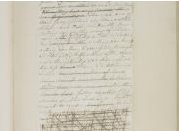
She wasn’t even a very good speller, and – most startling of all – she was messy. Here, for example, is a much-scratched-out page from her novel Persuasion:

(You can read or listen to an NPR feature about the manuscripts by clicking here.)

The release of Austen’s manuscripts by Oxford University this week brought with it a storm of controversy. Some Austen lovers are bemoaning the edits, complaining that Austen’s experimental style and feminine voice were lost when the changes were made. Others say that literary critics and historians need to reappraise Austen’s reputation.

And some people (I’m one) are shrugging our shoulders and saying that we knew it all along.

Well, not really.

But it’s generally true that when you encounter a great writer, there’s a great editor nearby. Or at least lots and lots of revising. For years I’ve been saying the first thing any would-be writer needs is a substantial wastebasket.

When I teach my own writing classes, I always bring in a letter I received from an editor about a book review I submitted for publication. Before my book review was accepted, I had to make 18 (count ’em) changes.

My students are always shocked. Some are outraged. Their writing teacher produced a manuscript that – gasp – wasn’t perfect?

That’s right. All professional writers make revisions. Lots of them.

Let’s turn the tables a bit. Why was Jane Austen (as I still think) such a great writer?

She had two things going for her: A huge wastebasket and a terrific editor.

Let’s make that three things. Most important of all was her willingness to stick with it until she got it right. Good for her – and good for us, who are much richer for the literary legacy she left behind.

(To learn more about what Jane Austen did right, click here.)

Share

More about Plain English

I just finished reading a fascinating history of Facebook (David Kirkpatrick’s The Facebook Effect – highly recommended). According to Kirkpatrick, Facebook has a number of carefully designed features that have contributed to its colossal success. One is founder Mark Zuckerberg’s insistence that nothing should be allowed to interrupt users’ experiences with Facebook. For this reason, popup ads have always been banned from the site.

There’s a lesson here for writers. Anything that interrupts the flow of ideas should be banned from your writing. Look for ideas that wander away from your main point and – the subject of today’s blog – extraneous words slow down and interrupt your readers’ experience. To put it another way: Writing plain English should be your goal.

Here’s a list of words and phrases to watch for. Each one is followed by a recommended substitute:

single click (click)

pulldown menu  (menu)

large in size  (large)

utilize  (use)

if or when  (if)

preregister  (register)

preplan  (plan)

prearrange  (arrange)

for the purpose of  (for)

if the event that  (if)

a rainfall event  (rain)

blue in color  (blue)

And here are two words you can often delete: individual and different. Take a look at these examples:

Individual members will receive two tickets to the conference. (What’s the difference between a member and an individual member? Nothing!)

Members will receive two tickets to the conference. CORRECT

Three different people asked me for directions. (What’s the difference between three different people and three people? Nothing!)

Three people asked me for directions. CORRECT

Share

The “Although” Problem

Fewer and fewer people seem to know how to use “although” correctly. I see writing like this all the time:

We’re making good progress on the new addition to our house. Although, the flooring is taking longer than we expected. WRONG

Although always introduces an extra idea. It’s not a substitute for however. If you write an although idea, make sure there’s a sentence to go with it:

Although the flooring is taking longer than we expected, we’re making good progress on the new addition to our house. CORRECT

Here are two other correct ways to do it:

We’re making good progress on the new addition to our house. However, the flooring is taking longer than we expected. CORRECT

We’re making good progress on the new addition to our house although the flooring is taking longer than we expected. CORRECT

And here are a few more examples. I’ve made these shorter and simpler, but they work the same way:

Although I enjoyed the movie, I don’t want to see it again. CORRECT

Barry still has plenty of energy although he worked the late shift last night. CORRECT

Notice:

  • It’s NEVER correct to put a comma after although.
  • An although idea is incomplete and always needs to be attached to a complete sentence.

Simple enough, right?

One more reminder: Don’t use although as a synonym for however. Take a look at this sentence:

The job offer is tempting. Although, I don’t want to leave New York. WRONG

Here are two ways to fix it:

The job offer is tempting although I don’t want to leave New York. CORRECT

The job offer is tempting. However, I don’t want to leave New York. CORRECT

Although many people make mistakes with although, you won’t have any problems from now on!

To learn more, click here and read about Comma Rule 1.

Share

Parenting

Today is Wednesday, the day our local newspaper publishes John Rosemond’s Parenting column. Rosemond is a family psychologist who preaches what he calls “traditional parenting” – a common-sense approach to childrearing that emphasizes discipline and responsibility. Rosemond is upbeat and encouraging (to his credit, he doesn’t advocate hitting kids), and I enjoy the little anecdotes he sprinkles through his columns.

But it’s also true that he’s been writing the same column every week for as long as I’ve been reading him. No matter what’s going on in the world, you’re going to read a little treatise about how Grandma knew best.

This morning, for example, the rescue of the Chilean miners is very much on the minds of people everywhere. Last night I saw a small boy waiting with his mother for his father to make the terrifying ride through the rescue shaft and emerge at last into daylight. I heard a psychologist on TV talk about possible post-traumatic syndrome problems for the rescued miners. What about their children – and children with no personal connection to the miners who, nevertheless, may be subjected to nightmares about being trapped underground?

You won’t read about it Rosemond’s column. He rarely ventures beyond a few familiar topics – homework, chores, potty training, and everyday misbehavior.

Now for some writing advice. Forget the “Write What You Know” advice beloved of editors and writing teachers. Expand your experience. If you have a blog, read over your last five or six entries. Are you circling around a few familiar and safe topics? Or has the larger world found its way into your writing space? Here’s hoping it has.


Share

Plain Language, Please

Last Wednesday Congress passed H.R. 946, a bill requiring federal agencies to use plain language in their forms, letters, and other documents. The bill passed overwhelmingly, despite a few naysayers who argued that the annual cost ($5 million) was too high for our high government deficits.

Good for Congress. Yes, five million dollars is a high price to pay for simple English. But it seems likely that great amounts of time and (more important) money will be saved in the long run when officials and citizens can understand government documents.

What flabbergasts me is that it’s going to cost $5 million to get officials to do what they should have been doing all along – writing plainly.

This morning I found a marvelous government website that offers many resources to help officials (and, incidentally, you and me) write more clearly: www.plainlanguage.gov.

Way to go, Congress!

(For more tips about clear, up-to-date business style, click here.)

Share

Hyphens

I almost turned down my first editing job because I was worried about making mistakes with hyphens. They are slippery little devils that cause a great deal of confusion.

Luckily, there are some easy-to-use tools that are a tremendous help with hyphens. Let’s take a look at them.

1.  Your first step should be understanding why hyphens are necessary in the first place. Their job is to combine words that go together, as in this example:

Joe and Barbara are first-time home buyers. CORRECT

Joe and Barbara aren’t first home buyers, nor are they time home buyers. In this sentence, first and time have to go together. That’s why the hyphen is there.

2.  Don’t use a hyphen if the two words don’t go together:

We need a short, catchy name for our project. CORRECT

The name will be short, and it will be catchy. The two words don’t go together. Use a comma, not a hyphen.

3.  Don’t use a hyphen if there’s no noun after the two-word phrase:

Joe and Barbara are buying a home for the first time. CORRECT (no hyphen)

We’re painting that wall dark red. CORRECT (no hyphen)

A dark-red wall will add drama to the room. CORRECT  (the hyphen is needed because dark red is followed by a noun, “wall”)

4.  Don’t use a hyphen with -ly words (adverbs):

The happily smiling children skipped across the playground. CORRECT (no hyphen)

5.  You need to know that hyphens tend to disappear over time. Week-end became weekend a long time ago. Back-yard is now backyard. Luckily your word-processing software will automatically flag and fix these for you. Pay attention to those red underlines on your screen!

6.  If you’re really serious about getting it right (for example, you’re a paid editor, like me), do some research on the Internet. The truth is that hyphen usage varies. For example, some companies put a hyphen into e-mail; others don’t. There are lots of ambiguities.

At one of my previous jobs, people kept getting into huge arguments about whether world class should have a hyphen. I solved the problem by Googling “world class” to see what other businesses, agencies, and educational institutions are doing. Many of them chose not to use the hyphen, and we decided to follow their example. It’s a good way to settle disputes about hyphens and other writing issues.

Here’s another smart move you should consider: Ask if your workplace has a style sheet (a list of rules for thorny issues like hyphens). If it doesn’t, suggest that your workplace create one.

Having the rules in one place (is “healthcare” one word or two? do we use “catalog” or “catalogue” here?) can save everyone a lot of headaches. You can find many style sheets online that can help your company get started.

Share

Arrive Late, Leave Early

Arrive late, leave early. There’s an intriguing bit of writing advice! What does it mean, and does it work?

Answers: Get to the interesting stuff quickly, don’t take longer than necessary, and yes, it works.

You should note, though, that “arrive late, leave early” overturns conventional writing advice, which suggests starting with a generalization and gradually arriving at your point. Here, for example, is how one first-year English textbook suggests that you begin an essay:

For a typical college freshman, entering college is fun and an exciting time of life.

The paragraph in this textbook example wanders around a bit (soda, pizza, music, playing cards) before it gets to the point: the writer is a twenty-nine-year-old freshman, and his experience has been different.

Hooey.

My advice: Arrive late, leave early. Here’s how I would start the same paper:

Typical? Hardly. Although I’ve been on the campus for almost three months now, I have yet to join the groups of students relaxing over cards and Cokes in the cafeteria. As a twenty-nine year old freshman, I’m having a very different college experience. For me, “relaxing” means bouncing my infant son on my knee while I struggle to read an English or psychology textbook. “Free time” means working the night shift at a discount store. Because I’m a husband and a father, college is serious business, leaving little time for recreation or making new friends.

Arrive late, leave early. Avoid preliminaries and introductions. See if you can combine action with atmosphere. If your character is closing a wet umbrella, you don’t need to write a sentence about the weather. Effective details – a pair of tickets to a Broadway show, snowflakes on your eyelashes, sand squishing between your toes – can set a scene in just a few words.

Good writing moves. Tell stories instead of philosophizing. Show rather than tell.

It’s fun to see how much you can pack into a sentence or a paragraph. Try it!

Share

National Punctuation Day

Be still, my heart: A whole day to celebrate commas, semicolons, and apostrophes!

In honor of National Punctuation Day, here are some helpful tips to use when you’re writing and editing your work:

1.  Pay attention to introductions (extra ideas at the beginning of sentences). They require commas:

When I saw the letter from Jane in my mailbox, my heart started pounding.

Once you know the difference between an introduction (which needs a comma) and a sentence (which needs a period), you won’t have to worry about run-ons and comma splices:

When I saw the letter from Jane in my mailbox, my heart started pounding. CORRECT

I saw the letter from Jane in my mailbox. My heart started pounding. CORRECT

2.  Break the bad habit of throwing an apostrophe into a word whenever you see an “s.” Apostrophes aren’t hard to learn – honest! Click here for some helpful resources.

3.  Adopt simple ways to think and talk about punctuation. Here are some handy rules that many people find helpful:

  • A semicolon is like a period, but it’s not followed by a capital letter.
  • Extra ideas (introductions) end with commas.
  • Sentences end in periods.

3.  Use your ears to help you punctuate. Listen for “Superman” sentences (voice drops) with two commas.

4.  Read, read, read. Ask yourself why the writer chose those punctuation marks. Observe and remember.

I’m always running into people who are astounded that periods and commas go inside punctuation marks. If you read magazines, newspapers, and books, you’ve probably seen these punctuation marks thousands of times. Take note, and use what you’ve learned next time! The same goes for commas, apostrophes, semicolons, and colons.

5.  Find a writing buddy and share your work. Talk about the punctuation choices you’ve made, and ask for feedback. Talking is a great way to learn, and you’ll be helping each other.


Share