An Interesting Sentence!

Today we’re going to look at a sentence that seemed simple to me – until I started an online conversation about it. Ray Lewis is an English teacher who saw something I didn’t!

Share

Fire Them!

Someone just posted a question online about the “lexical meaning of hate speech.”

What – I want to know – is the difference between meaning and lexical meaning?

Good writing never sounds pompous. Develop the habit of writing straightforward sentences. Treat unnecessary words like unnecessary employees: get rid of them.

Share

Words in Transition

Language is always changing! Rules come and go, and words acquire new meanings. No amount of hand-wringing will stop this process. We have to adjust our language practices as time passes.

Here are five words that are in flux right now. If you use them in your writing, be cautious. If you use the original meaning, readers might be confused. Make sure the meaning is absolutely clear. (I never use nonplussed, for example: too many people are confused about what it means.)

Notoriety is the wrong kind of fame. It doesn’t mean “famous”!

After his plagiarism was discovered, the notoriety cost him his job.  CORRECT

Unique means “one of a kind.” It doesn’t mean special or unusual.  My fingerprints (and yours!) are unique, but there’s nothing special or unusual about them.

Jackie designs and sew her own clothes because she wants a unique look.  CORRECT

Enormity means “a hideously bad action.” It has nothing to do with size.

That enormity deserves a long prison sentence.  CORRECT

Verbal means “having to do with words.” It can refer to both speech and writing.

Our students practice writing and talking because the school emphasizes verbal skills.  CORRECT

Nonplussed means “unsure” or “caught off guard.” 

When Mr. Brown asked me about the missing cash box, I was nonplussed.  CORRECT

A pocket watch showing the passage of time

                                      Words change as time goes by

Share

A Composer Named Scarlatti

If you enjoy classical music, you’ve probably heard of Domenico Scarlatti (1685-1757). He’s most famous for his harpsichord music.

Here’s a snippet of information that was just posted on our TV’s classical music station:

Scarlatti married his wife, Maria Caterina Gentili, at the age of 43.

It’s a sentence that needs improvement!

The first problem is this unnecessary sentence: Scarlatti married his wife….

If you were a man in the 1700s, who – pray – would you marry besides a wife? And there’s another problem: who was 43? The sentence has an indefinite pronoun reference…meaning (in plain English) that either Domenico or Maria could have been 43.

With a little effort, you can come up with a better sentence:

Scarlatti married Maria Caterina Gentili when he was 43.  BETTER

OR:

When Scarlatti was 43, he married Maria Caterina Gentili.  BETTER

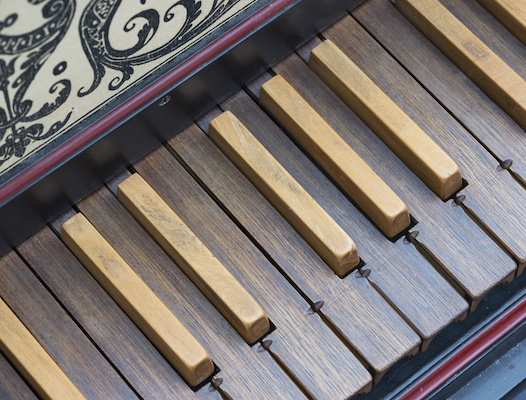
keyboard of old harpsichord with brown wooden keys

Share

Fixing a Static Sentence

Last week Charlie and I put our heads together to improve a sentence in one of his drafts. He was writing about protecting landscape plants from cold damage:

What the frost blanket, old bed sheet, or cardboard box accomplishes is to slow down the passage of heat stored in the ground and to hold it around the plant.

The word is tells you that this is a static sentence. Nothing is moving or changing. The frost blanket (or old bed sheet or cardboard box) exists, and that’s all.

Is (and are, was, were, and will be) are useful words, of course. Every writer (including me!) uses them all the time. But professional writers always take a moment to see if a more interesting word is called for.

In today’s sentence, we got rid of is altogether. Here’s the revised sentence:

The frost blanket, old bed sheet, or cardboard box slows down the passage of heat stored in the ground, holding it around the plant.  BETTER

It’s a more active sentence now. And the revision is six words shorter – another step towards greater readability.

A commercial frost blanket protects a plant against freeze damage.

An old bed sheet protects a tender plant from freeze damage.

Share

A Sputtering Sentence

Charlie and I often listen to classical music free, courtesy of our cable TV subscription. We especially enjoy the biographical snippets posted on the screen while the music is playing.

Sometimes, though, the writing falls short. I used to have an English teacher who kept urging us to “End strong!” when we were writing. I thought of him when I read this sentence about Chopin. Instead of “ending strong,” it sputters to the finish line:

When Frédéric Chopin was seven years old, he wrote the Polonaise in G Minor, which was printed.  WEAK

I think my former English teacher would be pleased with my rewrite:

The Polonaise in G Minor was published when Frédéric Chopin was only seven years old.  BETTER

But now we have another problem: my sentence is written in passive voice. Isn’t that bad writing?

The answer is…not always. Sometimes passive voice can solve a writing problem. Today’s sentence needs more emphasis. Using passive voice (“was published”) puts the Polonaise in G Minor at the beginning of the sentence. The result is a  sentence that starts strong and stays strong. 

Photo by Leo Reynolds

Share

The Chicago Manual of Style

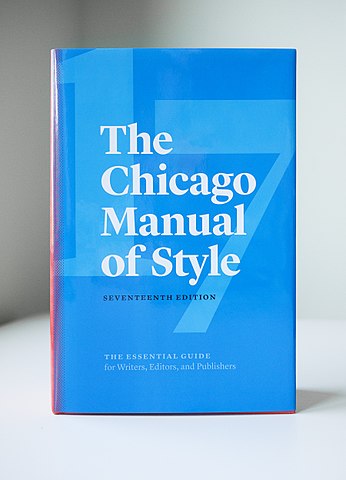
My friend Mike Goronsky sent me an interesting sentence last week. It showed up in a forum for The Chicago Manual of Style, which is probably the most respected resource for writing, usage, and grammar.

My wife Deb’s father passed away on Sunday.

The editor at The Chicago Manual of Style wrote a helpful explanation about why the sentence is okay, even though it breaks a rule about appositives.

I, on the other hand, read the sentence and got angry.

Let’s deal with the grammar issue first. (Don’t worry: I’m not going to ask you to learn what an appositive is.)

All of us automatically change our voices when we’re talking. Here’s an example: My husband, Charlie, enjoys gardening. If you read that sentence out loud, you’ll hear your voice go down and back up when you read Charlie.

If you didn’t change your voice, listeners might think you were a polygamist: My husband Charlie enjoys gardening. The implication is that you have another husband – Sam or Joe or Bill – who has another hobby. (But would anybody really think that? Of course not. You don’t really need the voice change and the commas.)

Let’s go back to Deb.  That very nice editor made two excellent points:

  1. Nobody’s going to think you have more than one wife.
  2. Jamming a pair of commas into that sentence would be messy: “My wife, Deb’s, father passed away.” Gack!

I agree with that editor…and I want to add that I’m truly sorry about Deb’s loss. But  that’s a ridiculous sentence – and an example of what’s wrong with the way we teach writing.

(I’m climbing onto my soapbox.)

Writing is a powerful way to connect with other people. That power has to be channeled and managed.

That means there’s much more to writing than figuring out where the punctuation goes. You can see that the editor did some analytical thinking right away: “Will anyone suspect that you’re a polygamist? No. So we don’t need those clunky commas.”

Well done! But he should have dug deeper.

Here’s what I mean. Suppose (sadly) your wife’s father died. Who would you share that news with? Friends. Relatives. In other words, people who know you and Deb. Or – even if they don’t know Deb – they would be people who already know her name. You wouldn’t say, “My wife Deb’s father….”

If you’re taking off from work to go to the funeral, you might tell your boss, or HR, or a few of your co-workers about your plans. They might never have met Deb, and it’s possible they wouldn’t even know her name. But is it necessary to bring it up? You have only one wife. I doubt that you would say, “My wife Deb’s father….”

And here’s the clincher. You had a relationship with Deb’s dad too. If friends and co-workers don’t know Deb, wouldn’t you tell them that your father-in-law died?

In other words, nobody in the real world is ever going to utter a sentence like “My wife Deb’s father passed away on Sunday.” It’s a stupid sentence made up by someone who views language as a game: Where do the commas and periods and apostrophes go? I know! I win! 

If you’re trying hard to improve your language skills, good for you! Use your time and energy to think about real-world writing issues: word choice, organizing and presenting ideas, critical thinking, and so on.

Plucking tricky sentences out of the air isn’t writing. It’s not going to teach you anything. You should constantly be asking yourself this question: How can I use language more effectively today? Right now?

Share

Hyphens. Adverbs. Yikes!

My friend Mike Goronsky came up with a clever way to make sure you’re using hyphens correctly in compound expressions.

It’s an obscure rule but a useful one. Often we need a hyphen with a two-word description:

He had a deadly-looking weapon.  CORRECT

But did you notice that “often”? Sometimes you don’t need a hyphen:

a badly written bill  CORRECT

How do you tell the difference? The answer is that adverbs don’t get hyphens.

But what if you’re a little uncertain about adverbs? English teachers always tell you to look for -ly words (sadly, merrily). There’s a catch, though. Some -ly words aren’t adverbs – ugly and costly, for example. How can you tell? Mike has come to the rescue!

Try this exercise he created – removing the second word. It makes everything crystal-clear:

a highly regarded study
Remove the second word “regarded.”
Now you have a “highly study.” Doesn’t make sense.
It’s an adverb! No hyphen.

the dimly lit study
Remove the second word “lit.”
Now you have “the dimly study.” No good.
It’s an adverb! No hyphen.

the barely worn dress
Remove the second word “worn.”
Now you have “the barely dress.” Ugh!
It’s an adverb! No hyphen.

BUT…

early-morning flight
Remove the second word “morning.”
You’re left with “early flight.” Makes total sense.
It’s an adjective! Add the hyphen in “early-morning flight.”

friendly-looking dog
Remove the second word “looking.”
Now you have “friendly dog.” Yay! Makes sense.
It’s an adjective! Add the hyphen in “friendly-looking dog.”

a family-friendly location
Remove the second word “friendly.”
You’re left with “a family location.” It’s an adjective! APPLAUSE! Add a hyphen!

Nobody could ever get this wrong using this trick! 😉😉

a magician with a wand and a top hat
Share

I Won’t Do It!

Last week I started reading a New York Times article about the CDC process for approving Covid booster shots. But I stopped reading when I read this sentence:

Even though Slavitt and Walensky were speaking on a public podcast, their tone at times resembled that of a private conversation between colleagues.

No, no, no! I refuse to use “that of.” It’s clumsy and adds nothing to a sentence.

Grammarians will undoubtedly argue with me. You need “that of” to make the sentence logical. Otherwise you’re comparing a tone to a conversation – apples and oranges, so to speak. 

I disagree: “that of” is overkill and unnecessary. No reader is  going to be confused if you omit “that of.” Here’s a useful rule for you: Readability is always more important than grammar. 

Here’s my version:

Even though Slavitt and Walensky were speaking on a public podcast, it sounded like a private conversation between colleagues.

Woman who's crazy, angry, and berserk

Share

An Unnecessary Word

Problems at Facebook have been front-page news this week! Concerns about Facebook are nothing new.  A 2020 New Yorker article explored the role that Facebook played in electing President Trump in 2016.

Here’s an excerpt from the article. Can you spot an unnecessary word?

Giles and Parscale owned two of the more ambitious Web-design businesses in town, and the merger allowed them to focus on their respective strengths: Giles made everything look good, and Parscale made everything work on the back end.

The offending word is – of course – respective. It adds nothing to most sentences. Even worse, respective makes your writing pompous and old-fashioned. Most of the time you should fight the urge to add respective to something you’ve written.

Facebook logo

Image provided by Julien Eichinger – stock.adobe.com
Share