It’s a Crime, But It’s Not a Run-On

Many English instructors (including me!) consider run-on sentences a capital offense. In my view, serious writers are supposed to be able to identify a sentence and end it with a period or a semicolon.

But there’s a lot of confusion about what a run-on sentence is. If you encounter a very long sentence, does that qualify as a run-on? I’ve had students randomly stick a period into the middle of a sentence on the grounds that a) it’s very long, b) it obviously needs a period somewhere. Nope!

So let’s clear this up. A very long sentence is…a very long sentence. It’s not a run-on and it’s not wrong, at least as far as grammar is concerned.

But cramming a bunch of facts into one endless sentence is not good writing. Below is an example from a recent newspaper articleIn October 2018, Jake Patterson kidnapped 13-year-old Jayme Closs. She managed to escape three months later. Here’s the sentence:

Patterson pleaded guilty Wednesday to kidnapping 13-year-old Jayme Closs and killing her parents, in a move that spares the girl held in a remote cabin for three months from the possible trauma of having to testify at his trial.

Whew. There are five important pieces of information here:

  • Patterson pleaded guilty to kidnapping on Wednesday
  • His victim was a thirteen-year-old girl
  • He also killed her parents
  • She was held in a remote cabin for three months
  • The guilty plea will spare her the possible trauma of having to testify at his trial

It’s not a run-on, and you can’t fix it with a period. Start over, and write several sentences instead of one.

Here’s a rule for you: one fact or idea per sentence, please. Your writing will be more readable that way. And there’s a bonus: your writing will be more emphatic. A fact or idea has more impact when in its own sentence.

Kidnapping victim Jayme Close and her captor, Jake Patterson

Share

Accident or Collision?

If you’re a regular visitor to my blog, you know that I like to talk about the philosophical issues we run into when we use language.

But I sometimes talk to real-world writers (like police officers!) who wonder if all this theoretical stuff really matters. Postmodern language issues can seem far removed from everyday life.

But they’re not – and here’s an example. You may be aware that some jurisdictions have improved their procedures for dealing with vehicle accidents. The New York Police Department is a good example.

Some time ago, the NYPD instituted a number of changes in the way it investigates and documents vehicular crashes. Case in point: The word “accident” has been replaced with “collision.”

The reason? The word accident evokes something unfortunate that happened on its own. But the word collision suggests that something went wrong. It feels more like a police matter.

Paul Steely White is the executive director of Transportation Alternatives, a cycling and pedestrian advocacy group. He said the changes constitute “a very significant step toward a safer, more humane city.”

Words matter! “An accident is when a meteor falls through your house and hits you in the head,” he said. “Collisions can be prevented.”

Words are more than just labels we stick onto things. They shape our thinking and help us make effective decisions – if we’re wise enough to think about them and make wise choices.

a collision

Share

#YouToo

Last week I read an intriguing column by Heidi Stevens: Monica Lewinsky Has a Message We Need to Hear. Thanks in part to the #MeToo movement, views about sexual misconduct are beginning to shift. (You will remember that Monica Lewinsky was a White House intern whose affair with President Clinton triggered impeachment proceedings.)

Instead of quickly concluding that “It’s all her fault,” we’re beginning to hear more discussions about sexual predators and abuses of power. (See also Joyce Maynard’s reminiscence about her affair with J.D. Salinger in What Writing about my Abusive Relationship with J.D.Salinger Taught Me about Silencing Women’s Voices.)

Of course those ideas are nothing new. One of the best articles I ever read about sexual misconduct appeared in a 1991 article in Christian Century magazine: Soul Stealing: Power Relations in Pastoral Sexual Abuse by the Reverend Pamela Cooper-White. 

 *  *  *  *  *  *

I named today’s post #YouToo in order to make a point: stories don’t arrive with a built-in meaning. We all have the power create the meaning. (Yes, you too!)

I’m not talking about the nonsensical notion that a word or a narrative means whatever you want it to mean. I’m saying that life is mysterious and people are complicated. The meaning of an event can change as time passes – or as you move from one person’s perspective to another.

Sally remembers Grandma as a lovely person; her brother Greg thinks Grandma was mean. A marital dispute that felt like World War III looks silly years later – or we realize it was a harbinger of an inevitable breakup down the road.

Language doesn’t just record facts: it sorts and evaluates them, opening us up to new insights and fresh possibilities. Good writers make language choices that help this process along.

And that brings me to “Into the Clear,” a provocative 2000 New Yorker article about novelist Philip Roth, author of Portnoy’s Complaint. The author, David Remnick, recalled a 1998 conversation he had with Roth about the Monica Lewinsky-Bill Clinton controversy:

Roth straightened and said, only half in jest, “Maybe [Clinton] should get on TV and talk frankly about adultery.” Maybe he could talk about the complexity of a long and difficult marriage, about frailty, and maybe he’d dare to ask if he is really so alone in his weaknesses. But there was, of course, no political sense in that.

Roth was right. Americans were eager to blame Lewinsky, or Clinton, or both. There was no “political sense” in exploring the forces that drove those two people into doing what they did.

But do we really have to be stuck there forever? Suppose Bill Clinton or Monica Lewinsky really had talked frankly about what led to the affair. We would have learned something.

That doesn’t mean we would have approved or excused what happened. I imagine it as taking a side step – and suddenly getting a whole new perspective. We’re adding to the meaning, not changing it. It’s an opportunity to dig into parts of the story we may have skipped over – and in that process we may gain understanding.

Perhaps we would even learn something about ourselves – about the forces in our own lives that sometimes trip us into abandoning our values, even if it’s just for a moment.

I am not asking you to reevaluate your opinion what Lewinsky and Clinton did (or what happened when Joyce Maynard lived with J.D. Salinger in 1972). But I am asking you to realize that language has the power to transform everything we know, think, and believe.

That doesn’t mean you have to do something big and serious. Language is fun (as every child babbling a string of nonsense words already knows!).

It does mean that language often offers us an opportunity to take that side step and discover a fresh perspective. We all need to make judgments about good-versus-bad and right-versus-wrong. But we can also ask questions that start with words like what, how, when, why, and what if. And we may come up with some amazing answers. Worth a try!

Philip Roth

Share

An Editor at Work: Stephen King

I’ve become a big fan of Amazon’s “Look Inside!” feature. You can read a significant chunk of many books absolutely free right on your computer screen.

“Look Inside” is intended to encourage browsers to buy books, but it’s also useful to writers. Instead of going to the library to browse through, say, 20 or 30 novels to see how a professional writes the first page, you can do the same thing at home. (Another great resource is www.Bartleby.com, which allows you to read the entire text of classic books online, absolutely free.)

Author Marilyn Durham used this strategy when she was writing her successful novel The Man Who Loved Cat Dancing. How do the pros handle transitions from one chapter to another? How are new characters introduced? What does good dialogue sound like? Examining published works at the library helped her answer all these questions.

Today I want to point you to a “Look Inside” feature that can help you learn about editing. Stephen King’s book On Writing: A Memoir of the Craft lets you compare an original piece he wrote with the edited version. Annotations explain the reasons for each change. It’s fun to read – and enlightening! Click here to read it. (If you own the actual book, this section starts on page 277).

Successful writers are always developing their craftsmanship. We’re fortunate to have the Internet right at our fingertips, offering us endless resources to help us achieve our writing goals.

Share

Jean Cleans Out a Folder

The folder where I store ideas about writing is starting to fill up! Here are some recent items:

1.  We often hear that complaints that language skills are deteriorating. I just came across some evidence that writing mistakes are nothing new. On September 5, 1819, poet John Keats sent a letter with a “should of” mistake. (“Should have” is the correct verb.)

“Had I known of your illness I should not of written in such sorry phrase in my first letter.”

What’s interesting is that elsewhere in the letter, Keats used “should have” correctly. So what happened? He made a careless mistake. That is not a sign that the sky is falling!

(I found the John Keats letter in Making Sense, a wonderful book about writing by David Crystal.)

2. Here’s a problematic sentence that Crystal talks about in his book. Can you figure out what’s wrong?

He had a large collection of illustrated magazines and books.

The grammar is fine, but the sentence is confusing. It could mean that the books are illustrated too – or maybe they’re not. Here’s a better version:

He had a large collection of books and illustrated magazines.

3.  Speaking of confusing sentences, here’s one I found on Quora:

Why are shop owners careless to leave the cash register unattended?

The sentence could have two meanings. That’s always bad when you’re trying to communicate with your readers. Here are two suggested rewrites:

Why do we think that shop owners are careless when they leave the cash register unattended?

Why do careless shop owners leave the cash register unattended?

4. If you read my blog often, you know that I despise the word respective. It’s empty and pompous, and you shouldn’t use it unless it’s absolutely necessary.

Here’s a gack-worthy sentence from the New Yorker – which is usually meticulous about editing:

In their respective starring roles, Aidy Bryant and Pamela Adlon play messy, interesting characters who refuse to make nice.

Get rid of respective, and the sentence is fine. And that deletion doesn’t change the meaning of the sentence.

5. Good writers try to make most sentences active. That’s easy to say, but sometimes it’s hard to know how to apply that principle! Here’s an example (again, from David Crystal’s Making Sense):

The opportunities for advancement were an important factor in my decision to take the job.

“The opportunities were” is too static. Here’s a more lively version:

I took the job because it offered opportunities for advancement.

Share

Freedom of Speech 2

This is a followup to my recent post about freedom of speech. Recently I’ve been hearing complaints about bias in various blogs and websites – especially social media. The argument centers on whether both sides of an argument should be covered. My answer is a strong NO.

Yes, I welcome feedback – negative and positive – to this blog. Sometimes I even invite guest authors to write a post from a viewpoint different from mine. It’s all part of the fun!

But I don’t feel obliged to allow everybody to post everything on this blog. That’s a misunderstanding of freedom of speech. It’s true that the First Amendment protects us from government interference with our right to say and write whatever we wish. I‘m not the government. That means I’m free to set up this blog any way I want to.

I envision myself talking to a group of people who want to go off the beaten path when it comes to writing and the English language. So you’ll never see a post here about – say – how to use the future-perfect tense in English. Sure, it’s a worthwhile topic, and I hope someone, somewhere is covering it. But it doesn’t match my goals for this blog.

That would be true even if the some important language topics weren’t being covered adequately on the internet, and it applies to other issues as well. Lately I’ve been hearing lots of complaints that Twitter/Facebook/Quora/Instagram/take-your-pick leans so far to the right/left that a large portion of the population is not being heard. Important issues are being neglected. We’re all being shortchanged. It’s awful.

My response to that is…stop whining and get busy. If a social media site isn’t presenting your viewpoint, find one that does. If none exists, start one. If your ideas aren’t reaching a large enough audience, implement some strategies to help you build a following.

If we feel that we’re not being heard, we have to be the ones taking the initiative.

a microphone

Share

Why Study Old English? Part 2

In a recent post I offered you some information about the history of the English language. I explained that in the 11th century, Old English began to lose its genders, conjugations, declensions, and grammatical cases. The great poets and storytellers in Anglo-Saxon England would barely recognize our language today.

In spite of those losses, English is still capable of great subtlety, variety, and beauty. If you know something about the history of our sturdy and vigorous language, you get the sense that English can survive just about anything that comes along.

So – for me, at least –  there’s no reason to panic about texting, slang, and the gradual disappearance of whom, shall, and other grammatical features of our language. Trust me: English is going to be just fine.

Today I’m going to talk about another reason why every writer should know something about the history of the English language. You might be surprised to know that there was a point in English history when our language almost disappeared.

Happily for us, the English language came roaring back, and today it’s studied and spoken all over the world. But there’s a lingering problem that every writer needs to know about.

Here’s what happened. In 1066, William the Conqueror crossed the English Channel and – with the help of a French army – conquered the British Isles. French became the official language of England, and everyone who wanted a good job made it their business to learn French.

Gradually English disappeared from everyday life for most people. Even the kings and queens in England conducted all their business in French. Only the lowest-paid laborers continued to speak English.

Eventually the French army left, and English again became the dominant language of the British Isles. But the Norman Conquest left us with an uneasy sense that French was better than English. After all, French was the language spoken by people who were wealthy and powerful.

You can still hear that uneasiness today. “Residence” (French) sounds fancier than “house” (English). We “express” (French) a feeling instead of “talking about it” (English). The problem is especially noticeable in business writing: “terminate” instead of “end,” “initiate” instead of “begin,” “facilitate” instead of “help” – you see this pattern everywhere.

The truth is that French words aren’t better than English ones. (I just wrote “aren’t inherently superior” – and crossed it out! I’d better practice what I’m preaching today.) A sentence written entirely in English often has more clarity and power than one clogged with French and Latin imports. Why say “Extinguish the illumination” when what you really mean is “Turn out the lights”?

English is a wonderful language! Let’s use it as much as possible. The next time you’re tempted to trot out a fancy French word, please pause for a moment. Could you substitute a plain and familiar English word that would do the job perfectly well?

                         William the Conqueror

Share

Why I Use the Singular “They”

Would you say that the sentence below is right – or wrong?

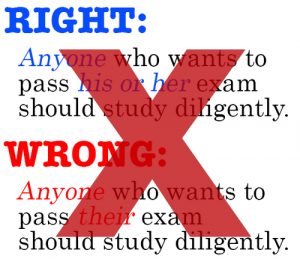
If anyone forgot their ticket, see me in the Events Office on the second floor.

Many people (I used to be one of them) would say that their is wrong. Anyone is singular, so it should be followed with another singular pronoun: his or her. Many people feel that using their instead of his or her is one more sign that our language is deteriorating. Are they right?

The surprising truth is that using “their” as a singular pronoun dates back to the 14th century, when English lost its gender-neutral singular pronoun. It was standard English and used by many serious writers, including Caxton, Shakespeare, Austen, Thackeray, Shaw, and many others.

But in the late 18th century, an American attorney named Lindley Murray decided that English should be more mathematical.

He wrote a book complaining about that usage, and – unfortunately – it became an international bestseller. Schools began teaching students to say “he” instead of “they.” When feminism came along in the mid 20-century, it got worse: now we had to use the clumsy he or she phrase.

Anyone bothered by the math should think about this: Are is another plural word that we use for one person when we say “you are.” You never say “You is,” do you? “You are my favorite aunt” is perfectly grammatical English, even though you’re talking to just one person.

Back in the time of Shakespeare, you were supposed to say “thou art” when you spoke to a single person. Nevertheless, soon almost everyone switched to the plural “you are.” Today nobody bats an eye about it.

If we can use “you are” for one person, we can use “they” for one person too.

It’s likely that even the “his or her” sticklers use the “singular they” more often than they realize.

Mary Norris (a wonderful writer and an authority on English usage) came out against the “singular they” in her book Between You and Me. (Apparently nobody told her about Lindley Murray!) But she uses a “singular they” herself in the book: “Nobody wanted to think they were not essential.”

Common sense is beginning to prevail, and many people (I’m one of them) have happily gone back to the original practice of using “they.” I have made a vow that I am never going to use “his or her” again. If anyone is upset about it, that’s their problem, not mine.

rule against using the singular they

Share

Do We Have to Obey the Rules?

In my previous post I raised an important question: what should you do when there’s a gap between an English rule and the way people actually use our language?

The answer is to think about the group you belong to – or the group you want to belong to. In a professional situation, you’ll probably want to be a stickler. In a social situation, you might not adhere so strictly to the rules.

But today I’m going to dig deeper. I want to talk about taking risks – deliberately breaking the rules to bring freshness and vitality to your writing.

This is something you probably won’t want to do until you’ve established your chops as a writer. If I were starting out as a scholar, I’d be afraid to even split an infinitive (ha! I just did!). You don’t color outside the lines when you’re the new kid on the block.

But more than 35 years have passed since my first foray into Shaw scholarship. I’m getting tired of being a disembodied, wise voice. My latest article (already accepted for publication later this year) is a discussion of My Fair Lady – the musical version of Shaw’s wonderful play Pygmalion. I considered questions like “Would Shaw have approved of My Fair Lady? Is it a fair treatment of his original play? How has My Fair Lady affected Shaw scholarship?”

But I also included my own reactions to My Fair Lady, and I talked personally about one of the controversial themes in the play – the male-female power struggles between Henry Higgins and his gifted pupil, Eliza Doolittle.

Can academic writing ever cross the line into personal writing? I would argue that it has to cross that bridge – even if we’re careful to avoid the words I and me. Our thoughts and experiences shape every word we write, no matter how hard we try to avoid them. Even the choice of a subject to write about is personal.

I’m going to rest my case by inviting you to read one of the greatest essays ever written about Shakespeare’s Hamlet. It’s called “Hamlet: The Prince or the Poem?” and the author is the great literary critic C.S. Lewis. This excerpt from his essay gives me chills every time I read it:

I would not cross the room to meet Hamlet. It would never be necessary. He is always where I am. 

(I’m pausing for a moment to enjoy those shivers going down my spine.)

And now – just for the heck of it – I’m going to swerve away from my main theme to make two more points:

  1. The only Latin word in Lewis’s three sentences is “necessary.” Everything else is ordinary English – proof that you can write brilliantly without having to resort to pompous words.
  2. I just ran Lewis’s three sentences through two readability formulas. The results? Second and fourth grade.

Hmmm. Maybe we don’t have to worry so much about respecting that gap between personal writing and serious writing. Something to think about!

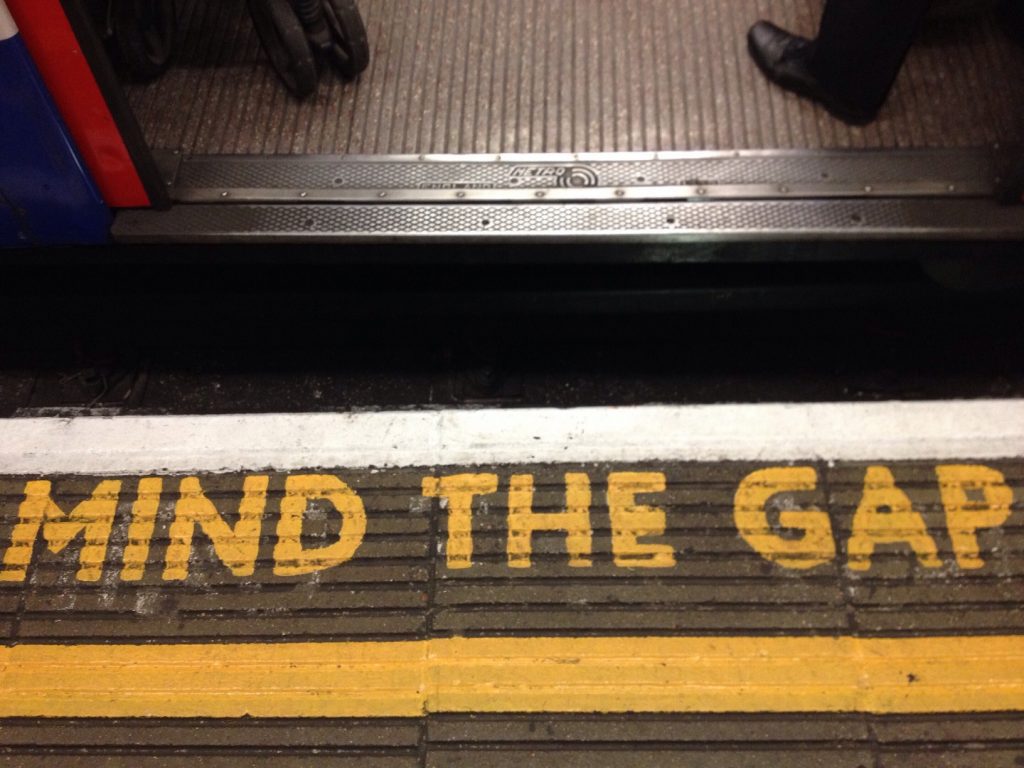
A "mind the gap" warning on a subway platform

Share

Prescriptive or Descriptive?

Last week a disgruntled college student (let’s call her “Linda”) logged on to Quora.com with a language problem. She had used dude in an academic paper. Her instructor said that dude is an inappropriate word for academic writing and crossed it out.

Linda wanted some ammunition to justify putting dude back into her paper. She felt that her instructor was being prescriptive rather than descriptive, and that was wrong…wasn’t it?

I told Linda that she was asking the wrong question. The terms “prescriptive” (laying down the law about language practices) and “descriptive” (suspending judgment about them) aren’t much help when you’re actually using the English language.

Language rules are slippery things. Here’s the best way to settle them: Think about the group you aspire to join – and adopt their language habits.

If your friends at college use dude in their conversations, go ahead and use it. But if your aim is to publish in an academic journal (or earn a good grade in Freshman Composition), you’re going to have to forsake dude. I’m sorry.

In my next post I’m going to dig deeper into Linda’s “Do I have to obey the rules?” question. It’s not as simple as you might think!

old strict teacher with glasses

Share